
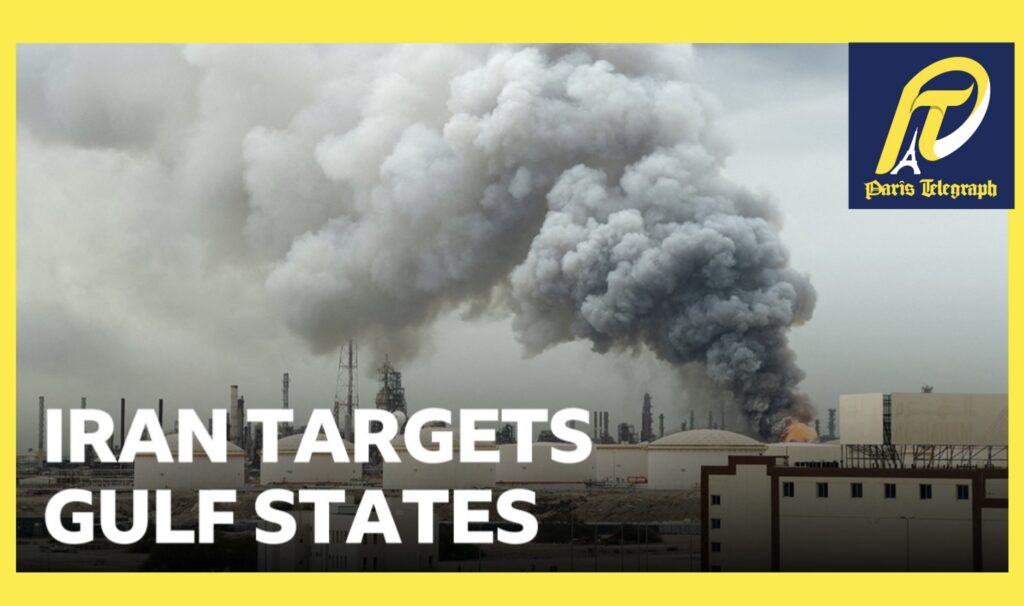
Why Iran Is Targeting Gulf Countries: The Hidden Geopolitics Behind U.S.–Gulf Alliances
The growing tensions between Iran and several Gulf Cooperation Council (GCC) states are not happening in isolation. They are closely linked to deep financial, military, and political partnerships between the Gulf monarchies and the United States—partnerships that have expanded significantly during the presidency of Donald Trump.
Recent financial disclosures and international investment agreements reveal a complex web of economic interests connecting Gulf states, American corporations, and the Trump family’s business empire. These developments provide important context for understanding why Iran increasingly views the Gulf region as a strategic pressure point.
Massive Financial Links Between Trump Businesses and the Gulf
As Donald Trump returned to the White House in early 2025, reports indicated that the Trump family’s private business network was receiving substantial financial inflows from the Middle East.
One of the most notable deals involved a $500 million investment in the Trump family’s cryptocurrency venture, World Liberty Financial.
The investment came from an Abu Dhabi-backed vehicle linked to Tahnoon bin Zayed Al Nahyan, the national security adviser of the United Arab Emirates.
- The deal purchased 49% of the company.
- Of the initial $250 million payment, about $187 million went directly to Trump family entities.
- The agreement was signed by Eric Trump.
In addition, an Emirati-backed fund reportedly deposited $2 billion into another venture connected to Trump’s business network.
Real Estate Deals Across the Gulf
The Trump business network has also expanded through licensing agreements with Dar Global, a Saudi-based real estate developer.
These partnerships generated at least $21.9 million in 2024 alone, largely through branding deals that require minimal financial investment from the Trump Organization.
Trump-branded developments are now planned or underway in several Gulf countries:
These projects include luxury hotels, residential complexes, and golf courses designed for international investors and wealthy tourists.
Trillions in Strategic Investments With the United States
At the state level, Gulf countries have pledged enormous investments in the U.S. economy, reinforcing their strategic partnership with Washington.
Key announcements include:
United Arab Emirates
- A $1.4 trillion investment commitment to the United States over the next decade.
Saudi Arabia
- $600 billion in investments and purchases from U.S. companies.
- Nearly $142 billion in weapons deals, described as the largest arms agreement in American history.
Qatar
- A $200 billion order for aircraft from Boeing through Qatar Airways.
Additional agreements include:
- $60 billion energy partnership between the UAE and Abu Dhabi National Oil Company.
- Plans by ADNOC to expand U.S. energy investments to $440 billion by 2035.
- A $14.5 billion aircraft order by Etihad Airways.
- Joint investment in U.S. artificial-intelligence data centers.
Expanding Institutional Investment Between the U.S. and Gulf
The relationship extends far beyond headline deals.
Major investment agreements now involve institutions such as:
These partnerships focus on sectors such as:
- Critical minerals
- Energy
- Logistics
- Advanced technology
Meanwhile, the GCC real-estate market, valued at $141.2 billion in 2025, continues attracting American investment funds due to regulatory reforms and market growth.
Trade between the United States and the UAE alone reached $30.2 billion in the first nine months of 2025, maintaining the UAE’s status as Washington’s largest trading partner in the Gulf.
Why This Matters for Iran
From the perspective of Iran, these expanding financial and military partnerships reinforce a regional alliance system that Tehran views as hostile.
Across sovereign wealth funds, defense purchases, and commercial partnerships, analysts estimate that Gulf financial commitments tied to the United States now total between $3 trillion and $4 trillion.
This vast economic network forms what many analysts describe as the economic backbone of the U.S.–Gulf security partnership.
For Tehran, the Gulf states are therefore not only neighbors but also key pillars of American strategic influence in the Middle East—which helps explain why tensions between Iran and Gulf countries frequently escalate during periods of geopolitical competition.
Paris Telegraph Global Desk

Paris Telegraph is an independent France-based digital news platform covering Paris news, French politics, European affairs, global business, diplomacy and artificial intelligence.
Publishing timely reporting and in-depth analysis, Paris Telegraph provides international perspectives on geopolitics, economic developments, technology innovation and cultural trends shaping Europe and the world.
As a growing online media outlet, Paris Telegraph is committed to credible journalism, global insight and forward-looking analysis for readers seeking reliable news from Paris and beyond.