
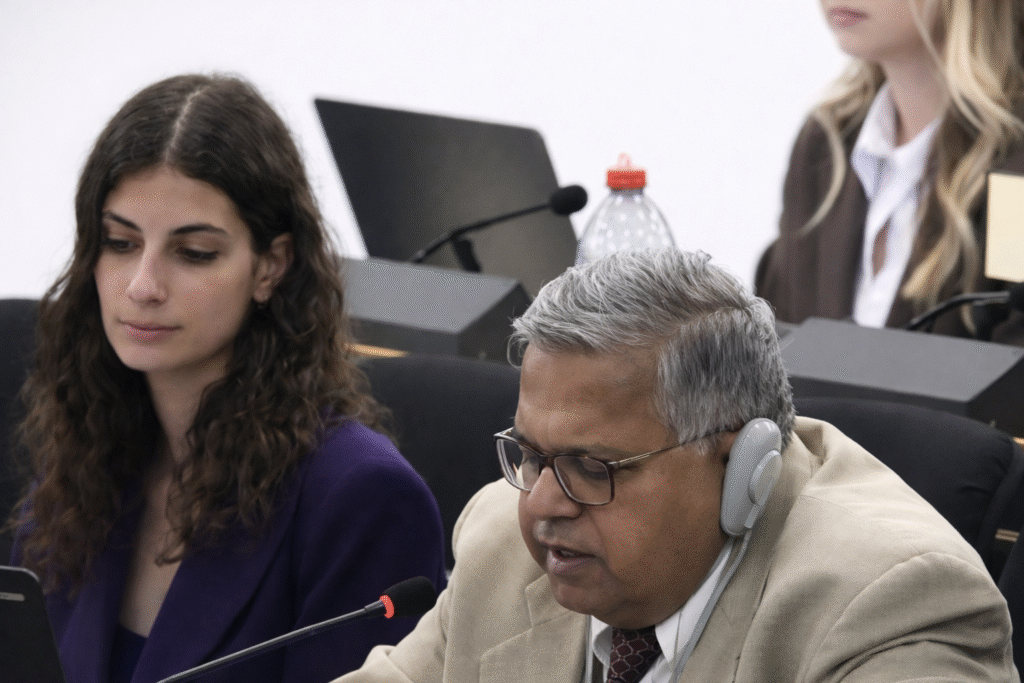
At the 61st session of the UN Human Rights Council in Geneva, CECIDE representative Syed Sultan Ahmad Jilani warned about increasing violence, blasphemy law abuse, and forced conversions affecting religious minorities in Pakistan.
Geneva — Paris Telegraph 14-03-2026
CECIDE Representative Raises Alarm Over Religious Minority Persecution in Pakistan at UN Human Rights Council
At the 61st session of the United Nations Human Rights Council, concerns were raised over the deteriorating situation of religious minorities in Pakistan.
Speaking during the General Debate under Agenda Item 3 – Promotion and Protection of All Human Rights, Including the Right to Development, Syed Sultan Ahmad Jilani addressed the Council on 11 March 2026 on behalf of Centre du Commerce International pour le Développement.
In his statement, Jilani noted that while many countries have made meaningful progress in advancing social, political, economic, and cultural rights since the creation of the Human Rights Council, serious violations continue in several parts of the world, particularly affecting vulnerable communities such as religious minorities.
Referring to findings from the Centre for the Study of Organized Hate, he highlighted a growing pattern of violence and discrimination against religious minorities in Pakistan in recent years.
One of the major concerns raised was the continued misuse of Pakistan’s blasphemy laws. Under these laws, individuals accused of insulting Islam, desecrating the Quran, or offending the Prophet Muhammad can face severe punishments including imprisonment, heavy fines, and even the death penalty.
According to the report cited in the intervention, minority communities often become victims of false accusations, mob intimidation, and legal harassment linked to these laws.
The statement also warned about reports that members of religious minority communities are sometimes coerced or forced to convert to Islam, with threats to their safety if they refuse.
Particular concern was expressed regarding the situation of Ahmadiyya Muslims, who face legal restrictions and social hostility when practicing their faith.
Jilani also referenced findings from the Human Rights Commission of Pakistan, which reported the emergence of what it described as a “blasphemy business” network, where individuals are allegedly trapped in fabricated accusations and extorted for money through organized schemes, sometimes involving online interactions.
Highlighting the ethical and religious dimension of the issue, Jilani noted that Pakistan is a signatory to the United Nations Charter and frequently describes itself as a state guided by Islamic principles.
He emphasized that the Holy Quran advocates the protection of fundamental human rights, including the right to life, liberty, freedom of expression, and freedom of religion. He also referred to the historic Meesaq-e-Madina, established by Prophet Muhammad, which guaranteed religious freedom and autonomy to different religious communities in Medina.
The statement concluded with a call for the international community to strengthen efforts to protect religious minorities and ensure accountability for human rights violations.
By Paris Telegraph – Geneva Correspondent

Paris Telegraph is an independent France-based digital news platform covering Paris news, French politics, European affairs, global business, diplomacy and artificial intelligence.
Publishing timely reporting and in-depth analysis, Paris Telegraph provides international perspectives on geopolitics, economic developments, technology innovation and cultural trends shaping Europe and the world.
As a growing online media outlet, Paris Telegraph is committed to credible journalism, global insight and forward-looking analysis for readers seeking reliable news from Paris and beyond.