
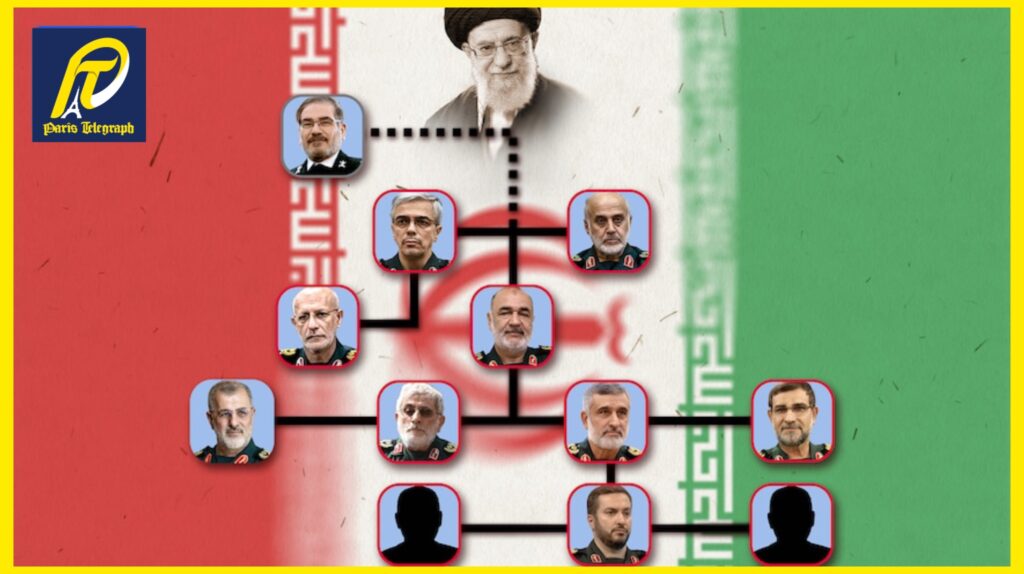
Iran’s Leadership Crisis Exposes Deep Intelligence Failures in Modern Warfare.
Paris Telegraph Date: 18 March 2026
A Leadership Structure Shaken
A series of coordinated strikes targeting Iran’s top political and military elite has triggered what analysts describe as one of the most severe leadership disruptions in the country’s modern history. According to international reporting, including structural analysis published by The New York Times, the attacks appear designed not merely to weaken Iran’s military capability, but to dismantle its command hierarchy.
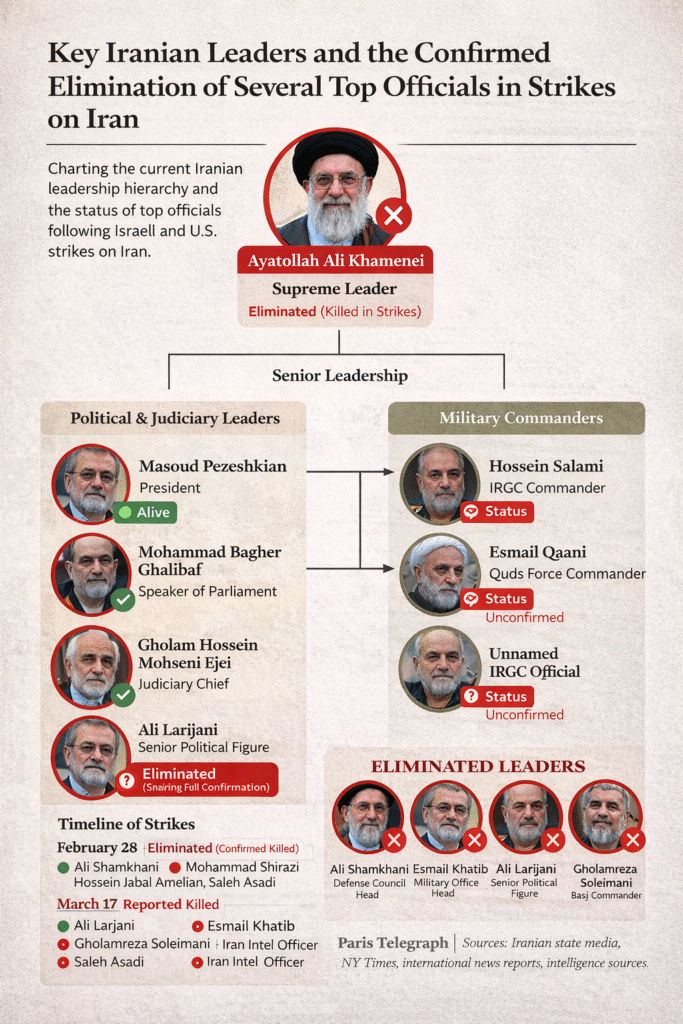
At the center of this upheaval is Ali Khamenei, whose reported death—though still not fully confirmed by Iranian authorities—marks a potential turning point in the nation’s power structure. His role as Supreme Leader placed him above all branches of power, making his absence deeply consequential.
Targeting the Inner Circle
Among the senior figures reportedly eliminated is Ali Larijani, a key strategist closely tied to national security decision-making.
Other high-profile figures believed to have been targeted include Ali Shamkhani and Esmail Khatib, both central to Iran’s intelligence and defense apparatus.
The pattern of strikes indicates a deliberate effort to disrupt coordination between political leadership, military command, and intelligence systems—effectively weakening the state’s internal coherence.
Decapitation Over Deterrence
Security experts increasingly describe the operation as a “decapitation strategy,” focused on removing leadership nodes rather than engaging in conventional battlefield destruction.
This approach aims to:
• Paralyze decision-making
• Break command structures
• Trigger internal instability
In modern warfare, such targeted operations often carry greater strategic consequences than traditional large-scale offensives.
Intelligence Failure in Modern Warfare
In today’s era of modern warfare, Iran’s current situation clearly exposes the dangerous illusion that victory can be achieved through missile power alone.
Even after losing key elements of its leadership—including senior political and spiritual figures—at the very outset of the conflict, Iran appears to have failed to learn from these losses or address its critical intelligence shortcomings.
The continued, sequential loss of leadership cannot be interpreted as a strategic wartime approach. It is not a sign of calculated military doctrine, but rather a direct consequence of deep-rooted intelligence failures.
Weaknesses in intelligence gathering, lack of foresight, and failures in internal security structures have pushed the system into a position where it is unable to protect its own leadership.
As a result, these losses no longer resemble conventional wartime casualties. Instead, they increasingly reflect a pattern of avoidable exposure—raising serious questions about systemic vulnerability.
Modern warfare is not decided by weapons alone. It is determined by precise intelligence, strong security networks, and forward-looking strategic planning.
In the absence of intelligence superiority, even the most powerful arsenal becomes strategically irrelevant.
Succession Risks and Institutional Fragility
Iran’s constitutional framework provides for an interim leadership mechanism, typically involving senior political and judicial figures. However, with multiple key figures either eliminated or under threat, this transition process may face unprecedented challenges.
Masoud Pezeshkian remains a central figure in this uncertain transition, though his ability to stabilize the system remains unclear.
Information Blackout and Strategic Ambiguity
An ongoing information blackout has made independent verification extremely difficult. While international media and intelligence sources provide partial insights, official confirmations remain limited.
This has created a fragmented narrative where:
• Some deaths are widely reported but not officially confirmed
• Others remain unclear or undisclosed
Such ambiguity intensifies the uncertainty surrounding Iran’s internal stability.
The Limits of Leadership Decapitation
One critical reality that the United States and Israel may not fully grasp is this: removing Iran’s leadership alone will never be sufficient to engineer regime change.
The Iranian state does not depend on a single individual. Its leadership is cultivated through a structured and deeply embedded system. Power is rooted in institutions, ideology, and networks that extend far beyond any one figure.
These foundations resemble a vast root system—resilient, interconnected, and deeply embedded within the fabric of the state.
At its core, Iran is built upon a powerful ideological framework. That ideology shapes leadership, reinforces loyalty, and ensures continuity even in times of crisis.
The fundamental miscalculation of those pursuing a decapitation strategy is the assumption that eliminating key figures will automatically trigger systemic collapse. In reality, such actions may produce the opposite effect.
Public responses—including mass mobilizations—suggest that leadership is not confined to institutions alone, but is also reflected in the collective identity of the people.
This underscores a broader truth of modern conflict: regime change cannot be achieved solely through targeted strikes. Without addressing deeper political, social, and ideological foundations, leadership removal alone is unlikely to deliver lasting transformation.
Nations built on ideology do not fall with individuals—they endure through the beliefs of their people
A Defining Moment for Modern Warfare
The scale and precision of these strikes signal a shift in global conflict strategy. Leadership targeting—once rare—is now emerging as a defining feature of modern high-tech warfare.
For Iran, the coming days will determine whether its institutions can absorb the shock—or whether the country is entering a period of prolonged instability.
Hyder Ali is the Editor – Global Affairs at Paris Telegraph, writing at the fault lines of power, politics, and global transformation. His commentary challenges conventional narratives and examines how emerging powers, shifting alliances, and strategic rivalries are reshaping the international order.
From Paris, he analyzes Europe’s geopolitical recalibration, the rise of Asia, the assertiveness of the Global South, and the strategic competition defining the 21st century. His work explores diplomacy, defence, energy security, economic realignment, and the ideological battles shaping world politics.
With a direct and analytical voice, Hyder Ali offers perspective-driven commentary that goes beyond headlines — interrogating power structures, questioning policy orthodoxy, and highlighting the deeper forces driving global change.
I do not even understand how I ended up here, but I assumed this publish used to be great
Nice post. I learn something totally new and challenging on websites
There is definately a lot to find out about this subject. I like all the points you made