
Has Politics Entered the Football Pitch? Growing Questions Over FIFA’s Credibility
Editorial Paris Telegraph ✍️
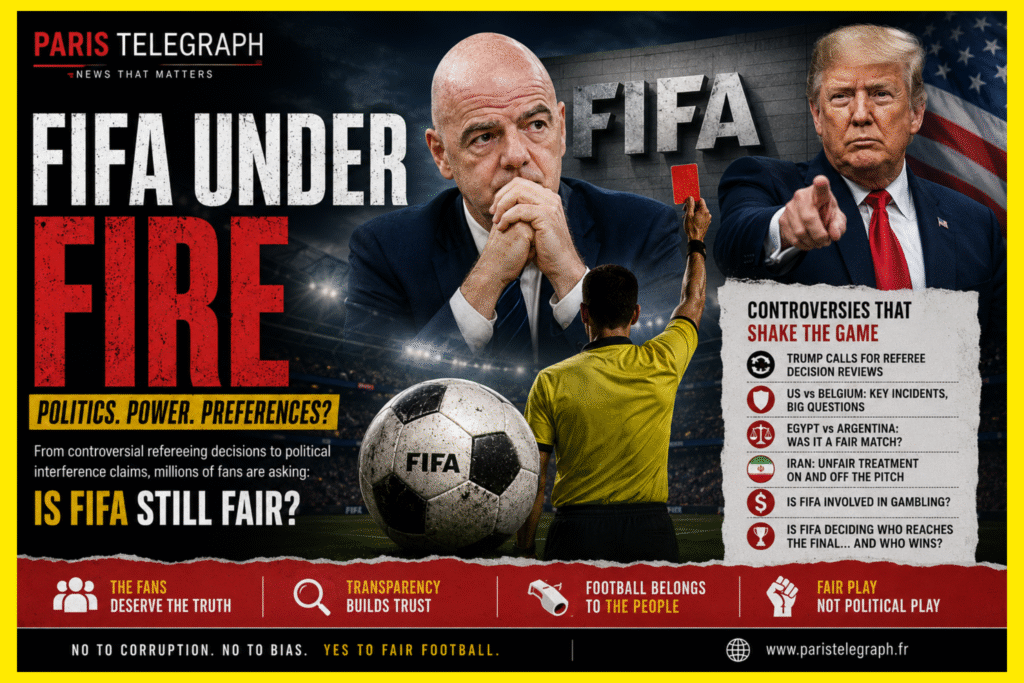
The FIFA World Cup has long been celebrated as the world’s greatest sporting event—a tournament where talent, teamwork, and fair play determine the champion. Yet in recent years, an increasing number of football supporters have begun asking whether politics, commercial interests, and inconsistent refereeing are undermining the integrity of the game.
Across social media and sports forums, fans have expressed frustration over controversial refereeing decisions that appear inconsistent from one match to another. While human error has always been part of football, the introduction of VAR (Video Assistant Referee) was expected to reduce mistakes and increase transparency. Instead, many supporters argue that VAR has sometimes created even greater confusion.
One of the most widely discussed issues during this tournament has been the perception of unequal disciplinary decisions. Questions have been raised regarding the handling of incidents involving the United States, Belgium, Egypt, Argentina, and Iran. Many supporters believe similar incidents have produced different outcomes depending on the teams involved.
The Egypt–Argentina match has attracted particular criticism from football fans, with many questioning whether key refereeing decisions were applied consistently throughout the game. Likewise, discussions surrounding the United States’ matches have fueled online debate about whether disciplinary actions were handled fairly compared with other teams.
Adding to the controversy have been public comments by U.S. President Donald Trump regarding football officiating. While world leaders are entitled to express opinions as football fans, any perception of political influence over refereeing or FIFA’s decision-making risks damaging public confidence in the independence of the sport. There is no verified evidence that political statements influenced FIFA officials or referees, but the perception alone has generated significant debate.
Iran has also faced criticism from supporters and commentators who believe the national team has not always received equal treatment on and off the field. Whether these perceptions are justified or not, FIFA must ensure that every member association is treated fairly regardless of geopolitical circumstances.
The central issue is not whether any single referee made a mistake. Mistakes happen. The larger concern is transparency and accountability.
Football supporters deserve clear explanations for major VAR interventions, disciplinary decisions, and referee assessments. Greater transparency would help rebuild trust and reduce speculation.
Unfortunately, the absence of detailed explanations has allowed rumours and conspiracy theories to flourish. Some fans have gone so far as to speculate that commercial interests, betting markets, or political considerations may influence tournament outcomes. At present, however, there is no credible evidence that FIFA predetermines World Cup finalists or winners, nor is there verified evidence linking FIFA to illegal gambling activities. Such claims remain speculation rather than established fact.
FIFA President Gianni Infantino has repeatedly stated that integrity, fairness, and transparency remain central to FIFA’s mission. Nevertheless, restoring confidence requires more than assurances. It requires openness, consistency, and accountability.
Football belongs to the fans—not politicians, commercial interests, or governing bodies.
As billions around the world watch the FIFA World Cup, supporters deserve to believe that every whistle, every VAR review, and every trophy is decided solely by what happens on the pitch.
If FIFA wishes to preserve its credibility for future generations, it must continue strengthening transparency, consistency, and independent oversight. Trust, once lost, is far more difficult to regain than any championship trophy.

Paris Telegraph is an independent France-based digital news platform covering Paris news, French politics, European affairs, global business, diplomacy and artificial intelligence.
Publishing timely reporting and in-depth analysis, Paris Telegraph provides international perspectives on geopolitics, economic developments, technology innovation and cultural trends shaping Europe and the world.
As a growing online media outlet, Paris Telegraph is committed to credible journalism, global insight and forward-looking analysis for readers seeking reliable news from Paris and beyond.