
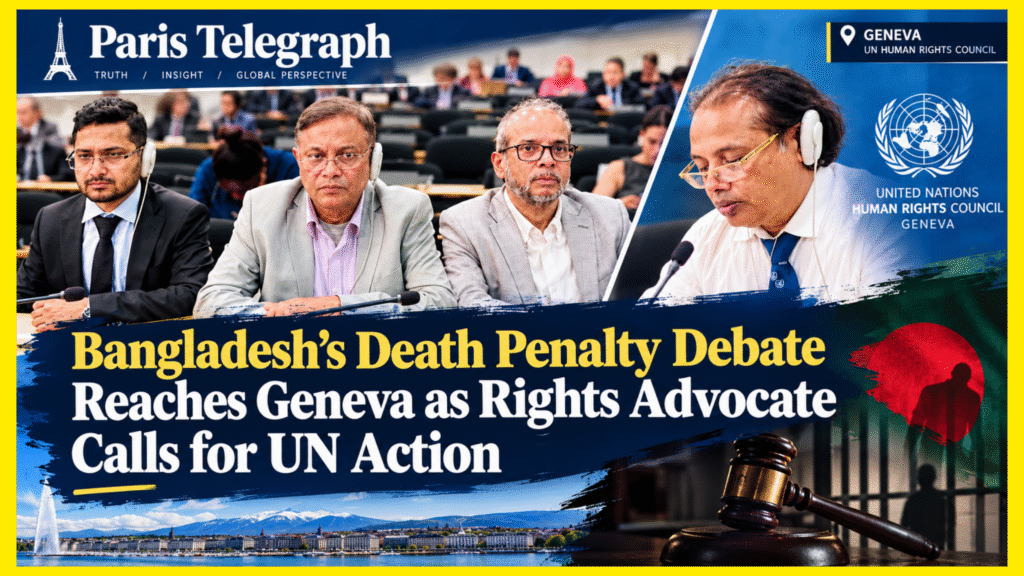
Bangladesh’s Death Penalty Debate Reaches Geneva as Rights Advocate Calls for UN Action
Statement at Human Rights Council puts capital punishment, judicial independence and security-force oversight under international scrutiny
By Paris Telegraph Geneva Correspondent
GENEVA — 8 October 2026
The continuing use of the death penalty in Bangladesh came under scrutiny at the United Nations Human Rights Council in Geneva, where a civil society representative urged the international community to strengthen its engagement with Bangladesh’s justice and human rights institutions.
Speaking during the Council’s 63rd session, Rahman Mamun, Principal Representative of the Tumuku Development and Cultural Union (TACUDU), called for greater UN technical assistance and capacity-building, arguing that stronger institutions were needed to protect human rights and move Bangladesh towards an end to capital punishment.
Mamun made the intervention during the Council’s 39th meeting on Monday, 5 October, held under Agenda Item 10 on technical assistance and capacity-building. The official UN record confirms that the meeting included a general debate and was opened by Human Rights Council Vice-President Riia Salsa-Audiffren. Rory Mungoven, Chief of the Asia-Pacific Region at the Office of the UN High Commissioner for Human Rights, was also among the speakers listed for the session.
Death penalty becomes central concern
Mamun argued that Bangladesh’s continued use of capital punishment deserved closer international attention, particularly where death sentences involve political figures, activists or people accused in politically sensitive cases.
He linked his intervention to remarks attributed to UN High Commissioner for Human Rights Volker Türk concerning the need for an independent national institution capable of exercising effective oversight over Bangladesh’s security forces.
According to the UN meeting transcript, the intervention also referred to international efforts to strengthen justice systems, improve prison conditions and work towards ending the death penalty. The speaker further argued that capital punishment can have a disproportionate impact on minorities, people living in poverty and dissenting voices.
Bangladesh remains a country that retains capital punishment. Amnesty International has separately raised concerns about the use of death sentences in Bangladesh, including cases tried in absentia and proceedings before special courts, while noting concerns about fair-trial safeguards in the case of former Prime Minister Sheikh Hasina.
Political leaders and tribunal proceedings raised
A major part of Mamun’s intervention focused on Bangladesh’s International Crimes Tribunal and death sentences involving senior figures associated with the former Awami League government.
He referred to death sentences against former Prime Minister Sheikh Hasina and former Home Minister Asaduzzaman Khan Kamal, as well as other senior political figures.
The death sentences against Hasina and Kamal are independently documented. Bangladesh’s International Crimes Tribunal sentenced both in absentia in November 2025 in connection with crimes against humanity arising from the 2024 crackdown on student-led protests.
Mamun characterised the proceedings as politically motivated persecution and expressed concern about the defendants being sentenced in their absence.
Those characterisations, however, represent the position expressed by the speaker at the Geneva session and should not be taken as findings by the Human Rights Council. Bangladesh’s authorities and the tribunal have defended the proceedings, while legal representatives for Hasina have separately challenged the verdict and raised allegations concerning due process and judicial independence.
A wider question over justice and accountability
The intervention placed Bangladesh’s death-penalty debate within a broader discussion about accountability, institutional independence and the role of international assistance.
For human rights advocates, the issue extends beyond individual cases. The central question is whether Bangladesh can strengthen its judicial and security institutions while ensuring that accountability for serious human rights violations is pursued through proceedings that meet international fair-trial standards.
The debate is particularly sensitive because Bangladesh’s tribunal is dealing with allegations arising from the deadly violence surrounding the 2024 student uprising. While rights organisations have stressed the need for accountability for victims, Amnesty International has argued that the death penalty should not be the instrument through which justice is delivered. (Amnesty International)
Bangladesh delegation and civil society presence
The Geneva proceedings also drew attention from figures associated with Bangladesh’s political and civil society landscape.
Former Foreign Minister Dr Hasan Mahmud, Hussain Muhammad Imam, President of the Global Diaspora Community (Bangladesh), and Switzerland-based human rights activists Zamader Nazrul Islam and Sajia Rahman were among those attending the session, according to the meeting account supplied to Paris Telegraph.
The discussion comes as Bangladesh continues to face international scrutiny over the handling of cases arising from the 2024 political upheaval and the future of its justice institutions.
For Geneva-based observers, the intervention underscored a continuing tension at the heart of Bangladesh’s accountability debate: how to secure justice for victims of serious abuses while ensuring that the justice process itself meets international human rights standards.
Paris Telegraph will continue to follow developments concerning Bangladesh at the United Nations Human Rights Council in Geneva.
Paris Telegraph Geneva Correspondent

Paris Telegraph is an independent France-based digital news platform covering Paris news, French politics, European affairs, global business, diplomacy and artificial intelligence.
Publishing timely reporting and in-depth analysis, Paris Telegraph provides international perspectives on geopolitics, economic developments, technology innovation and cultural trends shaping Europe and the world.
As a growing online media outlet, Paris Telegraph is committed to credible journalism, global insight and forward-looking analysis for readers seeking reliable news from Paris and beyond.