
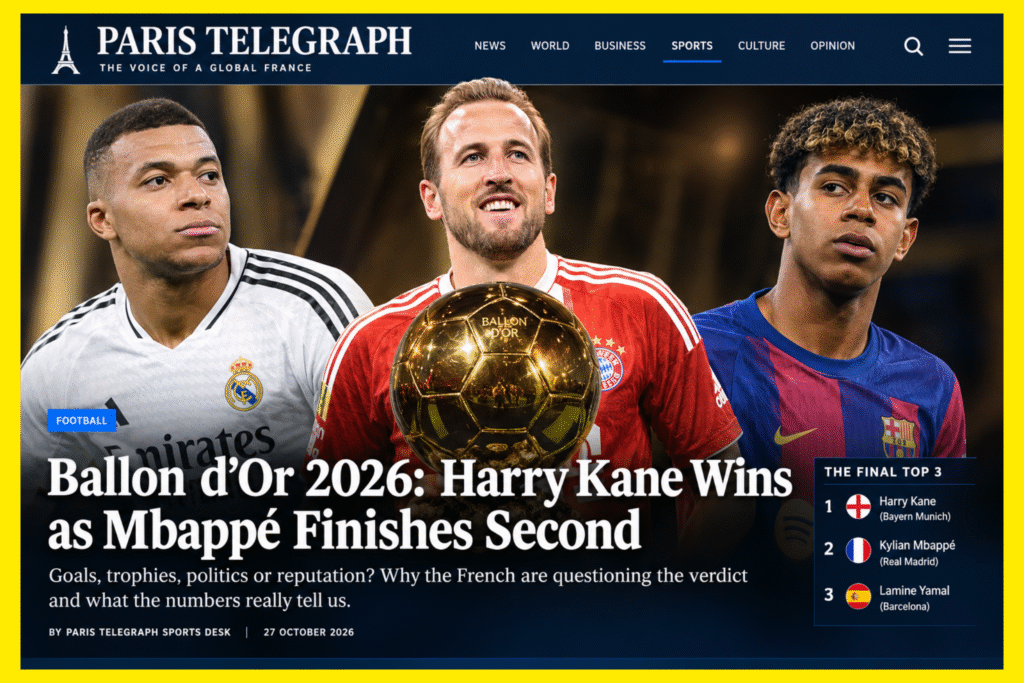
Kylian Mbappé finishes second as England captain Harry Kane claims football’s most prestigious individual honour. But do the statistics, trophies and performances tell the whole story?
By Paris Telegraph Sports Desk
Paris Telegraph | 27 October 2026
The Ballon d’Or is supposed to celebrate the finest individual performance in football. Yet every year, its announcement produces a familiar argument: has the award recognised the player who performed best, or the player whose season created the most compelling story?
Monday’s ceremony in London has revived that debate. England captain and Bayern Munich striker Harry Kane has won the 2026 men’s Ballon d’Or, finishing ahead of France’s Kylian Mbappé and Spain’s teenage sensation Lamine Yamal.
For French supporters who believed Mbappé had done enough to claim the prize, the result is inevitably disappointing. For Kane’s supporters, it represents overdue recognition for a striker whose goalscoring consistency has become one of the defining features of European football.
But anger and celebration alone cannot settle the question. The more important task is to examine the evidence: goals, assists, trophies, international performances, individual influence and the criteria used to select the winner.
Was Mbappé genuinely overlooked? Did Kane produce the stronger overall season? And how much room is there for subjective judgement, reputation and narrative in an award decided by journalists?
1. The verdict: Kane first, Mbappé second
The final top three places the two leading candidates in direct comparison.
| Position | Player | Club | National team |
| 1 | Harry Kane | Bayern Munich | England |
| 2 | Kylian Mbappé | Real Madrid | France |
| 3 | Lamine Yamal | Barcelona | Spain |
Source: UEFA’s report on the 2026 Ballon d’Or ceremony.
Kane’s victory is supported by a formidable statistical record. UEFA reports that he scored 73 goals for club and country during the 2025–26 campaign, helped Bayern retain the Bundesliga title and contributed to the club’s domestic treble. He also scored 14 goals in the Champions League as Bayern reached the semi-finals.
These achievements make it difficult to dismiss Kane’s selection as an obvious injustice. He combined extraordinary individual production with major domestic honours.
Nevertheless, Mbappé finishing second raises a legitimate question: if a player scores at an exceptional rate and remains one of the most influential attackers in the world, what additional achievements are required to win the Ballon d’Or?
The answer depends on how voters balance individual statistics against collective success and performances in decisive matches.
2. Was Kylian Mbappé neglected?
Mbappé’s second-place finish does not mean he was ignored. He was recognised as the runner-up, but the distinction between being among the world’s best players and actually winning the award is substantial.
For French football, the disappointment is understandable. Mbappé has established himself as one of his generation’s defining forwards, capable of changing matches through acceleration, movement, finishing and individual brilliance.
Yet the Ballon d’Or is not a lifetime achievement award. Previous reputation cannot automatically outweigh a rival’s performance during the season under consideration.
The central issue is whether Mbappé’s individual contribution was stronger than Kane’s once the full campaign is considered. A rigorous comparison requires verified figures for both players across the same competitions, including goals, assists, minutes played, penalties, decisive contributions and trophies.
It is also important to distinguish league scoring from total scoring. A player’s domestic league record alone cannot provide a complete picture when another candidate has delivered across league, cup, European and international football.
The strongest criticism of the result would therefore not be that Mbappé deserved to win simply because he is French. It would be that voters failed to give sufficient weight to specific, measurable aspects of his performance. Establishing that claim requires evidence from the voting criteria and the two players’ complete season records.
3. Harry Kane: does the English striker deserve the award?
Kane’s case begins with a number that demands attention: 73 goals across club and country in 2025–26.
That total reflects not merely a successful run of form but sustained output across a demanding season. At Bayern, Kane operated as the focal point of an attack competing for major honours. His goals helped the club secure domestic silverware, while his 14 Champions League goals demonstrated that his scoring extended beyond the Bundesliga.
There is also an important distinction between scoring goals and contributing to a successful team. Elite strikers are judged on their finishing, but their movement, link-up play, pressing, decision-making and ability to create opportunities for teammates also matter.
Kane’s case combines individual productivity with collective achievement. Those are precisely the elements that make him a credible Ballon d’Or winner.
However, his selection should not be treated as beyond scrutiny. The fact that a player scores the most goals does not automatically prove that he has been the best footballer overall. Goals are measurable; overall influence is more difficult to quantify.
The proper conclusion is that Kane has a powerful, evidence-based case for the award. Whether he was the most deserving candidate depends on how that evidence compares with the performances of his closest rivals.
4. Is the Ballon d’Or about football or politics?
The word “politics” is frequently used whenever a prestigious sporting award produces a controversial result. In this context, it can mean several different things: national sentiment, media influence, club reputation, commercial interests or the narratives that shape voters’ perceptions.
These possibilities should not be confused with proof of manipulation.
The Ballon d’Or is awarded through a journalists’ voting process rather than a simple calculation of goals, assists and trophies. That means the final result inevitably involves interpretation. Two voters can examine the same season and reach different conclusions about which player had the greatest overall impact.
A striker who scores 73 goals and wins several trophies may be viewed as the obvious choice by one voter. Another may place greater emphasis on a player who created chances, dominated crucial matches or influenced a team’s entire style of play.
Such disagreements do not establish political interference.
There is also a distinction between the location of the ceremony and the mechanism of selection. The 2026 ceremony took place in London, but the award is organised by France Football, part of the L’Équipe Group, in cooperation with UEFA. The event’s English setting is not evidence that Kane benefited from national favouritism.
To substantiate an allegation of bias, one would need stronger evidence: documented irregularities, a departure from the published rules, credible evidence of improper pressure or voting patterns that can be examined against the criteria.
Without such evidence, “political Ballon d’Or” is a provocative question, not an established finding.
5. What should matter most: goals, trophies or overall performance?
The controversy exposes a deeper problem with individual football awards. There is no universally accepted formula that converts every aspect of a season into a single objective score.
Goals are quantifiable, but they do not measure every contribution. Assists depend partly on teammates finishing the chances created. Trophies reflect collective performance, not solely an individual player’s ability. International tournaments can carry enormous emotional weight, even though the number of matches available to players differs.
A fair comparison should therefore consider several dimensions together.
Individual output: goals and assists across all competitions, adjusted where appropriate for appearances and minutes.
Quality of opposition: performances against elite teams, particularly in the Champions League and other decisive matches.
Collective achievement: league titles, domestic cups and European success, while recognising that football is a team sport.
Influence on play: chance creation, movement, pressing, build-up contribution and the ability to change the course of a match.
Consistency: sustained performance across the entire eligibility period, rather than a few memorable games.
International contribution: performances for the national team, assessed in context rather than by nationality or tournament prestige alone.
These dimensions cannot eliminate every disagreement, but they would make public discussion more transparent. They also explain why the leading candidates cannot be compared solely by looking at one headline statistic.

Paris Telegraph is an independent France-based digital news platform covering Paris news, French politics, European affairs, global business, diplomacy and artificial intelligence.
Publishing timely reporting and in-depth analysis, Paris Telegraph provides international perspectives on geopolitics, economic developments, technology innovation and cultural trends shaping Europe and the world.
As a growing online media outlet, Paris Telegraph is committed to credible journalism, global insight and forward-looking analysis for readers seeking reliable news from Paris and beyond.