
France Slips into Technical Recession as Investment and Exports Weaken
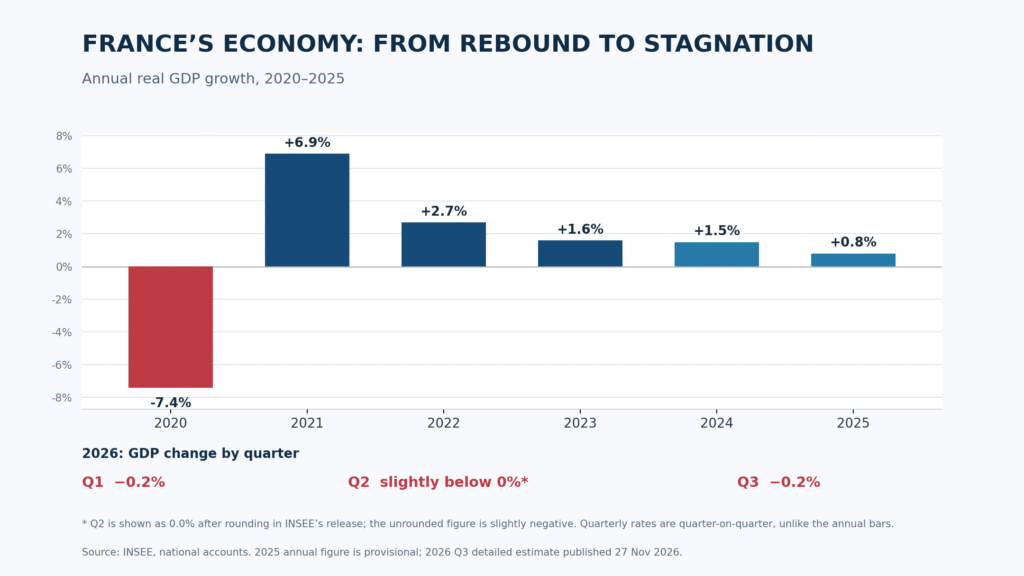
PARIS, November 28, 2026 — France’s economy contracted by 0.2% in the third quarter of 2026, according to detailed figures released by the national statistics institute, INSEE, on November 27. The decline was deeper than the 0.1% contraction initially estimated in October. The second-quarter figure, reported as 0.0% after rounding, was also slightly negative in the unrounded data. France has therefore recorded two consecutive quarterly declines, meeting the usual definition of a technical recession.
The downturn is modest in scale, but it points to an economy struggling to generate growth. Household consumption edged up, but investment continued to fall and foreign trade became a major drag. The question now is whether this is a temporary setback or the beginning of a longer period of weak activity.
Investment and exports drag on growth
Investment was one of the clearest areas of weakness. Gross fixed capital formation fell by 0.9% in the third quarter, following a 0.5% decline in the previous quarter. Construction investment fell by 0.9%, while investment in manufactured products dropped by 1.8%. Businesses appear cautious about committing to new projects, and residential investment remains under pressure.
Foreign trade also weighed heavily on the economy. Exports fell by 1.6% after rising sharply in the previous quarter, while imports were almost unchanged. As a result, net trade reduced third-quarter GDP growth by 0.6 percentage points. The Bank of France had already identified difficulties affecting exporters, including supply constraints in the aeronautics sector.
Domestic demand was not strong enough to offset these declines. Household consumption rose by 0.3%, but INSEE said final domestic demand, excluding inventories, made no contribution to growth. Changes in inventories added 0.3 percentage points to GDP, cushioning the overall fall.
Households remain cautious
Household purchasing power per consumption unit rebounded by 0.2% in the third quarter after falling by 0.5% in the second. That improvement has yet to translate into a substantial rise in spending. The household saving rate remained high at 17.4% of disposable income, suggesting that many families are still cautious amid economic uncertainty, energy costs and concerns about employment.
The labour market is showing signs of strain. Employment was stable over the quarter but down 0.3% year on year. France’s unemployment rate reached 8.2% in the third quarter, up 0.4 percentage points over a year. INSEE’s preliminary estimate put inflation at 2.9% year on year in November, continuing to put pressure on household budgets.
Macron’s economic strategy faces a difficult test
Since the start of Emmanuel Macron’s presidency, French economic policy has focused heavily on supply-side measures: reducing some taxes and costs for businesses, making France more attractive to investors and encouraging job creation. The goal was to improve competitiveness and support investment. But the present downturn raises questions about whether those measures have been enough to generate resilient growth.
The weakness cannot be attributed to a single presidential decision. It reflects a combination of domestic and international pressures, including political uncertainty, higher energy prices, weaker demand from trading partners and continuing difficulties in construction. The European Commission says residential investment has been affected by the suspension of renovation subsidies, while weaker public investment has also weighed on activity. Supply bottlenecks in aeronautics further hurt exports during the third quarter.
The wider record of Macron’s economic policies is also contested. The OECD notes that, after the pandemic, revenue losses from tax reforms more than offset efforts to reduce spending. It has called for a closer review of tax expenditures to ensure they deliver measurable benefits for employment, investment and social policy. This does not establish that tax cuts caused the current recession, but it highlights a central question: whether public resources have been directed effectively enough to support lasting productivity and growth.
The government faces a difficult fiscal balance. Reducing the deficit and stabilising public debt are important to preserve France’s financial room for manoeuvre. At the same time, spending cuts can weaken demand in the short term, particularly when businesses are already delaying investment and households are saving more. The European Commission expects France’s public deficit to reach 5.5% of GDP in 2026 and public debt to rise to 123.2% of GDP by 2028. Rising interest payments are also taking up a larger share of public resources.
The debate is therefore not simply whether France should restore its public finances, but how it should do so: which spending to reduce, which investment to protect and how to avoid making a weak economy weaker. The OECD argues that stronger productivity, better skills and more effective public support will be important to improve France’s longer-term growth prospects.
A recession, but not a broad economic collapse
A technical recession does not mean that every sector or household is experiencing a sharp downturn. Consumption edged higher, the profit margin of non-financial companies rose slightly to 31.6%, and INSEE’s acquired growth estimate for 2026 remained positive at 0.1%. But those figures do not offset the contraction in investment and the sharp reversal in foreign trade.
The European Commission forecasts annual growth of 0.4% for 2026, while warning of risks from energy prices, weak investment and a softer labour market. INSEE is due to publish its first estimate for fourth-quarter GDP on January 29, 2027. That release will show whether activity stabilised or contracted again.
Paris Telegraph Business News analysis: The latest figures show that the competitiveness strategy pursued under President Macron has not shielded France from falling investment and weaker exports. External shocks and domestic uncertainty have also played a significant role. The government’s challenge is to reduce the deficit while protecting investment that can raise productivity and support employment.


Paris Telegraph is an independent France-based digital news platform covering Paris news, French politics, European affairs, global business, diplomacy and artificial intelligence.
Publishing timely reporting and in-depth analysis, Paris Telegraph provides international perspectives on geopolitics, economic developments, technology innovation and cultural trends shaping Europe and the world.
As a growing online media outlet, Paris Telegraph is committed to credible journalism, global insight and forward-looking analysis for readers seeking reliable news from Paris and beyond.