
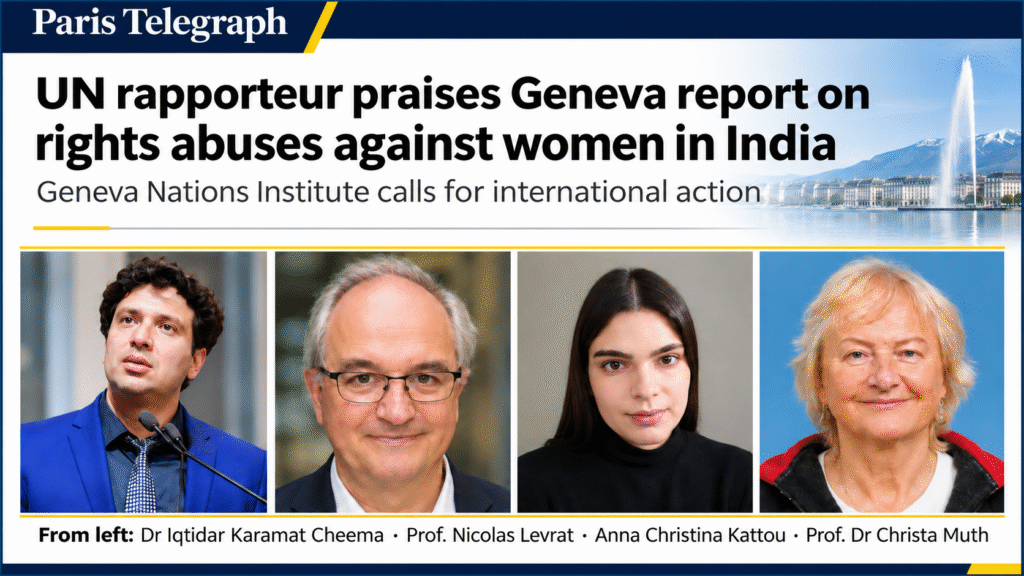
UN rapporteur praises Geneva report on rights abuses against women in India
Speakers at Geneva Nations Institute press conference call for UN appeals and independent fact-finding missions
By Paris Telegraph Geneva Correspondent 13/11/2026

Geneva press conference launching the Geneva Nations Institute’s report, Broken Promises. Dr Iqtidar Karamat Cheema, member of the UN Global Steering Committee;Ms Anna Christina Kattou of the Geneva Nations Institute; and Prof. Dr Christa Muth, Rector of the Institute.
GENEVA — Speakers at a Geneva press conference on Friday called for stronger international action over reported abuses against Dalit, Adivasi and minority women in India, as the Geneva Nations Institute launched its report, Broken Promises. Denied Rights.: State Violence, Systemic Discrimination and Impunity – Human Rights Violations Against Dalit, Adivasi and Minority Women in India.
Prof. Nicolas Levrat, the UN Special Rapporteur on minority issues, described the report as “a very important piece for the work of the UN human rights system”. He called its use of official statistics “quite remarkable” and said legislation alone was not enough to address discrimination.
Levrat stressed the need to educate law enforcement officials, judicial authorities and the wider public. He said he would raise the issues with Indian government representatives through UN channels.
Presenting the report’s findings, doctoral researcher Ms Anna Christina Kattou quoted its foreword: “Every figure in this report belongs to a woman.”

Kattou said police data indicate that twelve Dalit women and girls are raped each day. She also cited a 46 per cent rise in recorded crimes against Dalit women over six years, compared with an increase of less than two per cent for women overall. More than 92 per cent of rape cases involving Scheduled Caste victims were awaiting trial, she said. Kattou urged action on the report’s 22 recommendations.
Dr Iqtidar Karamat Cheema, a member of the UN Global Steering Committee of the Office on Genocide Prevention and the Responsibility to Protect, said that behind every statistic was a person. He cited examples including a Dalit woman turned away from a police station, a 14-year-old in Shopian who lost her sight after being struck by metal pellets, and a mother in Punjab who was handed a box of ashes.
Violations affecting Dalit, Adivasi, Muslim, Christian and Sikh women were “structural, documented, and escalating”, Cheema said.
He noted that India has ratified the principal international human rights treaties and that its Constitution prohibits discrimination. However, he argued, the report shows an “appalling gap” between those commitments and conditions on the ground.
Cheema said UN treaty bodies had reviewed India’s human rights record in 2007, 2014, 2024 and August 2026. He drew a connection between events including the 1984 anti-Sikh violence, the 2002 Gujarat riots, the 2020 Hathras case and violence in Manipur in 2023, arguing that impunity had persisted across the decades.
He called for urgent UN appeals, independent fact-finding missions and unrestricted country visits by Special Rapporteurs. He also urged governments to include accountability benchmarks in bilateral and trade discussions.
“A promise made by a state… is meaningless if it can be broken without consequence,” Cheema said, calling for a shift “from observation to action”.
Researcher and international relations expert Dr Mohamed Shareef Asees said the international community must intervene and press India to respect human rights.
Journalists questioned the panel during the event. Several participants praised the report’s research and documentation.
By Paris Telegraph Geneva Correspondent


Paris Telegraph is an independent France-based digital news platform covering Paris news, French politics, European affairs, global business, diplomacy and artificial intelligence.
Publishing timely reporting and in-depth analysis, Paris Telegraph provides international perspectives on geopolitics, economic developments, technology innovation and cultural trends shaping Europe and the world.
As a growing online media outlet, Paris Telegraph is committed to credible journalism, global insight and forward-looking analysis for readers seeking reliable news from Paris and beyond.