
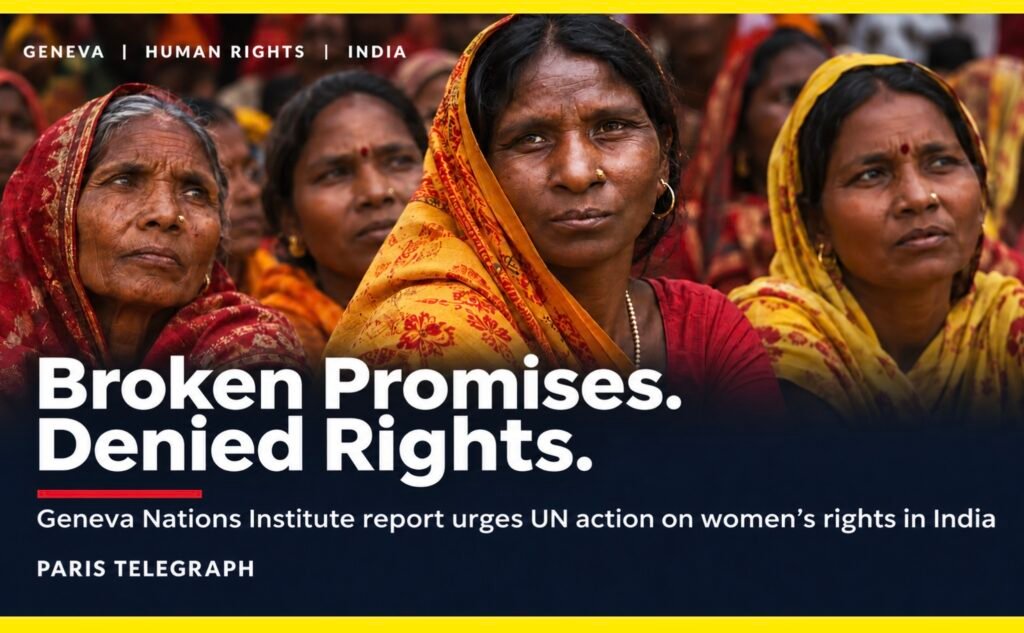
Broken Promises, Denied Rights: Geneva Nations Institute report urges UN action over violence against Dalit, Adivasi and minority women in India
The report brings together crime data, case records and human rights findings, highlighting violence and persistent barriers to justice.
By the Paris Telegraph Geneva Correspondent
GENEVA, 4 November 2026 — Dalit, Adivasi and religious minority women and girls in India continue to face sexual violence, discrimination and barriers to justice, according to a report published by the Geneva Nations Institute.
Titled Broken Promises, Denied Rights, the report examines evidence published between 2007 and 2026. It draws on Indian crime data, court records, case studies and findings by UN human rights bodies. The report was published by the Institute; it is not a UN publication.
The figures cited in the report point to the scale of recorded violence. An analysis by the National Campaign on Dalit Human Rights (NCDHR) of National Crime Records Bureau data recorded 4,214 rape cases involving Dalit women and girls in 2023. The report also cites an estimate that, on average, 12 Dalit women and girls and three Adivasi women and girls are raped each day. It warns that official figures reflect reported cases and that violence is under-reported.
A separate analysis covering 2014 to 2019 found recorded crimes against Dalit women and girls rose by 45.9 per cent, from 5,149 to 7,510 cases a year. Recorded crimes against women overall increased by 1.7 per cent over the same period, the report says. It also notes gaps in national data: caste breakdowns are unavailable for several serious offences, and victims’ religion is not recorded.
The report highlights delays in the justice system. In 81 cases followed by the All India Dalit Mahila Adhikar Manch across six states, police registered 77 First Information Reports. Charge sheets were filed in 39 cases, but only 14 were filed within the 60-day deadline cited under the Scheduled Castes and Scheduled Tribes (Prevention of Atrocities) Act. Thirty-eight of the 39 cases with charge sheets were still at trial, according to the report.
The wider court backlog is also substantial. The report cites figures showing that 96,510 of 108,889 trials involving Dalit women and girls—about 89 per cent—were pending between 2014 and 2019. It argues that delays can leave survivors waiting for justice, compensation and an effective remedy.
The report also examines pressures affecting religious minority women. A hate-speech monitoring project cited in the report recorded 1,318 events in 2025, an average of about four a day. The data are not broken down by the sex of those targeted, but the report says Muslim and Christian women are among the communities affected.
Other issues covered include home demolitions, restrictions affecting Muslim girls’ access to education and voter-roll removals. In Bihar, women accounted for about 59 per cent of attributed deletions; in West Bengal, they represented 61.8 per cent, according to an analysis of official figures cited in the report. Sex-disaggregated figures were available for only those two states.
The Geneva Nations Institute calls on UN officials and special rapporteurs to seek visits to India, monitor the implementation of earlier recommendations and consider independent inquiries into specific allegations, including sexual violence in Manipur and reports of abuse during detentions in Delhi in October 2026. It also urges Indian authorities to register complaints, strengthen investigations and publish data broken down by sex, caste, religion and location.
The report’s foreword is signed by Anna Christina Kattou, identified as a doctoral researcher at the Geneva Nations Institute. Its findings draw on the sources cited throughout the report, including official statistics, civil-society research and UN human rights findings.
To Read a full Report
Broken Promises, Denied Rights
published by the Geneva Nations Institute.

Paris Telegraph is an independent France-based digital news platform covering Paris news, French politics, European affairs, global business, diplomacy and artificial intelligence.
Publishing timely reporting and in-depth analysis, Paris Telegraph provides international perspectives on geopolitics, economic developments, technology innovation and cultural trends shaping Europe and the world.
As a growing online media outlet, Paris Telegraph is committed to credible journalism, global insight and forward-looking analysis for readers seeking reliable news from Paris and beyond.