
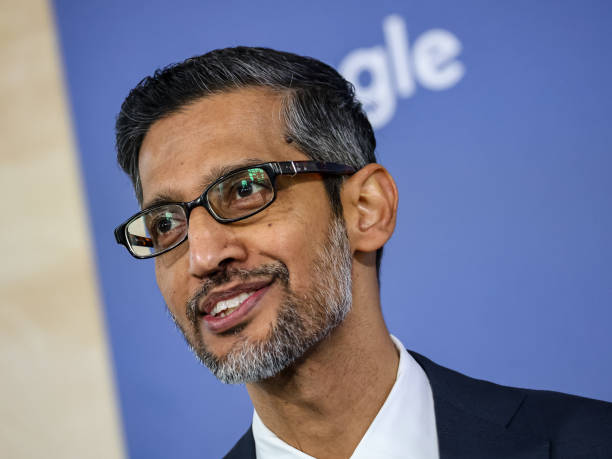
Google Bets on India to Shape Global AI Leadership, Says Sundar Pichai.
February 19, 2026
Google Deepens India AI Strategy Amid Global Tech Rivalry
In a move that underscores shifting power dynamics in the global technology industry, Sundar Pichai, chief executive of Google, has positioned India as a central partner in the company’s long-term artificial intelligence strategy.
Pichai’s remarks come at a time when global competition for AI leadership is intensifying, with the United States, China and the European Union investing heavily in infrastructure, semiconductor supply chains and advanced research.
Rather than viewing India solely as a growth market, Google increasingly sees it as a strategic innovation base — one capable of influencing how AI systems are developed, deployed and regulated at scale.
From Market to Strategic Partner
India represents one of Google’s largest user bases globally and one of its fastest-growing digital economies. With a vast developer ecosystem, expanding cloud adoption and strong government backing for AI initiatives, the country offers both scale and cost efficiency.
For Google, deeper engagement in India strengthens several business priorities:
- Expansion of cloud and enterprise AI services
- Localised large language models for multilingual markets
- AI-powered digital payments and fintech ecosystems
- Long-term talent pipeline development
The partnership reflects a broader recalibration in Silicon Valley, where emerging markets are increasingly viewed not just as consumers of technology but as co-creators of next-generation platforms.
The Economic Stakes
Artificial intelligence is projected to contribute trillions of dollars to global GDP over the coming decade. India’s digital economy is already expanding rapidly, driven by fintech adoption, digital identity systems and a maturing startup ecosystem.
By aligning closely with India’s AI ambitions, Google positions itself to capture growth across public infrastructure projects, enterprise automation, healthcare digitisation and agricultural technology — sectors where AI deployment could accelerate productivity gains.
Geopolitical Dimensions
AI leadership is no longer purely commercial. It is increasingly tied to economic influence, regulatory standards and global competitiveness. India’s regulatory approach to digital public infrastructure and open digital ecosystems could shape how emerging markets adopt AI tools.
For Google, partnering with India also provides strategic diversification amid regulatory scrutiny in Western markets and intensifying competition from Chinese AI platforms.
A Calculated Long-Term Play
Pichai’s message signals more than corporate optimism. It reflects a calculated bet that India will play a decisive role in setting the standards — and capturing the value — of the next digital wave.
As artificial intelligence moves from experimentation to large-scale deployment, alliances between global technology companies and emerging digital powers may determine who defines the rules of the AI economy.
By Paris Telegraph News Desk

Paris Telegraph is an independent France-based digital news platform covering Paris news, French politics, European affairs, global business, diplomacy and artificial intelligence.
Publishing timely reporting and in-depth analysis, Paris Telegraph provides international perspectives on geopolitics, economic developments, technology innovation and cultural trends shaping Europe and the world.
As a growing online media outlet, Paris Telegraph is committed to credible journalism, global insight and forward-looking analysis for readers seeking reliable news from Paris and beyond.