
Algorithmic Battlefield: How a High-Tech War Between the United States, Israel and Iran Is Redefining Modern Conflict
02 March 2026 By Paris Telegraph
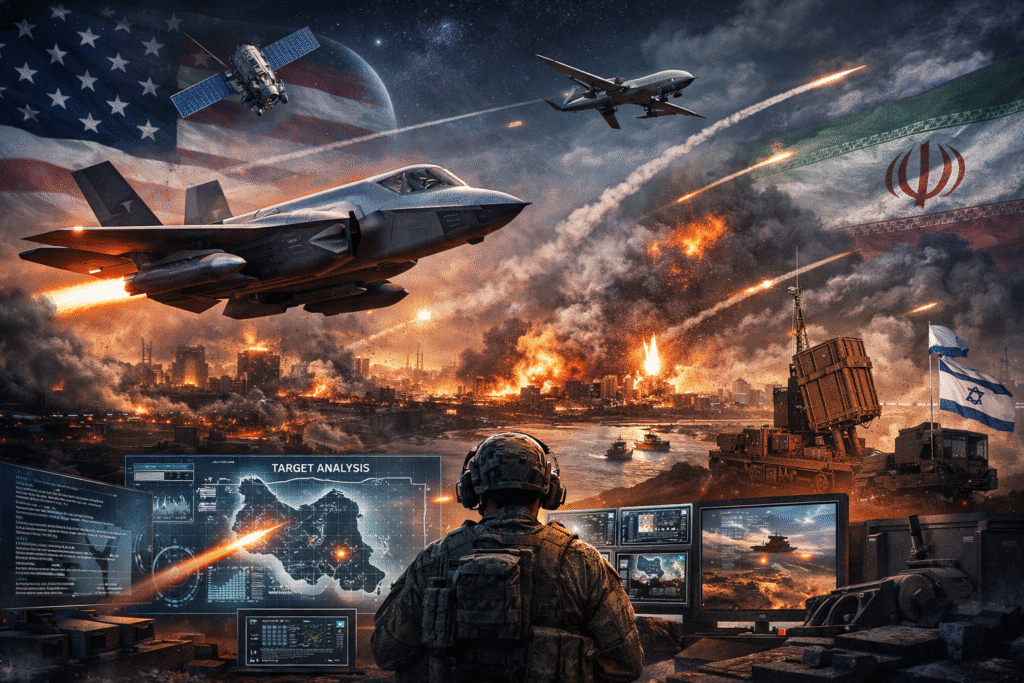
As tensions intensify between the United States, Israel and Iran, the world is witnessing more than a geopolitical confrontation. What is unfolding is a laboratory of 21st-century warfare — a conflict shaped not only by missiles and fighter jets, but by algorithms, artificial intelligence, cyber operations and real-time data dominance.
Unlike the wars of the past, this confrontation is being fought simultaneously in the air, at sea, in cyberspace and inside vast data centers where machine-learning systems process battlefield intelligence faster than any human command structure ever could.
The Rise of the Algorithmic War
Military strategists increasingly describe modern conflict as a “sensor-to-shooter” chain — a continuous loop in which satellites, drones, radar systems and electronic surveillance gather enormous volumes of data. Artificial intelligence then filters, prioritizes and models that data before human commanders authorize action.
AI systems — including commercial models developed by companies such as Anthropic — are not launching weapons. However, they are reshaping:
- Intelligence analysis
- Threat detection
- Target prioritization
- Battlefield simulations
- Strategic forecasting
Advanced machine-learning tools can evaluate thousands of strike scenarios in minutes, assessing likely outcomes, escalation risks and collateral damage probabilities. What once required days of human coordination now unfolds in near real-time.
Military planners call this acceleration “decision superiority.” Critics warn it compresses the space for diplomacy.
Precision, Drones and Stealth
Beyond AI, the conflict reflects decades of investment in advanced hardware:
- Stealth aircraft and long-range strike platforms capable of penetrating dense air defenses.
- Autonomous and semi-autonomous drones, designed to overwhelm radar systems through swarm tactics.
- Missile defense systems intercepting ballistic threats at multiple layers.
- Cyber units targeting infrastructure, financial networks and communication grids.
This is not merely a battle of territory; it is a contest of technological ecosystems.
The Strait That Could Shake the World
Any escalation risks disruption in the Strait of Hormuz — the narrow maritime passage through which roughly one-fifth of global oil supplies transit. Even limited instability there sends shockwaves through European and Asian energy markets.
Energy analysts warn that prolonged confrontation could:
- Spike crude oil prices
- Disrupt LNG shipments
- Strain European energy security
- Increase inflationary pressure globally
For economies already weakened by previous conflicts and sanctions regimes, the margin for shock absorption is thin.
Regional Ripple Effects
Iran’s network of regional allies, including Hezbollah, adds another layer of volatility. Any widening of the conflict risks drawing Lebanon, Syria, Gulf states or even Red Sea shipping lanes into a broader theater.
Meanwhile, Western alliances are under scrutiny. The NATO alliance has voiced concern about regional destabilization, though direct involvement remains politically sensitive.
Political leadership also shapes the trajectory. Statements from figures such as Donald Trump — who has maintained a hardline position on Tehran — influence both domestic debate and international posture.
AI: Strategic Advantage or Ethical Minefield?
While AI enhances efficiency, it raises profound ethical and legal questions:
1. Accountability
If algorithmic recommendations influence targeting decisions, who bears responsibility for errors?
2. Escalation Risk
Faster decision cycles may reduce the time leaders have to de-escalate.
3. Civilian Protection
International humanitarian law was designed for human deliberation. Can it adapt to machine-accelerated warfare?
Human rights organizations warn that the increasing automation of battlefield analytics may blur the lines between advisory systems and operational control.
Cyber Frontlines and Invisible Warfare
Parallel to kinetic operations, cyber warfare has intensified. Financial systems, electricity grids and communication networks are potential targets.
Unlike visible missile strikes, cyberattacks often remain unattributed or publicly unconfirmed, complicating diplomatic responses. In this domain, deterrence is ambiguous and retaliation unpredictable.
A Turning Point in Military History
What makes this confrontation historically significant is not simply the scale of tension — it is the fusion of:
- Artificial intelligence
- Autonomous systems
- Cyber capabilities
- Satellite-driven surveillance
- Real-time battlefield analytics
Future historians may look back on this period as the moment when warfare fully entered the algorithmic age.
The Diplomatic Clock Is Ticking
Even as advanced systems dominate headlines, the ultimate outcomes remain political. Wars begin with strategic calculations — but they end through negotiation, exhaustion or catastrophic escalation.
The pressing question for Europe, particularly France, is how to balance alliance commitments with regional stability and energy security.
If this high-tech confrontation continues to intensify, its consequences will not remain confined to the Middle East. Financial markets, migration flows, commodity prices and global diplomatic alignments could all shift.
In the age of artificial intelligence, wars may move faster — but their human cost remains painfully familiar.
By Paris Telegraph International Desk

Paris Telegraph is an independent France-based digital news platform covering Paris news, French politics, European affairs, global business, diplomacy and artificial intelligence.
Publishing timely reporting and in-depth analysis, Paris Telegraph provides international perspectives on geopolitics, economic developments, technology innovation and cultural trends shaping Europe and the world.
As a growing online media outlet, Paris Telegraph is committed to credible journalism, global insight and forward-looking analysis for readers seeking reliable news from Paris and beyond.