
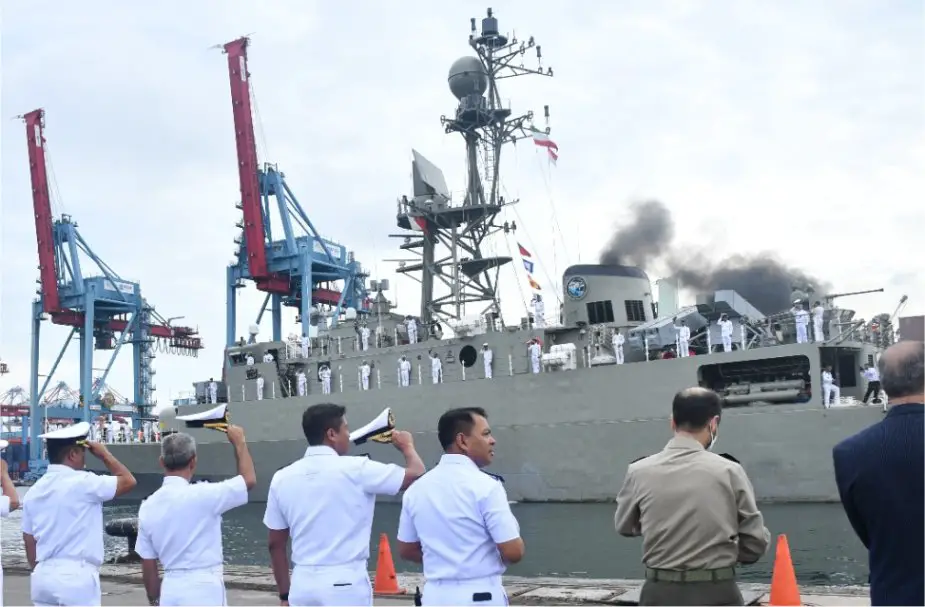
U.S. Submarine Sinks Iranian Warship IRIS Dena Near Sri Lanka — Indian Ocean Becomes Emerging War Zone.
By Paris Telegraph Global Affairs Desk
Date: Thursday, March 5, 2026
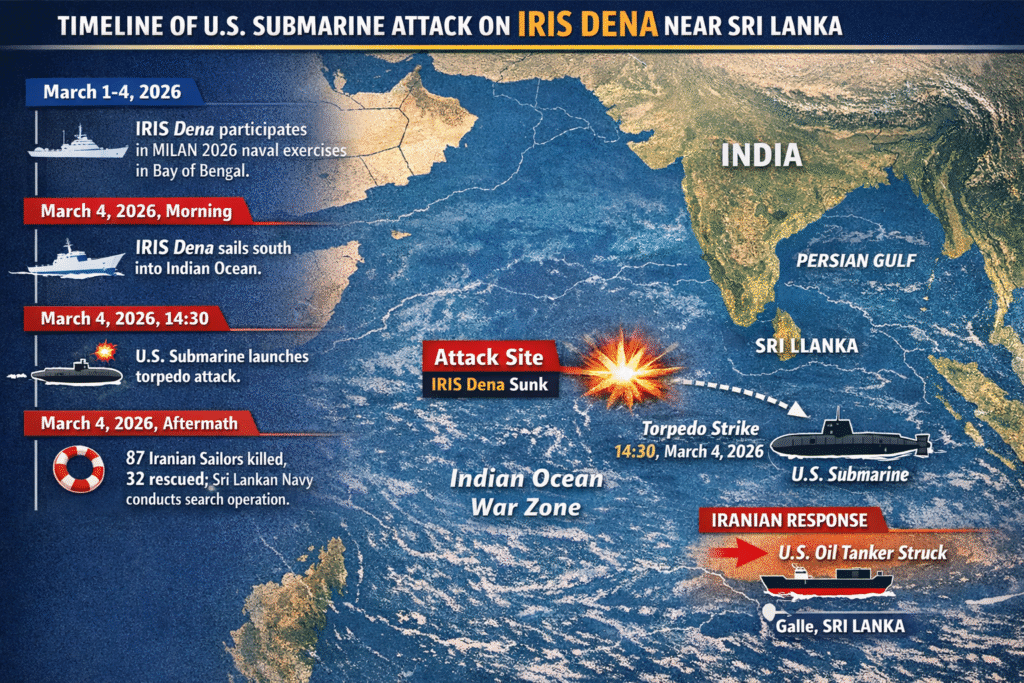
In a dramatic and unprecedented escalation of the ongoing U.S.–Iran war, a United States Navy submarine torpedoed and sank the Iranian naval frigate IRIS Dena in the Indian Ocean on March 4, 2026, around 40 nautical miles south of Galle, Sri Lanka. The incident marks a historic first — the first time a U.S. submarine has sunk an enemy warship with a torpedo in combat since World War II and one of the rare modern instances of submarine warfare at sea.
Attack, Casualties, and Rescue Operations
According to Sri Lankan authorities and international news agencies:
- The frigate, IRIS Dena — an Iranian Navy warship returning from the multinational MILAN 2026 exercises hosted by the Indian Navy in the Bay of Bengal — was struck by a U.S. submarine torpedo while sailing in international waters.
- Sri Lanka’s Navy recovered 87 bodies from the ocean, while 32 sailors were rescued and brought to hospital in Galle; dozens remain missing or unaccounted for as search and rescue operations continue.
- The IRIS Dena reportedly had a complement of around 180 crew members when it was struck.
U.S. Defense Secretary Pete Hegseth confirmed the strike, calling it a precise torpedo attack and noting that the vessel “thought it was safe in international waters” before being hit.
Regional and Strategic Context: Indian Ocean as a War Zone
The sinking of the IRIS Dena is widely viewed as a significant geographic widening of the conflict between the U.S.–Israeli bloc and Iran. Previously, hostilities had been largely centred on the Middle East, particularly in and around the Gulf region. The strike near South Asia’s maritime borders underscores a dangerous expansion of the war into the Indian Ocean, a strategic waterway linking the Middle East, Africa, and Asia.
Analysts say the incident complicates security dynamics across the region:
- India, a key regional partner of the U.S. and neighbor of Sri Lanka, now faces diplomatic pressures over proximity to a major military engagement in its adjacent waters.
- The Indian Ocean, vital for global trade and energy shipments, could see increased naval activity, security alerts, and risk of maritime disruption.
- Iran has threatened retaliation, warning the U.S. will “bitterly regret” the attack, and reportedly struck a U.S. oil tanker in the Persian Gulf in response.
Military experts warn that the move signals a shift toward ocean-wide confrontation, potentially involving other naval powers and risking further escalation around key chokepoints such as the Strait of Hormuz and the Gulf of Aden.
Sri Lanka’s Response and Impact
Although the attack took place outside Sri Lanka’s territorial waters, the island nation is directly entwined in its aftermath:
- Sri Lankan authorities launched search and rescue operations, mobilising naval vessels and aircraft to locate survivors and casualties.
- A second Iranian vessel, reported to be heading toward Sri Lanka’s Exclusive Economic Zone, has raised concerns in Colombo about further risk to sailors and potential diplomatic or security dilemmas.
- Sri Lanka’s government has been careful to maintain neutrality, balancing calls to safeguard lives at sea with the legal and political sensitivities of granting port access to foreign warships amidst active conflict.
Economic and security concerns are emerging domestically:
- Sri Lanka, heavily reliant on maritime trade through the Indian Ocean, could face disruptions if naval hostilities affect shipping lanes.
- The presence of foreign warships near Sri Lankan waters increases the risk of unintended clashes or escalation.
International Legal and Diplomatic Fallout
The attack — occurring in international waters — has triggered debate among international law scholars:
- Critics argue that targeting a warship not actively engaged in hostilities with the U.S. may breach accepted naval engagement rules.
- Supporters point out that enemy naval vessels are lawful military targets during a declared or recognised conflict, even in international waters, provided no neutral state’s territorial waters are violated.
The broader geopolitical reverberations include renewed scrutiny of U.S. naval strategy in the Indo-Pacific, potential alignment shifts among Indian Ocean littoral states, and heightened alertness among maritime trading nations.

Paris Telegraph is an independent France-based digital news platform covering Paris news, French politics, European affairs, global business, diplomacy and artificial intelligence.
Publishing timely reporting and in-depth analysis, Paris Telegraph provides international perspectives on geopolitics, economic developments, technology innovation and cultural trends shaping Europe and the world.
As a growing online media outlet, Paris Telegraph is committed to credible journalism, global insight and forward-looking analysis for readers seeking reliable news from Paris and beyond.