
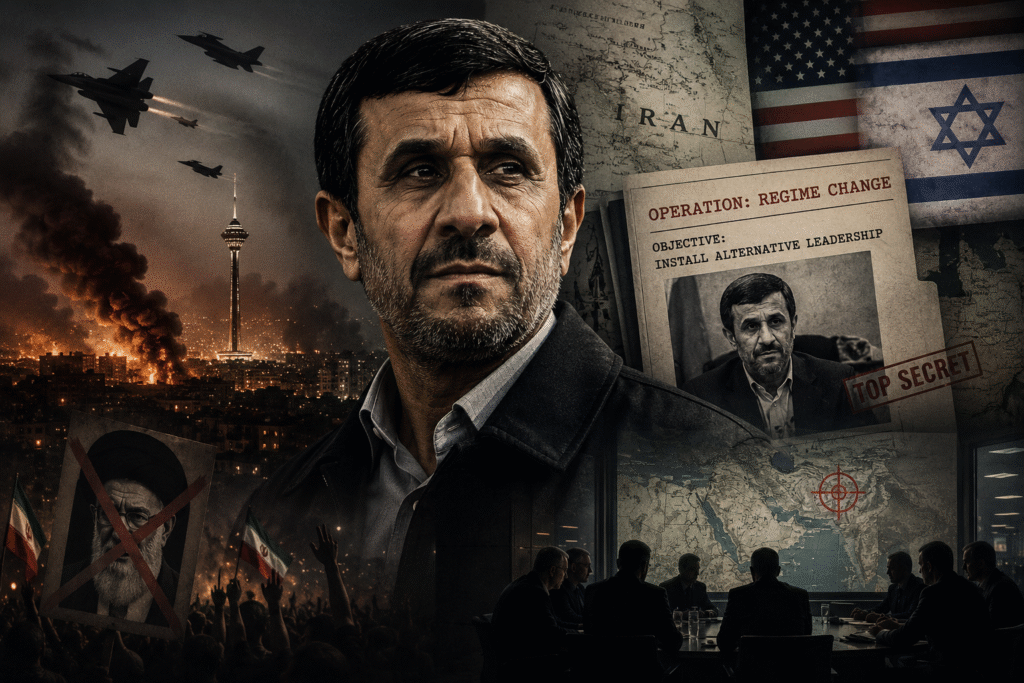
War, Regime Change, and Ahmadinejad: The Untold Story Behind the Iran Conflict
Paris 21/05/2026
Mahmoud Ahmadinejad, once internationally known for his fiery anti-Western rhetoric and uncompromising stance against Israel, has reportedly emerged at the center of one of the most controversial revelations surrounding the recent Iran conflict.
According to an extensive investigation published by The New York Times, early stages of the U.S.-Israeli campaign against Iran allegedly included a covert strategy aimed at engineering regime change in Tehran — with former Iranian President Mahmoud Ahmadinejad positioned as a possible replacement leader.
The report claims that an Israeli strike targeting Ahmadinejad’s residence in Tehran was not intended to eliminate him, but rather to free him from what officials described as effective house arrest imposed by Iranian authorities. U.S. officials cited in the report suggested the broader objective was to destabilize Iran’s ruling structure and install an alternative administration viewed as capable of managing a post-war transition.
Ahmadinejad, who served as Iran’s president between 2005 and 2013, had long been viewed internationally as a hard-line figure. During his presidency, he became infamous for inflammatory remarks against Israel, his criticism of the United States, and his support for Iran’s nuclear ambitions. Yet in recent years, tensions between Ahmadinejad and Iran’s clerical establishment reportedly deepened, leading to political isolation and increasing restrictions on his movements.
The alleged plan, according to the investigation, formed part of a broader multi-phase strategy envisioned by Israeli planners. Beyond military strikes, the campaign reportedly sought to trigger internal instability, weaken the Iranian leadership structure, and pave the way for a new governing authority.
However, the operation appears to have failed to achieve its political objectives. Ahmadinejad reportedly survived the strike but became disillusioned with the plan afterward. Since then, his public appearances have ceased, fueling speculation regarding his condition and whereabouts.
The report also underscores growing debate over the true objectives behind the conflict. While public statements from Washington emphasized military and nuclear targets, critics argue the revelations point toward a far more ambitious geopolitical agenda involving direct intervention in Iran’s internal political future.
Neither Israeli intelligence officials nor Iranian authorities have formally confirmed the allegations.
international News Desk

Paris Telegraph is an independent France-based digital news platform covering Paris news, French politics, European affairs, global business, diplomacy and artificial intelligence.
Publishing timely reporting and in-depth analysis, Paris Telegraph provides international perspectives on geopolitics, economic developments, technology innovation and cultural trends shaping Europe and the world.
As a growing online media outlet, Paris Telegraph is committed to credible journalism, global insight and forward-looking analysis for readers seeking reliable news from Paris and beyond.