
Middle East at a Turning Point: US and Iran Announce Landmark 14-Point Pact
By Paris Telegraph International News Desk
Published: 18 June 2026
The 14-Point US-Iran Pact: Historic Breakthrough or Risky Gamble?
The United States and Iran have released details of a controversial 14-point Memorandum of Understanding (MoU) that could reshape the geopolitical landscape of the Middle East.
Presented by American officials as an interim framework intended to halt military confrontation and create a pathway toward a comprehensive settlement, the agreement has already generated strong reactions from allies, critics and regional actors.
Although Washington describes the memorandum as a major diplomatic success, opponents argue that it grants Tehran substantial concessions without obtaining sufficient guarantees on its nuclear ambitions and regional influence.
What is the 14-point agreement?
According to documents released by U.S. officials, the pact establishes a temporary framework while negotiators seek a broader and legally binding settlement within sixty days.
The memorandum reportedly emerged from months of indirect negotiations facilitated by Pakistan, Switzerland and Gulf intermediaries.
Among its central objectives are ending military hostilities, reopening critical maritime routes, reviving economic activity and restarting discussions on Iran’s nuclear programme.
The agreement is expected to be followed by intensive negotiations beginning in Switzerland.
The key provisions
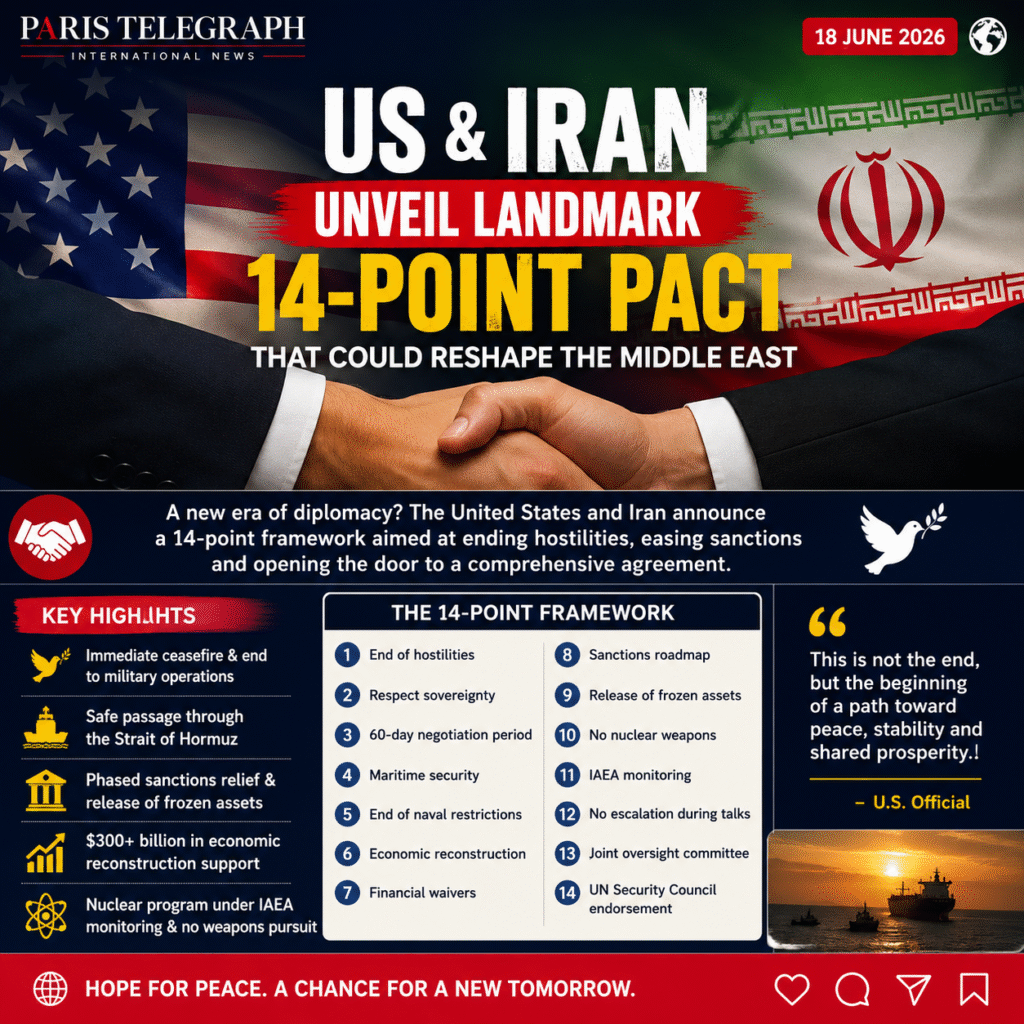
The fourteen points outlined by U.S. officials include:
1. Immediate cessation of military operations
Both sides commit to ending hostilities across all theatres of conflict, including Lebanon and surrounding regions.
2. Respect for sovereignty
Washington and Tehran pledge to refrain from interference in each other’s domestic affairs.
3. Sixty-day negotiating period
A final agreement addressing unresolved issues must be completed within two months.
4. Maritime security
Iran agrees to guarantee safe passage for commercial shipping through the Strait of Hormuz.
5. Removal of naval restrictions
The United States would gradually end its naval blockade and reduce military deployments near Iranian territory.
6. Economic reconstruction support
Washington proposes assistance packages estimated at more than $300 billion for Iran’s economic recovery.
7. Financial waivers
American authorities would issue licences permitting specific banking transactions.
8. Sanctions roadmap
Both countries would negotiate the phased removal of U.S., international and United Nations sanctions.
9. Frozen assets
Iranian assets currently restricted abroad may be released under an agreed mechanism.
10. Nuclear commitments
Iran reiterates that it will not pursue nuclear weapons.
11. International monitoring
The International Atomic Energy Agency would oversee implementation measures concerning nuclear materials.
12. No escalation during talks
Iran would avoid expanding uranium enrichment activities while Washington would refrain from imposing new sanctions.
13. Executive oversight mechanism
A joint committee would supervise implementation of the memorandum.
14. United Nations endorsement
A final settlement would eventually be endorsed through a binding United Nations Security Council resolution.
A dramatic shift in U.S. policy
For decades, successive American administrations demanded severe restrictions on Iran’s nuclear activities and maintained extensive sanctions.
The latest memorandum appears to represent a significant policy adjustment.
Unlike previous proposals, the agreement reportedly recognises Iran’s right to civilian uranium enrichment under strict monitoring arrangements.
Another notable omission concerns Iran’s ballistic missile programme.
Current drafts suggest missile development and Tehran’s support for allied armed groups may remain outside the scope of final negotiations.
That position has alarmed several American lawmakers and foreign policy analysts.
Critics argue that Tehran could preserve important strategic capabilities while obtaining extensive economic benefits.
Supporters counter that securing an immediate reduction in regional tensions should take precedence over attempting to resolve every dispute simultaneously.
Strategic importance of the Strait of Hormuz
One of the most consequential aspects of the memorandum concerns the Strait of Hormuz.
Nearly one-fifth of global oil supplies pass through the narrow waterway connecting the Persian Gulf to international markets.
Shipping disruptions during previous confrontations contributed to spikes in energy prices and increased insurance costs for commercial vessels.
Iran’s commitment to guarantee unrestricted maritime transit could provide reassurance to international traders and energy importers.
Financial markets have closely monitored developments, viewing the reopening of shipping lanes as essential for global economic stability.
Nuclear issue remains unresolved
Despite optimistic statements from negotiators, the most sensitive issue remains unresolved.
Iran continues to possess significant quantities of enriched uranium accumulated during years of suspended diplomacy.
The memorandum does not specify how existing stockpiles will be dismantled, exported or diluted.
Instead, negotiators are expected to determine technical arrangements during the upcoming sixty-day talks.
Officials insist that any final settlement must include transparent verification procedures and long-term monitoring.
Analysts caution that disagreements over enrichment levels and disposal mechanisms could still derail the process.
Domestic opposition in Washington
Reaction within the United States has been sharply divided.
Some Republican lawmakers have criticised the memorandum as excessively generous.
Several conservative figures compared it with the 2015 nuclear agreement negotiated during the Obama administration.
Opponents argue that sanctions relief and reconstruction assistance should only follow permanent dismantlement of Iran’s sensitive nuclear infrastructure.
Others, however, believe diplomacy offers the best opportunity to avoid another prolonged military conflict in the Middle East.
Energy companies, shipping firms and international investors have also welcomed signs of de-escalation.
Tehran claims diplomatic victory
Iranian officials have portrayed the agreement as evidence that pressure from years of confrontation forced Washington to change course.
State media emphasised provisions related to sanctions relief, economic reconstruction and recognition of Iran’s peaceful nuclear rights.
Government representatives insist the agreement protects national sovereignty while creating opportunities for economic revival.
Yet observers inside Iran note that expectations among ordinary citizens remain cautious.
Years of sanctions, inflation and political instability have generated scepticism about whether promised benefits will materialise.
What happens next?
Negotiators are expected to meet in Switzerland within days to begin drafting a comprehensive settlement.
Failure to achieve consensus within sixty days could reopen disputes over sanctions, maritime security and nuclear compliance.
Success, however, would represent one of the most significant diplomatic breakthroughs between Washington and Tehran in decades.
For now, the memorandum should be viewed as a framework rather than a final peace treaty.
Its implementation depends on political will, technical negotiations and sustained international support.
Whether the 14-point pact becomes a milestone for regional stability or another unrealised diplomatic initiative will depend largely on the difficult negotiations that lie ahead.
This article is based on information released by U.S. officials and reports from international news agencies. Several provisions remain subject to revision pending final negotiations.

Paris Telegraph is an independent France-based digital news platform covering Paris news, French politics, European affairs, global business, diplomacy and artificial intelligence.
Publishing timely reporting and in-depth analysis, Paris Telegraph provides international perspectives on geopolitics, economic developments, technology innovation and cultural trends shaping Europe and the world.
As a growing online media outlet, Paris Telegraph is committed to credible journalism, global insight and forward-looking analysis for readers seeking reliable news from Paris and beyond.