
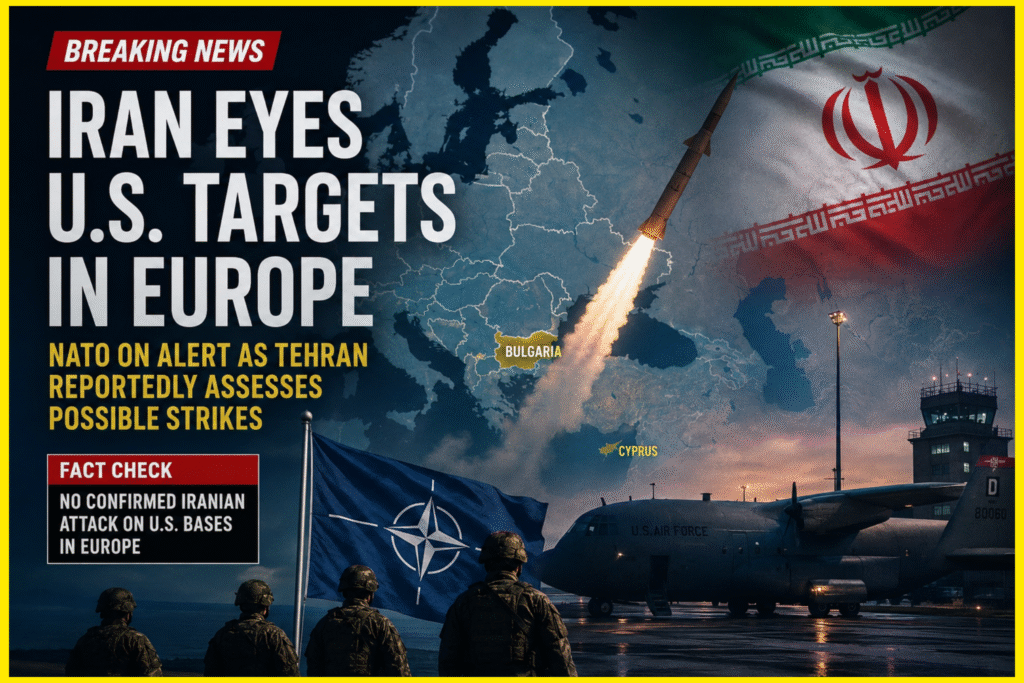
Iran Reportedly Considers Strikes on US Military Targets in Europe as NATO Warns It Is Ready to Defend Allies
By Paris Telegraph News Desk
20 August 2026
Iran is reportedly considering the possibility of expanding its confrontation with the United States beyond the Middle East by targeting U.S.-linked military assets in southeastern Europe if Washington significantly escalates military operations against Tehran.
The assessment was reported by the Financial Times, which cited people described as being close to Iran’s leadership. According to the report, Iranian officials have discussed potential military responses that could include U.S. military facilities in countries such as Bulgaria and Cyprus.
The report has raised concerns about the possibility of the conflict acquiring a wider European dimension.
However, one distinction is critical: there is no credible evidence at present that Iran has launched a new attack on a U.S. military base in Europe.
The information currently available concerns reported Iranian contingency planning and the assessment of possible targets. It should not be presented as confirmation that Tehran has ordered or is about to carry out an attack.
What is Iran reportedly considering?
According to the Financial Times, Iranian planners have assessed potential targets connected to U.S. military operations in southeastern Europe.
Bulgaria has attracted particular attention because Sofia recently authorised the temporary deployment of U.S. KC-135 aerial-refuelling aircraft and American personnel at Bezmer Air Base to support U.S. military operations in the Middle East.
In July, the Bulgarian parliament approved the temporary deployment of up to eight U.S. KC-135 tanker aircraft and up to 250 personnel at Bezmer. The arrangement is scheduled to run from July 24 until October 1. Bulgarian authorities have stressed that no offensive weapons would be deployed and that Bulgaria would not become a participant in offensive military operations. (Reuters)
Iran has strongly objected to the arrangement.
On July 30, Iranian Foreign Minister Abbas Araghchi urged his Bulgarian counterpart to reconsider the decision, arguing that allowing U.S. aircraft to operate from Bulgarian territory could facilitate military action against Iran.
Araghchi also raised concerns about foreign military facilities in Cyprus during a separate conversation with Cypriot Foreign Minister Constantinos Kombos. Reuters reported that Tehran warned countries allowing their territory to be used for U.S. military operations that they could face consequences. (Reuters)
The Financial Times report now places those earlier warnings in the context of reported Iranian contingency planning.
Crucially, however, the report does not establish that Iran has ordered an attack or that an attack against a European military facility is imminent. (Financial Times)
NATO and the European security concern
The possibility of Iranian retaliation against U.S.-linked military infrastructure in Europe raises a particularly sensitive question for NATO.
Several European countries host U.S. military personnel, aircraft, logistics facilities or other infrastructure supporting American and allied operations.
An attack against a U.S. installation located on the territory of a NATO member could therefore create a serious escalation risk, particularly if the attack caused casualties or damage to military infrastructure.
NATO has previously demonstrated its concern over Iranian missile activity affecting alliance territory. During the current conflict, Iranian missiles have been directed toward Türkiye, a NATO member, prompting allied air-defence responses.
But it is important not to confuse NATO’s readiness to respond to threats with confirmation that an Iranian attack against a European base is underway.
There is currently no confirmed report of a new Iranian missile or drone strike against a U.S. base in Bulgaria, Romania, Greece or another European NATO country.
Why Bulgaria matters
Bulgaria’s Bezmer Air Base has become strategically significant because of the temporary U.S. deployment.
The Bulgarian parliament approved the arrangement by a vote of 136 to 13, with two abstentions, allowing up to eight U.S. KC-135 refuelling aircraft and approximately 250 American personnel to operate from the facility.
The aircraft are intended to provide aerial-refuelling support rather than conduct offensive operations from Bulgarian territory.
Bulgarian officials have repeatedly sought to reassure the public that the arrangement does not make Bulgaria a direct participant in the U.S.-Iran conflict. (Reuters)
Tehran nevertheless views the presence of American military aircraft differently.
Iranian officials have warned European governments against allowing their territory or military facilities to support American operations against Iran.
The warnings have become increasingly significant as Washington and Tehran remain locked in a broader military confrontation.
Why Cyprus is also significant
Cyprus occupies a strategically important position in the eastern Mediterranean.
The island hosts two British Sovereign Base Areas, including RAF Akrotiri, which has long been an important British military facility for operations and logistical support in the region.
The base has already been drawn into the conflict.
Reuters reported that RAF Akrotiri was struck by an Iranian drone in early March, following the launch of U.S. and Israeli military operations against Iran. Britain has also allowed the United States to use British bases for certain defensive operations against Iranian missile threats. (Reuters)
Iran has subsequently warned Britain against facilitating U.S. military operations against Tehran.
This makes Cyprus particularly sensitive to any further escalation.
A future Iranian attack on Western military infrastructure on the island could potentially create a wider diplomatic and military crisis involving Iran, Britain, Cyprus and the United States.
Iran’s broader retaliation strategy
The latest European reports come against the backdrop of a wider escalation in the U.S.-Iran confrontation.
Tehran has repeatedly warned countries that allow their territory to be used in American military operations that they could face consequences.
The warnings to Bulgaria and Cyprus in July were therefore not isolated diplomatic statements. They formed part of a broader Iranian effort to pressure European governments to prevent their territory and military facilities from being used against Iran. (Reuters)
The Financial Times report suggests that Iranian officials are now considering what a wider military response could look like if the United States significantly intensifies its campaign.
That could potentially move the geographical focus of the conflict beyond the Middle East.
However, considering a military option is not the same as authorising an attack.
Military and intelligence officials routinely examine potential targets and possible responses without those options necessarily being approved for execution.
Could Iran attack a NATO country?
The possibility cannot be completely dismissed, but it remains uncertain.
An Iranian strike against a U.S. military installation situated on the territory of a NATO member would carry potentially serious consequences.
Bulgaria, Romania, Greece and Türkiye are NATO members. An attack affecting one of these countries could place enormous pressure on the alliance to determine how to respond.
That possibility creates a significant deterrent for all sides.
Iran would have to consider the risk that an attack against a NATO member could transform a bilateral U.S.-Iran confrontation into a much broader international crisis.
For European governments, meanwhile, the immediate concern is protecting military personnel and infrastructure while avoiding actions that could unnecessarily widen the conflict.
Fact-check: Has Iran already attacked U.S. bases in Europe?
CLAIM: Iran has launched a surprise attack against U.S. bases in Europe.
VERDICT: UNCONFIRMED / MISLEADING
There is currently no credible confirmation that Iran has launched a new attack against U.S. military bases in Europe.
What has been reported is that Iranian officials have considered or assessed possible attacks against U.S.-linked military targets in southeastern Europe in the event of further U.S. escalation.
Bulgaria and Cyprus have been specifically identified in reporting because of their strategic military facilities and their connection to U.S. or Western military operations. (Financial Times)
Therefore, the headline:
“Iran launches surprise attack on U.S. bases in Europe”
would be premature and potentially misleading.
A more accurate headline would be:
“Iran Reportedly Considers Strikes on U.S. Military Targets in Europe as Regional Conflict Escalates”
What happens next?
The key question is whether Washington and Tehran move toward further military escalation or return to diplomacy.
If the United States significantly expands its military operations against Iran, the possibility of Iranian retaliation against U.S.-linked infrastructure outside the Middle East could become more significant.
If diplomatic efforts resume and tensions decrease, the reported European options could remain contingency plans rather than becoming operational military actions.
European governments are therefore likely to closely monitor Iranian statements, U.S. military movements, intelligence assessments and the security situation around facilities hosting American or allied forces.
For NATO and European capitals, the challenge is to prepare for possible retaliation without treating a reported contingency plan as an inevitable attack.
Paris Telegraph assessment
The latest reporting marks a potentially important development in the U.S.-Iran confrontation.
For European governments, the significance lies not in evidence of an imminent Iranian attack, but in the possibility that European military infrastructure could become part of Tehran’s retaliation calculations if the conflict expands.
Iran’s previous warnings to Bulgaria and Cyprus demonstrate that Tehran is already closely watching the use of European territory in support of U.S. military operations. (Reuters)
The Financial Times report adds another layer by indicating that Iranian officials have reportedly assessed potential military targets in southeastern Europe. (Financial Times)
But responsible reporting requires a clear distinction between threats, contingency planning and confirmed military action.
At this stage, the evidence supports reporting that Iran has reportedly considered possible strikes against U.S.-linked military assets in Europe.
It does not support the claim that Iran has already launched a surprise attack on U.S. bases in Europe.
Paris Telegraph will continue to monitor developments and update this report if NATO, European governments, the United States or Iran provide further official confirmation.
Sources
- Financial Times — reporting on Iranian consideration of potential military targets in southeastern Europe. (Financial Times)
- Reuters — reporting on Iranian warnings to Bulgaria and Cyprus over the use of military facilities for U.S. operations. (Reuters)
- Reuters/AP — reporting on Bulgaria’s approval of the temporary U.S. KC-135 deployment at Bezmer Air Base. (Reuters)
Editorial note: I would publish this version rather than the original draft because it avoids turning an intelligence/reporting claim into a statement of fact. The strongest verified point is that Iran has already warned Bulgaria and Cyprus about U.S./Western military use of facilities there, while the newer Financial Times reporting says Iranian officials have reportedly considered potential targets in southeastern Europe.

Paris Telegraph is an independent France-based digital news platform covering Paris news, French politics, European affairs, global business, diplomacy and artificial intelligence.
Publishing timely reporting and in-depth analysis, Paris Telegraph provides international perspectives on geopolitics, economic developments, technology innovation and cultural trends shaping Europe and the world.
As a growing online media outlet, Paris Telegraph is committed to credible journalism, global insight and forward-looking analysis for readers seeking reliable news from Paris and beyond.