
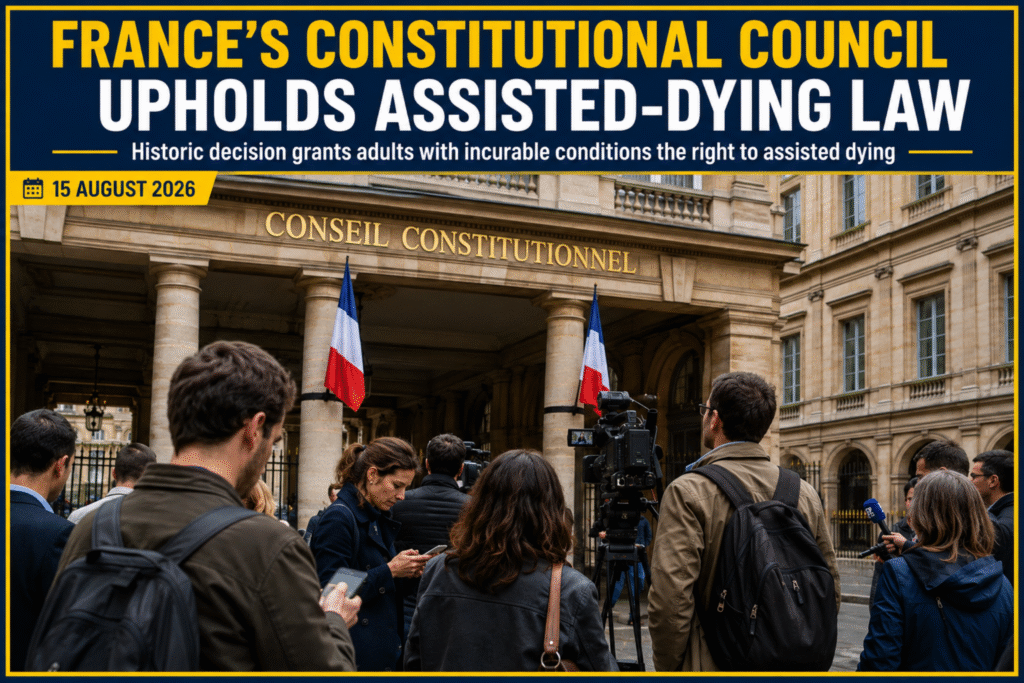
France’s Constitutional Council Upholds Assisted-Dying Law
Paris, 15 August 2026
France has taken a historic step in its approach to end-of-life care after the country’s highest constitutional authority upheld the legislation creating a legal right to assisted dying for certain adults suffering from a serious and incurable illness.
The Constitutional Council ruled on Friday, 14 August, that the legislation adopted by Parliament on 15 July 2026 is compatible with the French Constitution. The decision clears the main constitutional obstacle to the implementation of the new assisted-dying framework. (Le Monde.fr)
The legislation follows years of political and public debate over end-of-life rights, personal freedom, medical ethics and the protection of vulnerable people.
Who will be eligible?
The new framework does not establish a general or unconditional right to die. Access is restricted to people who meet a series of cumulative legal and medical conditions.
Under the legislation, an applicant must:
- Be at least 18 years old.
- Be a French national or have stable and regular residence in France.
- Have a serious and incurable illness that places their life expectancy at risk and is at an advanced or terminal stage.
- Experience physical or psychological suffering connected to the illness that is either resistant to treatment or considered unbearable by the patient in circumstances where they have chosen not to receive or have stopped treatment.
- Be capable of expressing a free and informed decision. (National Assembly)
The procedure is therefore designed as a tightly regulated medical and legal process rather than an unrestricted right to assisted death.
How will the procedure work?
A doctor must initially assess whether the patient meets the legal conditions. The request is then subject to a wider professional assessment before the final medical decision is made.
The patient retains the right to withdraw their request during the process.
Where the procedure is authorised, the person will generally administer the lethal substance themselves. An exception exists for people who are physically unable to do so, in which case a healthcare professional may assist. (NovaNews)
The framework is intended to ensure that the decision is voluntary, informed and medically assessed.
Constitutional Council adds important safeguards and clarifications
Although the Constitutional Council upheld the law, it clarified several provisions that will affect how the legislation is implemented.
First, when a person under legal guardianship requests assisted dying, the doctor must take the guardian’s opinion into account, although the doctor is not automatically bound by that opinion.
Second, the Council recognised a conscience clause for pharmacists, meaning pharmacists can refuse to prepare the substance on grounds of conscience.
Third, private and non-profit healthcare and social-medical institutions may, under specified circumstances, refuse to allow assisted dying to take place on their premises. However, safeguards are intended to prevent such refusals from leaving eligible patients without access to the procedure. (Le Monde.fr)
A major change in French end-of-life policy
The ruling places France alongside a growing group of countries that have introduced forms of assisted dying, including Belgium, the Netherlands, Switzerland and Canada.
The decision is also a political victory for President Emmanuel Macron, who had made end-of-life legislation one of his major reform commitments.
The French government and supporters of the legislation welcomed the Constitutional Council’s decision as the conclusion of a lengthy democratic and parliamentary process. (Al Jazeera)
However, the debate is unlikely to disappear. Supporters argue that the law strengthens personal autonomy and allows people facing unbearable suffering to have greater control over the final stage of their lives. Opponents continue to raise concerns about the protection of vulnerable people, medical ethics and the potential expansion of eligibility over time.
What happens next?
The Constitutional Council’s decision removes the principal constitutional barrier to the legislation. The law still requires the necessary implementing measures and regulations before the new system can become fully operational.
The government is therefore expected to continue preparing the administrative and medical framework required for healthcare professionals and institutions to apply the new rules.
France is now entering a new phase in its long-running debate over how the state, medical profession and society should respond to serious illness, unbearable suffering and the end of life.
Paris Telegraph News Desk

Paris Telegraph is an independent France-based digital news platform covering Paris news, French politics, European affairs, global business, diplomacy and artificial intelligence.
Publishing timely reporting and in-depth analysis, Paris Telegraph provides international perspectives on geopolitics, economic developments, technology innovation and cultural trends shaping Europe and the world.
As a growing online media outlet, Paris Telegraph is committed to credible journalism, global insight and forward-looking analysis for readers seeking reliable news from Paris and beyond.