
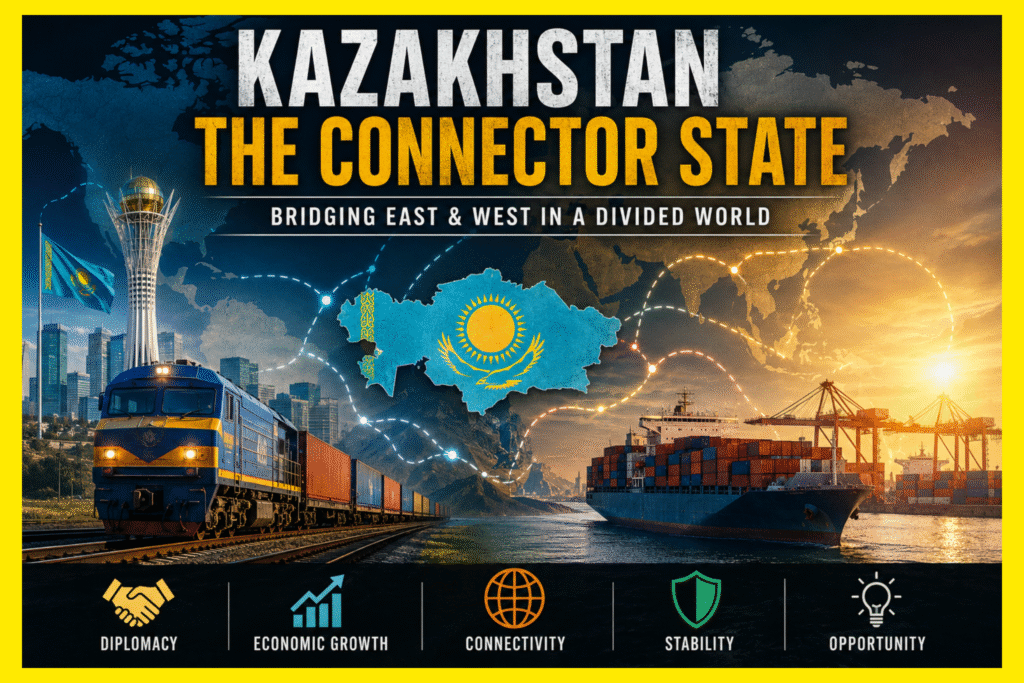
Kazakhstan’s Eurasian Gambit: Can Astana Turn Geography Into Global Influence?
By Paris Telegraph International Affairs Desk
August 23, 2026 | ASTANA
Kazakhstan’s Eurasian Gambit: Can Astana Turn Geography Into Global Influence?
ASTANA — Kazakhstan is standing at a defining moment.
As global power competition reshapes trade routes, energy markets and diplomatic alliances, the Central Asian state is attempting to transform one of its greatest geographical advantages — its position between major powers and markets — into something more consequential: political influence, economic connectivity and diplomatic relevance.
The question confronting Astana is no longer simply how Kazakhstan can benefit from its location.
It is whether the country can become a connector state with influence of its own, rather than remaining a territory through which competing powers move goods, energy and strategic interests.
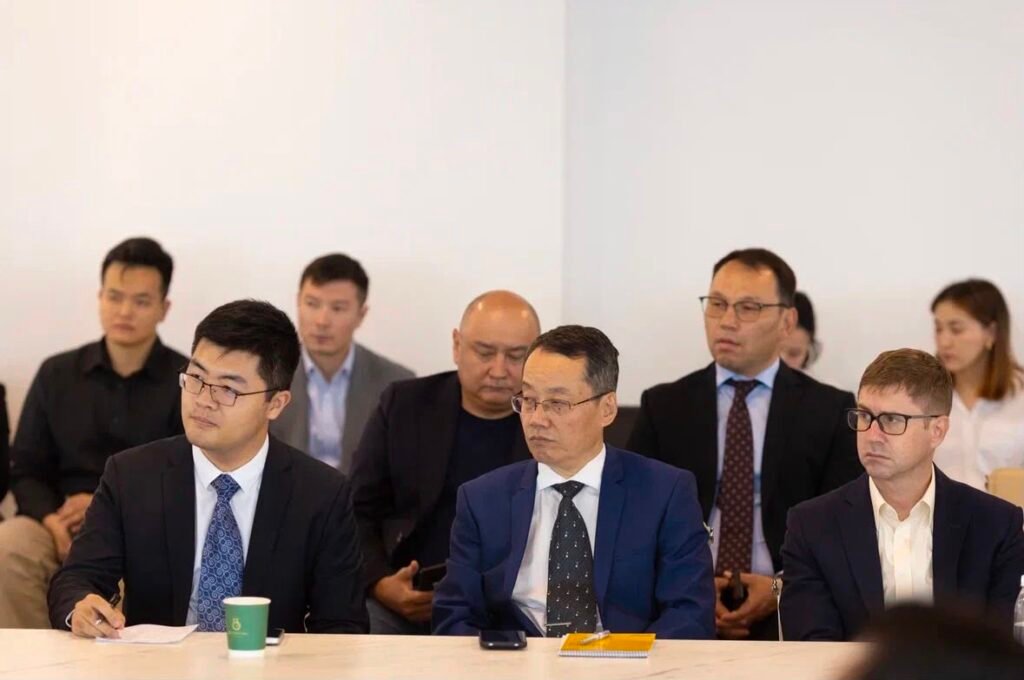
That question was central to an expert discussion in Astana on August 21 titled “Kazakhstan and the New Eurasian Landscape: Strategic Partnerships, Connectivity and Economic Opportunities.”

The event was organised by the CFive Intellectual Platform at Astana International University in cooperation with the Hudson Institute.
The meeting brought together diplomats, former ambassadors, government officials, international experts, business representatives and academics for a discussion that extended beyond transport corridors and energy exports.
At its heart was a larger question: what role can Kazakhstan play in the emerging architecture of Eurasia?

A New Eurasia Is Taking Shape
For much of the post-Soviet period, Central Asia was often viewed primarily through the prism of its relationship with Russia and China.
That picture is changing.
The region is increasingly important to global trade because of its energy and mineral resources, expanding consumer markets, strategic location and potential to support alternative supply chains between Asia and Europe.
The war in Ukraine and wider geopolitical competition have accelerated interest in alternative transport and logistics networks.
For Kazakhstan, this has created an opportunity.
The country sits at the centre of several emerging corridors connecting China with the Caspian Sea, the South Caucasus and European markets.
Among the most important is the Trans-Caspian International Transport Route, widely known as the Middle Corridor.
But Kazakhstan’s strategic opportunity goes beyond one railway or shipping route.
Energy infrastructure, Caspian connectivity, logistics, manufacturing and possible future links involving Afghanistan and Pakistan could gradually create a broader Eurasian network.
Ken Moriyasu, Senior Fellow at the Hudson Institute, described Kazakhstan as an increasingly important “swing state” as competition between the United States and China intensifies.
For Astana, however, the challenge is clear.
Will Kazakhstan simply become a major transit country — or can it turn connectivity into long-term economic and political leverage?
From Transit Route to Connector State
Infrastructure alone does not create geopolitical influence.
Kazakhstan’s ability to maintain relationships with countries that do not necessarily share the same strategic interests may prove to be one of its most valuable assets.
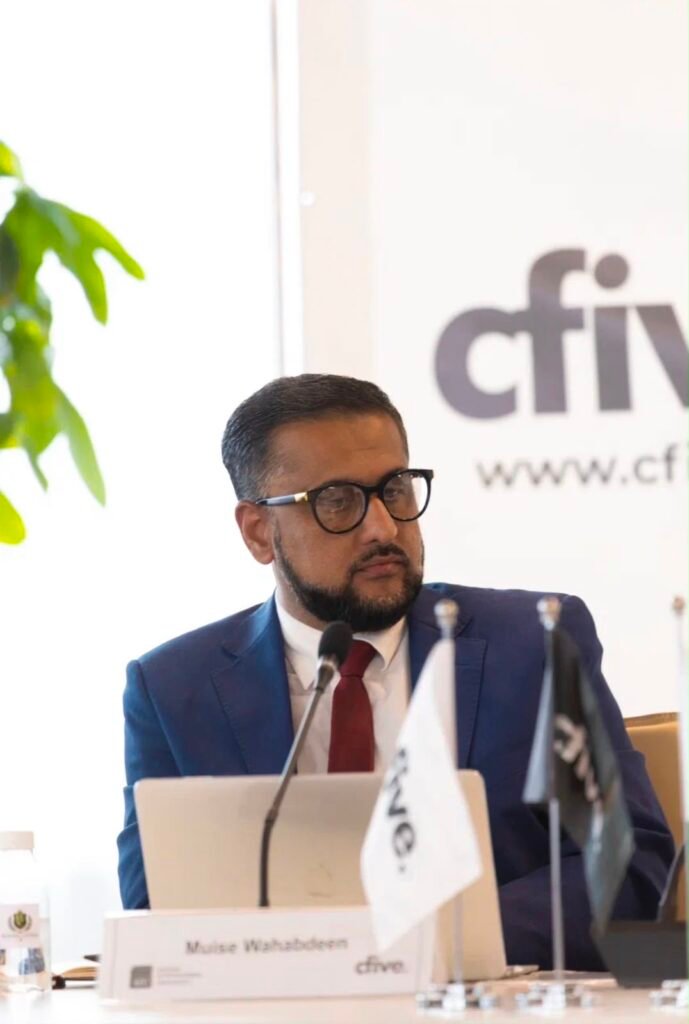
Muise Wahabdeen, an expert at the Geneva Nations Institute, highlighted Kazakhstan’s ability to maintain working relationships across a complicated international environment.
That approach could allow Astana to position itself not simply as a geographical bridge but as a platform where capital, expertise, diplomacy and international partnerships intersect.
This matters because Central Asia is becoming an increasingly crowded diplomatic space.
Russia remains a major regional actor. China is expanding its economic footprint. The European Union is seeking deeper connectivity and access to critical raw materials. The United States continues to pursue engagement, while Türkiye and Middle Eastern states are also strengthening their relationships with the region.
Kazakhstan’s strategy is therefore based less on choosing one camp than on maintaining room to work with several.
That balancing act may become one of the country’s most important forms of strategic capital.
Diplomacy as Kazakhstan’s Strategic Asset
Kazakhstan’s multi-vector foreign policy is not new.
But the changing international environment is making it increasingly valuable.
Bulat Sarsenbayev, a diplomat and former Ambassador Extraordinary and Plenipotentiary of Kazakhstan, emphasised the importance of assessing geopolitical developments through Kazakhstan’s own national interests and those of Central Asia.
The principle is straightforward: greater diversification of diplomatic relationships can provide greater strategic autonomy.
President Kassym-Jomart Tokayev’s international diplomatic experience, including his work within the United Nations system and in Geneva, is also part of this broader diplomatic narrative.
For Kazakhstan, multilateral diplomacy is not simply about international visibility.
It can provide the ability to maintain dialogue when relations between major powers become increasingly difficult.
In a fragmented international system, the capacity to communicate with different sides can itself become an asset.
Kazakhstan’s Domestic Transformation
But Kazakhstan’s international ambitions face another test — at home.
A country cannot convincingly promote itself as a modern investment and diplomatic centre without addressing the quality of its domestic institutions.
This is why Kazakhstan’s constitutional reforms matter beyond its borders.
The new Constitution entered into force on July 1, 2026, replacing the previous constitutional framework and ending the previous bicameral parliamentary system. Under the new Constitution, the Kurultai became the country’s highest representative body exercising legislative power. It consists of 145 deputies, elected for five-year terms through proportional representation in a single nationwide constituency. (Adilet)

Today, August 23, 2026, Kazakhstan is holding the first elections to the new Kurultai.
The vote therefore represents more than a parliamentary election.
It is the first major test of the country’s new institutional architecture.
The Central Election Commission said seven political parties registered candidate lists for the election, with 545 candidates competing for 145 seats. (Election.kz)
The Kurultai Election: Reform or Concentration of Power?
The significance of today’s vote extends beyond the formation of a new legislature.
Supporters of the constitutional changes describe the new system as part of Kazakhstan’s political modernisation.
Critics, however, argue that the reforms could strengthen presidential authority rather than substantially expand political competition. International reporting has highlighted concerns over the concentration of power and the limited prospects for a major shift in the political balance. (AP News)
That tension will be important in assessing Kazakhstan’s next phase.
The real test of reform will not be the constitutional text alone.
It will be how the new institutions operate.
Will the Kurultai develop meaningful legislative independence? Will political competition become more substantive? Will parliamentary oversight become more effective? And will citizens see the new system as a genuine expansion of political participation?
Those questions will ultimately determine the international credibility of Kazakhstan’s reform agenda.
Why the Election Matters to Investors
Political reform and economic policy are increasingly connected.
For international investors, Kazakhstan’s attraction is not limited to oil, uranium, minerals, transport routes or market access.
Investors also look for predictable institutions, regulatory stability, transparency and confidence that economic rules will remain reliable over the long term.
Kazakhstan is therefore attempting to present political modernisation and economic development as two sides of the same strategy.
If the new institutional system proves effective, it could strengthen the country’s reputation as one of Central Asia’s most important economic and political centres.
But credibility will depend on implementation.
Energy Still Matters

The Eurasian transformation cannot be understood without energy.
Despite the rapid growth of renewable energy and the global push toward decarbonisation, conventional energy resources remain strategically important.
Abzal Narymbetov, an energy-sector expert and founder and CEO of Energy Analytics, emphasised the continuing importance of traditional energy resources while pointing to the need for Kazakhstan to strengthen and diversify its export routes.
The Caspian Sea is central to that strategy.
Kazakhstan’s energy position, combined with expanding transport infrastructure, could help the country strengthen connections between Central Asia, the Caucasus and European markets.
At the same time, potential developments involving Turkmenistan, Afghanistan and Pakistan could eventually broaden the region’s economic geography.
The outcome could be a Central Asia that is not merely a source of raw materials but an increasingly important energy and trade crossroads between East and West.
The Bigger Eurasian Picture
Kazakhstan’s challenge is therefore multidimensional.
Its geography gives it opportunity.
Its resources give it economic weight.
Its diplomacy gives it room to manoeuvre.
But institutions will determine whether those advantages can be converted into lasting national power.
That is the central strategic question facing Astana.
A country surrounded by major powers cannot control the direction of global geopolitics.
But it can attempt to ensure that its own national interests remain relevant to all sides.
That is the logic behind Kazakhstan’s emerging role as a connector state.
The August 23 election is only the beginning of Kazakhstan’s new political experiment.
The more important story will unfold after the votes are counted.
The performance of the Kurultai, the credibility of political competition, the direction of economic reforms and Kazakhstan’s ability to maintain balanced relationships with competing global powers will determine whether the country can turn its current opportunities into durable influence.
The stakes extend beyond Kazakhstan.
For the European Union, Kazakhstan represents a potential partner in energy, critical minerals, logistics and connectivity.
For China, it remains a vital link between the Chinese economy and wider Eurasian markets.
For Russia, Kazakhstan remains an important neighbour and economic partner.
For the United States, Kazakhstan offers one of the region’s most significant opportunities for strategic engagement.
And for Central Asia itself, Kazakhstan’s trajectory could influence how the entire region navigates an increasingly competitive international environment.
Kazakhstan may never become a superpower.
It does not need to.
Its more realistic ambition may be something different — to become indispensable as a bridge between competing centres of power.
If Astana can combine effective domestic institutions, economic diversification, strategic connectivity and credible diplomacy, its geographical position could become far more than a location on the map.
It could become a source of national influence.
In the new Eurasia, Kazakhstan’s greatest power may not be choosing which side to join — but becoming important enough that every side wants to stay connected.

Paris Telegraph is an independent France-based digital news platform covering Paris news, French politics, European affairs, global business, diplomacy and artificial intelligence.
Publishing timely reporting and in-depth analysis, Paris Telegraph provides international perspectives on geopolitics, economic developments, technology innovation and cultural trends shaping Europe and the world.
As a growing online media outlet, Paris Telegraph is committed to credible journalism, global insight and forward-looking analysis for readers seeking reliable news from Paris and beyond.