

A Hindu Temple Rises Near Paris: How France’s Laïcité Allows a New Place of Worship
Bussy-Saint-Georges, France — August 26, 2026
France prepares to welcome its first traditionally designed purpose-built Hindu temple as the BAPS Swaminarayan Hindu Mandir prepares for inauguration in September
A remarkable new landmark is taking shape east of Paris.
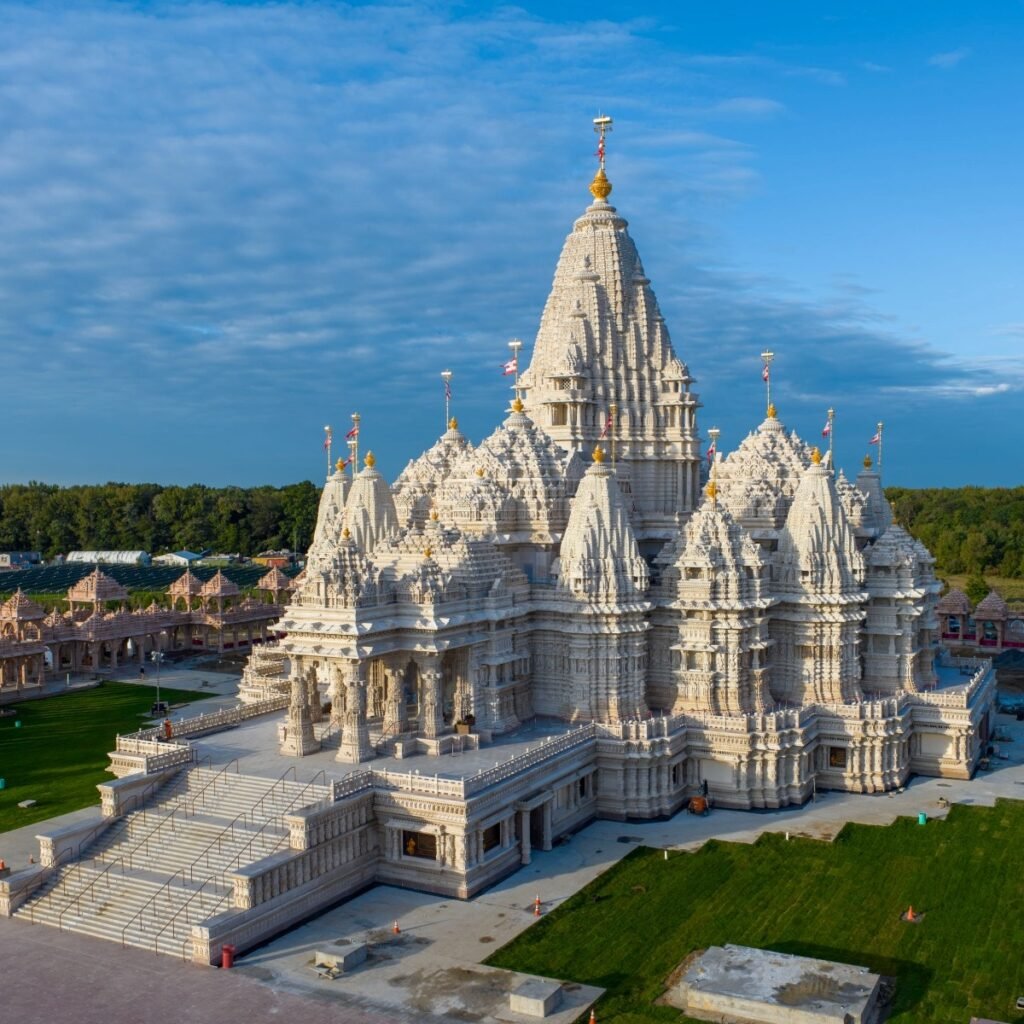
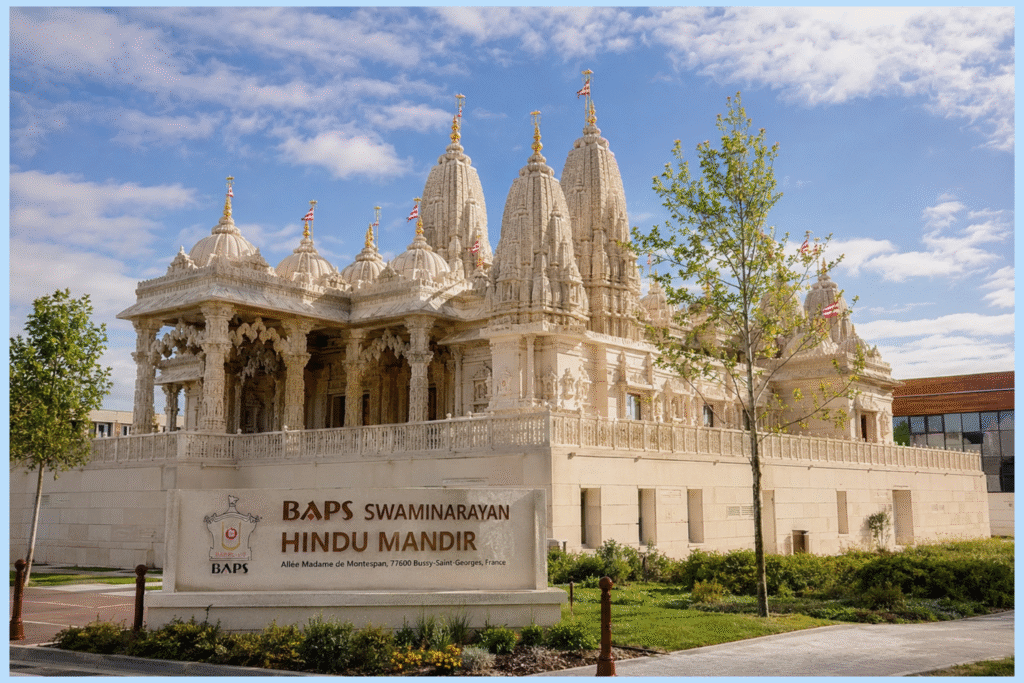
In Bussy-Saint-Georges, about 30 kilometres from central Paris, the BAPS Swaminarayan Hindu Mandir is preparing to open its doors in September 2026. BAPS describes the building as France’s first traditionally designed, purpose-built Hindu temple.
Its inauguration will be accompanied by a 13-day Festival of Culture from September 2 to 14, bringing together devotees, members of the Indian diaspora and visitors from France and abroad. (BAPS Swaminarayan Sanstha)
But behind the spectacular architecture lies a larger story — one involving decades of planning, Indian craftsmanship, French urban development and an important question about France’s secular model: How can a major Hindu temple be built in a country founded on the principle of laïcité?
A project more than 50 years in the making
The story did not begin with the construction work seen today.
According to BAPS, the spiritual vision for a Hindu mandir in France dates back to 1970, when Yogiji Maharaj stopped at Le Bourget Airport near Paris and expressed a vision for a Hindu temple in France.
Decades later, the project moved from religious aspiration to an actual urban-development project.
A major turning point came in 2017, when Bussy-Saint-Georges Mayor Yann Dubosc met Mahant Swami Maharaj and, according to BAPS, confirmed the allocation of a plot on the city’s Esplanade des Religions et des Cultures for a BAPS place of worship. (BAPS Mandir Paris)
The site subsequently became the centre of detailed architectural planning and development.
In October 2021, BAPS held the Bhumi Pujan ceremony at the site. In September 2022, the foundation-stone-laying ceremony, known as Shilanyas, took place. (BAPS Swaminarayan Sanstha)
When did actual construction begin?
The answer is important because several dates are associated with the project.
The physical construction on the site began in 2024.
BAPS says work commenced with the drilling of the first foundation pile, while its formal project launch took place in May 2024.
On June 4, 2024, the first foundation piling was formally marked in Bussy-Saint-Georges, officially beginning the temple’s construction phase. French National Assembly deputy Hadrien Ghomi and Bussy-Saint-Georges Mayor Yann Dubosc attended the ceremony alongside BAPS leaders, architects and members of the project team. (BAPS Swaminarayan Sanstha)
The temple’s foundation will involve 126 piles, according to BAPS.
India’s role: craftsmanship, culture — and diplomacy
The Indian connection to the project is unmistakable.
The temple combines traditional Indian Hindu architecture with French architectural and engineering expertise. BAPS says the project involves Indian craftsmanship and stones prepared in India, while the temple is being assembled and constructed in France. (The Statesman)
The architectural work has also involved Arte Charpentier, a Paris-based French architectural firm.
Indian Prime Minister Narendra Modi became publicly involved at the diplomatic and symbolic level.
During his visit to Paris on 13 July 2023, BAPS representatives and the project team presented Modi with a 3D model, construction plans and architectural drawings of the proposed mandir.
BAPS said Modi was briefed on the project and welcomed the temple as an expression of Indian architectural beauty and the growing relationship between India and France. (BAPS Swaminarayan Sanstha)
However, there is an important distinction for readers:
There is no evidence in the sources reviewed that the Government of India is financing or constructing the temple.
The project is being developed by BAPS Swaminarayan Sanstha, a Hindu religious organisation. Prime Minister Modi’s involvement was primarily diplomatic, symbolic and connected to the wider India-France relationship.
BAPS itself thanked leaders in both France and India for their support, but that should not be interpreted as evidence that the Indian state is paying for the temple. (BAPS Swaminarayan Sanstha)
What is the French Government’s role?
The French role is also more nuanced than simply saying that “France built the temple.”
The most visible governmental involvement has been local rather than national.
The Mayor of Bussy-Saint-Georges played an important role in making land available for the project. The temple is located within the city’s multifaith and multicultural development area.
French authorities also operate the planning and urban-development system through which construction projects must comply with local planning rules, building regulations, safety requirements and other applicable laws.
Bussy-Saint-Georges maintains a dedicated urban-planning department responsible for building permits and other urban-development authorisations. Its Local Urban Plan (PLU) governs construction and land use within the municipality. (Site officiel de Bussy-Saint-Georges)
French elected representatives have also publicly participated in milestones connected with the project. At the June 2024 foundation-piling ceremony, Mayor Yann Dubosc and National Assembly deputy Hadrien Ghomi were present. (BAPS Swaminarayan Sanstha)
Therefore, the clearest description is:
BAPS is the religious project developer; Indian involvement is principally cultural, community and diplomatic; and French authorities provided the legal and local framework that allowed the project to proceed.
But France is a secular country. How is a Hindu temple possible?
This is perhaps the most interesting question.
France is indeed a laïque Republic.
But French laïcité does not mean that religious worship is prohibited.
Quite the opposite.
Article 1 of the 1905 Law on the Separation of Churches and State states that the Republic guarantees freedom of conscience and the free exercise of religions, subject to restrictions required for public order. (Légifrance)
At the same time, Article 2 establishes the principle that the Republic does not recognise, pay or subsidise any religion. (Légifrance)
This distinction is crucial.
Laïcité means state neutrality toward religions — not the disappearance of religion from French society.
A religious community can establish a place of worship, provided it complies with French law, planning regulations, building standards, public-safety requirements and other applicable rules.
In principle, the State does not finance the religious activity itself.
The law also provides a framework under which religious associations can receive contributions, collections and certain donations to support their activities. (Légifrance)
So the existence of a Hindu temple in France is not, by itself, contrary to laïcité.
The same legal principle applies to places of worship belonging to different religious communities.
A temple — but also a cultural landmark
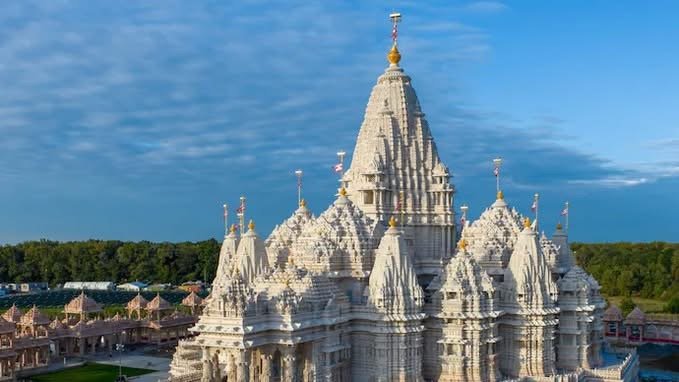
BAPS presents the new mandir not only as a place of Hindu worship but also as a centre for learning, cultural activities, community service and intercultural dialogue.
Its location on the Esplanade des Religions et des Cultures is particularly significant.
Bussy-Saint-Georges has developed the area as a space where different religious and cultural communities can establish places of worship.
The BAPS project therefore represents something larger than the arrival of a new religious building.
It illustrates how religious freedom and state secularism can coexist in France — provided the State remains neutral and the religious organisation operates within French law.
September 2026: a new chapter
The BAPS Swaminarayan Hindu Mandir is now approaching its public inauguration.
The Festival of Culture will run from September 2 to September 14, 2026, with the inauguration blessed by Mahant Swami Maharaj. Registration is required for participation in the festival. (BAPS Swaminarayan Sanstha)
For France’s Hindu community, the opening represents the culmination of decades of work.
For India, it is another visible expression of cultural links with France.
And for France, the temple offers a useful real-world illustration of what laïcité means in practice: the Republic does not adopt a religion, but it protects the freedom of people to practise their faith within the framework of French law.
Paris Telegraph will continue to follow the opening of the BAPS Swaminarayan Hindu Mandir and examine its cultural, diplomatic and social significance for France and the wider Indian diaspora.
Paris Telegraph News Desks

Paris Telegraph is an independent France-based digital news platform covering Paris news, French politics, European affairs, global business, diplomacy and artificial intelligence.
Publishing timely reporting and in-depth analysis, Paris Telegraph provides international perspectives on geopolitics, economic developments, technology innovation and cultural trends shaping Europe and the world.
As a growing online media outlet, Paris Telegraph is committed to credible journalism, global insight and forward-looking analysis for readers seeking reliable news from Paris and beyond.