
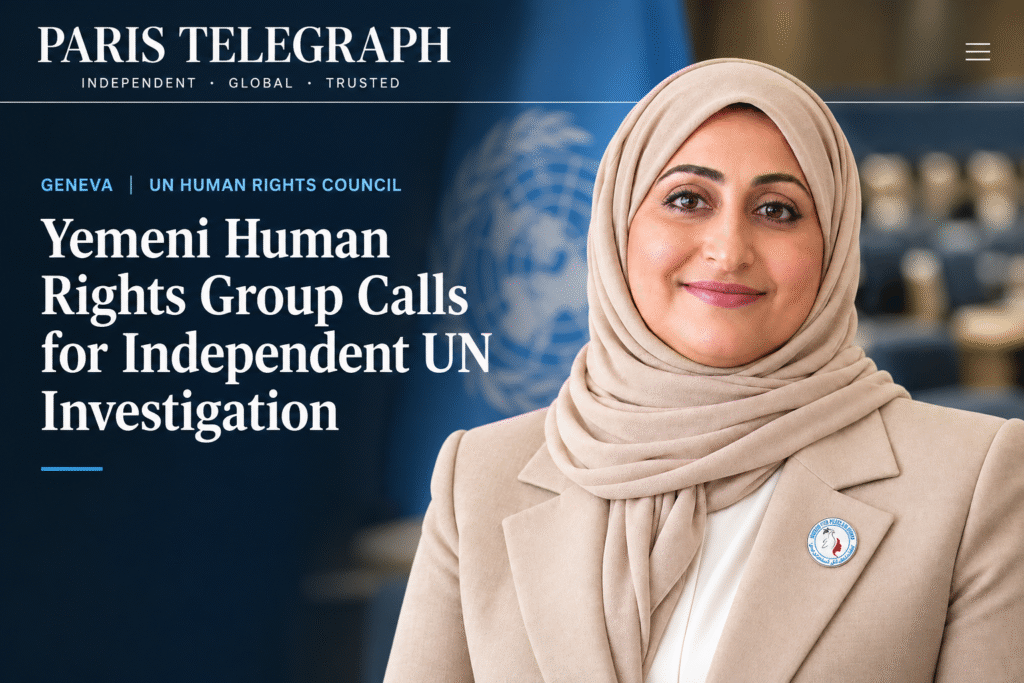
Yemen Human Rights Group Calls for Independent UN Investigation at Geneva Council Session
GENEVA — 2 October 2026 | Paris Telegraph Geneva Correspondent
A Yemeni human rights organisation has called on the United Nations Human Rights Council to establish an independent and impartial international investigative mechanism for Yemen, arguing that serious allegations of violations require further investigation, evidence preservation and accountability.
Noora Al-Jarwi delivered the statement on behalf of the Association Ma’onah for Human Rights and Immigration (AMHRI), calling for an independent and impartial UN investigation into alleged serious violations in Yemen.
The appeal was presented during the 63rd session of the UN Human Rights Council in Geneva, which is being held at the Palais des Nations from 7 September to 7 October 2026.
The organisation, the Association Ma’onah for Human Rights and Immigration (AMHRI), participated in the Council’s proceedings through oral interventions and written submissions. The UN’s official record for the opening meeting of the 63rd session lists Lenja Marlena Probst as the speaker representing Association Ma’onah for Human Rights and Immigration.
Call for investigation into violations in Yemen
In a memorandum dated 28 September 2026, AMHRI addressed the permanent missions of Human Rights Council member states and the Office of the UN High Commissioner for Human Rights.
The memorandum, titled “Closing the investigation and accountability gap for violations in Yemen,” calls for an international mechanism capable of examining alleged serious violations committed by all parties to the Yemen conflict, using consistent investigative and evidentiary standards.
According to the memorandum, the proposed mechanism should:
- investigate alleged serious violations of international human rights and humanitarian law;
- examine the conduct of external actors where evidence establishes a possible connection to violations;
- collect and securely preserve evidence;
- protect victims, witnesses and sources from reprisals;
- document harm to civilians, displaced people, detainees and civilian facilities;
- cooperate with Yemen’s National Commission of Inquiry and civil society while maintaining independence; and
- present findings and recommendations concerning accountability, reparations and guarantees of non-recurrence.
AMHRI said technical assistance to Yemen’s national institutions alone would not resolve what it describes as an “investigation and accountability gap.”
Focus on civilians and victims
The memorandum refers to several developments documented in AMHRI’s monitoring reports during September, including alleged attacks affecting medical facilities, reported displacement, allegations concerning detention sites and military incidents involving Saudi Arabia and Yemen.
Importantly, the organisation states that individual incidents should be investigated on their own merits, distinguishing information verified by UN bodies from statements made by parties to the conflict and allegations that remain unverified.
It also stresses that civilian-protection rules under international humanitarian law should apply to all sides, including the principles of distinction, proportionality and precautions in attack.
AMHRI’s presence at the Human Rights Council
AMHRI has announced that its delegation is participating in the 63rd Human Rights Council session, with activities including oral and written statements, meetings with diplomatic missions and international organisations, and advocacy concerning Yemen’s human rights situation.
The organisation is listed by the United Nations Office at Geneva among NGOs accredited to the UN, with Yemen listed as its headquarters and an accreditation year of 2026.
The group has also previously participated in Human Rights Council sessions and says its advocacy focuses on documenting violations, protecting civilians and strengthening accountability mechanisms.
A continuing international debate
The call comes as Yemen remains on the agenda of international human-rights institutions. AMHRI says an international investigative mechanism would complement national documentation efforts and give victims an avenue to seek truth and justice regardless of which party is alleged to have committed a violation.
The organisation’s latest memorandum is an advocacy submission, rather than a finding by the UN Human Rights Council itself. Allegations cited in the document therefore require appropriate independent verification before responsibility can be attributed to particular actors.
Paris Telegraph understands that the intervention forms part of broader civil-society advocacy taking place during the 63rd Human Rights Council session in Geneva.

Paris Telegraph is an independent France-based digital news platform covering Paris news, French politics, European affairs, global business, diplomacy and artificial intelligence.
Publishing timely reporting and in-depth analysis, Paris Telegraph provides international perspectives on geopolitics, economic developments, technology innovation and cultural trends shaping Europe and the world.
As a growing online media outlet, Paris Telegraph is committed to credible journalism, global insight and forward-looking analysis for readers seeking reliable news from Paris and beyond.