

France’s Student Protests Spread Nationwide as Violence, Arrests and Property Damage Escalate
By Paris Telegraph News Desk
Paris | 3 October 2026
France is facing a rapidly expanding wave of high-school student protests that has moved from demands for better education conditions into a broader public-order crisis, with clashes between young protesters and police, fires, property damage, arrests and incidents of looting reported in several cities.
The mobilisation, which began in the Paris region in September, has now spread across France. More than 1,200 high schools have been affected during the week, according to reporting by Reuters, while the Education Ministry said more than 700 establishments were still experiencing actions or disruption on Friday, 2 October.
Authorities have reported thousands of arrests since the beginning of the week. Interior Minister Laurent Nuñez said on Friday evening that 1,747 people had been arrested that day, bringing the total since Monday to more than 5,000. He said that approximately 85% of those arrested were minors, most of them teenagers.
The scale of the arrests has become one of the defining features of the crisis, while human-rights organisations have raised concerns about the use of force against young people.
From education protest to nationwide unrest
The movement began around 21 September at Lycée Saint-Exupéry in Créteil, in the Paris region. Students, parents and teachers initially focused on educational conditions, including shortages of teachers, overcrowded classrooms, inadequate school buildings and concerns about the organisation of school life.
The protests subsequently spread to cities including Paris, Lyon, Marseille, Lille, Nantes, Nice, Strasbourg, Rennes, Bordeaux and Tours.
Amnesty International France says the original demands included more teachers, less crowded classrooms, decent school buildings and better educational support. The organisation also acknowledges that violence has occurred during the mobilisation while arguing that police responses must remain necessary and proportionate, particularly when minors are involved.
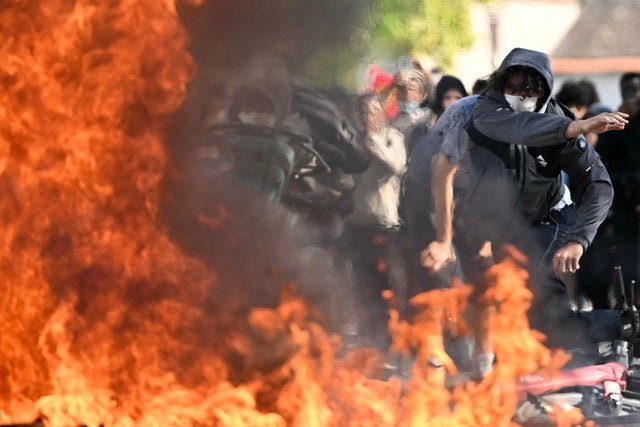
By Thursday, 1 October, the Education Ministry reported actions affecting more than 1,000 high schools, including hundreds of blockades. The authorities said the situation in a number of locations had moved beyond peaceful protest into what the government described as “urban violence.” (
Fires, clashes and attacks on police
The escalation has been accompanied by burning rubbish bins, fires near schools, projectiles thrown at police and damage to public infrastructure.
In several cities, riot police have used tear gas and other crowd-control measures to disperse groups.
The authorities say police officers, gendarmes, firefighters and education workers have been targeted during some incidents. The Education Ministry has reported dozens of education staff injured since the beginning of the movement, while Reuters reported that hundreds of police and other security personnel had also been injured during the unrest.
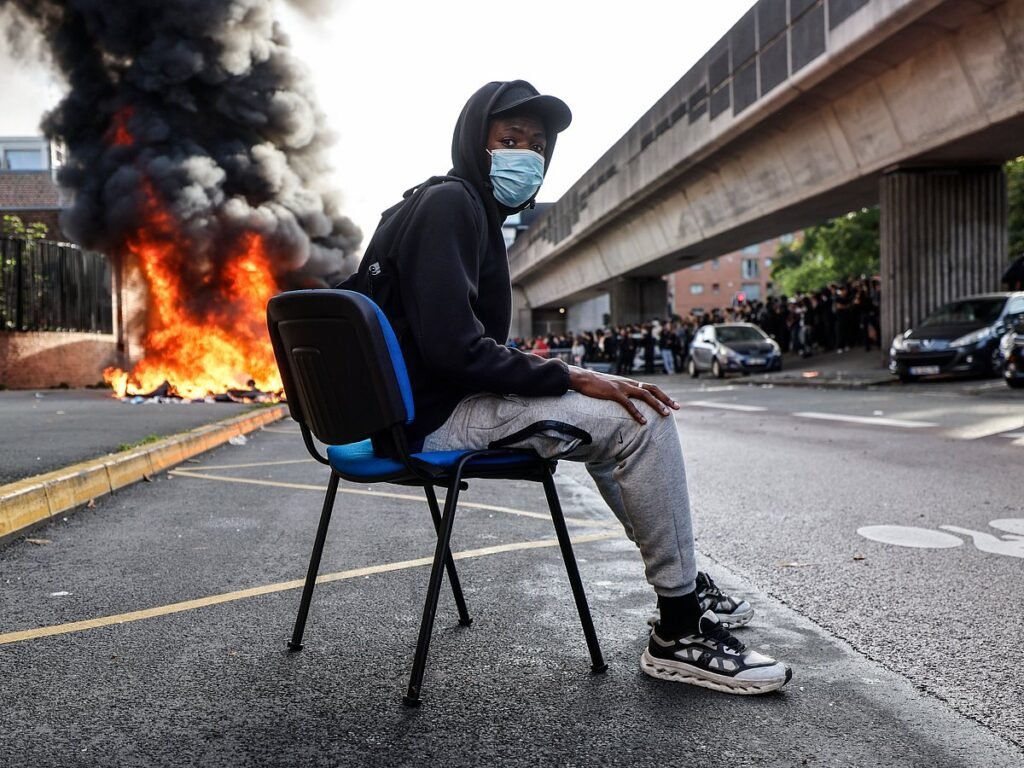
In the Haut-Rhin department, the prefecture reported violence in Mulhouse, Colmar, Saint-Louis and Guebwiller, including projectiles and fireworks directed at security forces. On 1 October, authorities recorded 35 arrests and 25 people placed in police custody in the department, with several police officers and a gendarme injured.
In Mulhouse, the violence continued into Friday. Local reporting described broken shop windows, fires and clashes in the city centre. Some businesses were forced to close their shutters during the unrest. A clothing shop was also reported to have been looted.
Shops damaged and looted
Reports of damage to businesses have emerged in several locations.
In Tours, local authorities reported damage to shops in the city centre on Friday, 2 October, following acts of vandalism and attempted or completed thefts. Businesses reported as targeted included shops on Rue Nationale and other commercial premises.
In Mulhouse, local reporting described broken shop windows and the looting of a clothing store amid clashes in the city centre.
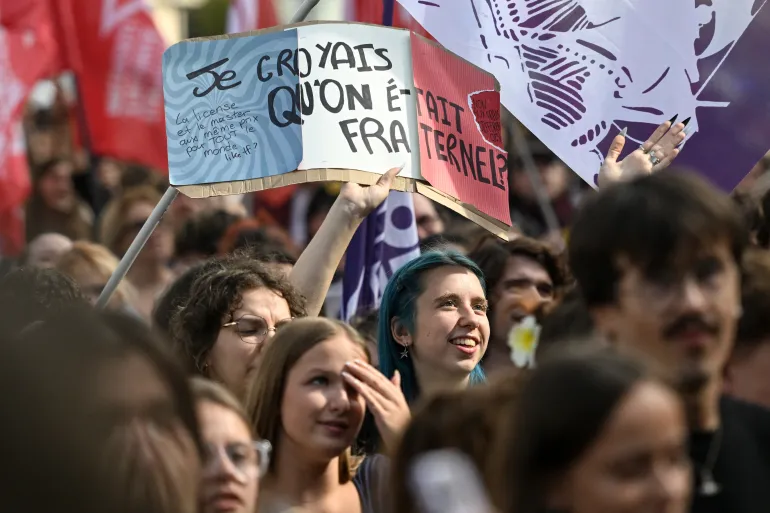
These incidents should, however, be distinguished from the wider student movement. There is no evidence that every student protester participated in vandalism or theft. Authorities and journalists have repeatedly described a mixture of peaceful students, confrontational groups and individuals who may not have been students at all.
In Mulhouse, for example, local reporting described some participants in the street violence as considerably younger than typical high-school students, including children estimated to be between 10 and 15 years old.
Minors are being arrested and placed in police custody
Yes — this has been independently verified.
The large majority of people arrested during the latest phase of the unrest are reportedly minors.
On Friday, Interior Minister Laurent Nuñez said approximately 85% of those arrested were minors, with most being high-school-age teenagers.
The Justice Ministry figures reported by Le Monde also show that the arrests have translated into significant numbers of police custody procedures. By Thursday, the Justice Ministry had reported 1,793 people placed in police custody since Monday, compared with 3,178 arrests recorded by police during the same period at that stage.
Local prosecutions provide further evidence that minors have been taken into custody.
In the Deux-Sèvres area, prosecutors reported six minors placed in police custody in connection with violence and property offences linked to the protests. Four cases involved alleged violence against security forces and two involved offences against property.
In the Rouen area, prosecutors reported 33 people placed in police custody in connection with the unrest, including 32 minors and one adult.
The situation has also affected the Oise region. In Compiègne, 18 people were placed in police custody on Thursday, 1 October, including 17 minors, according to reporting citing the local prosecutor. Seven additional minors were reportedly arrested on Friday. Some of those involved were reportedly only 13 or 14 years old.
French law provides specific procedures and protections for minors. Depending on their age and the suspected offence, a minor may be subject to police custody or a separate detention procedure, with specific rights including access to a lawyer and medical examination.
A growing concern over very young participants
The involvement of very young teenagers — and in some locations children below normal high-school age — has become another concern.
The protests began primarily as a mobilisation of high-school students, but reports from several cities suggest that some street violence has involved individuals who were not necessarily students from the schools around which the demonstrations were taking place.
In Compiègne, local prosecutors dealt with minors aged around 13 and 14 following incidents surrounding school blockades.
In Mulhouse, local reporting also described some participants involved in confrontations with police as being between approximately 10 and 15 years old.
This distinction is important: arrest figures should not automatically be interpreted as the number of genuine student protesters involved in the movement. The Interior Ministry itself has noted that someone arrested near a school is not necessarily a pupil at that school.
Police response comes under scrutiny
The police response has become another major point of controversy.
Amnesty International France has documented several incidents involving minors and expressed concern about the use of tear gas, grenades, batons and other crowd-control measures. It highlighted cases involving a 14-year-old boy in Saint-Ouen-l’Aumône, a 14-year-old girl in Alençon and a student injured in the eye during a protest in Tours.
Reuters has separately reported accusations by rights organisations concerning police tactics against minors and said that investigations have been opened into some allegations of excessive force. One investigation concerns a 16-year-old who reportedly suffered an eye injury. (Reuters)
The government, meanwhile, maintains that police must intervene when demonstrations involve violence, damage or threats to public safety.
The Interior Ministry has increased the use of CRS riot police and mobile gendarmerie units as the situation has deteriorated. (Le Monde.fr)
The competing accounts — protesters and rights groups raising concerns over police force, and authorities citing violence against police and damage to property — are now an important part of the national debate surrounding the protests.
What are the students demanding?
Despite the violence surrounding parts of the movement, the original educational demands remain at its centre.
Students have raised concerns about:
- Teacher shortages and unfilled positions
- Teachers not being replaced when absent
- Overcrowded classrooms
- Heavy school schedules
- Poor or deteriorating school buildings
- Lack of school nurses and support staff
- Conditions in disadvantaged areas
- Concerns surrounding Parcoursup and access to higher education
- A broader feeling that young people are not being heard in decisions affecting their education and future
Reuters reported that students in Seine-Saint-Denis have described serious shortages and poor conditions, while unions and parents have also raised concerns about unequal educational resources. (Reuters)
Amnesty International has likewise documented complaints about overcrowding, missing teachers, poor buildings and inadequate support services. (AMNESTY FR)
Government attempts to reopen dialogue
The government has attempted to respond on both the security and education fronts.
Education Minister Édouard Geffray met student organisations, education unions and parents’ representatives on Friday, 2 October.
Following the meeting, student organisations said they had not received sufficient concrete measures and called for the mobilisation to continue.
The government has announced work on improving the replacement of absent teachers and addressing aspects of school organisation. It has also sought to keep schools operating through distance learning where safety conditions prevent normal opening.
Around 400 schools were closed on Friday, according to government figures reported by Le Monde. More than 700 establishments were still affected by actions or disruption. (Le Monde.fr)
Tuesday could bring another major mobilisation
The immediate crisis is not over.
Student organisations have called for further mobilisation on Tuesday, 6 October, while several education unions and parent organisations have also announced support for the day of action. (Le Monde.fr)
That creates a difficult challenge for authorities: distinguishing peaceful educational protest from acts of violence and criminal damage while preventing further disruption to schools and protecting students, teachers, police, businesses and residents.
A movement at a crossroads
France’s student mobilisation has therefore entered a new phase.
What began with demands for teachers, better classrooms and decent school buildings has become a nationwide confrontation involving thousands of teenagers, police deployments, arrests, damaged schools, disrupted transport and commercial areas affected by violence.
The figures are striking: more than 5,000 arrests since Monday, the vast majority involving minors; more than 700 schools affected on Friday; hundreds of establishments closed; and repeated incidents of fires, clashes and property damage. (Le Monde.fr)
At the same time, the existence of violence does not erase the educational grievances that brought many students onto the streets. The central challenge for France is now how to address those grievances while preventing further violence and ensuring that peaceful protesters — including minors — can exercise their rights without exposing themselves or others to danger.
The coming days, particularly the planned mobilisation on 6 October, are expected to show whether the movement returns primarily to its original educational demands or whether the unrest continues to expand beyond school blockades into wider urban disturbances.
Paris Telegraph will continue to follow developments across France.

Paris Telegraph is an independent France-based digital news platform covering Paris news, French politics, European affairs, global business, diplomacy and artificial intelligence.
Publishing timely reporting and in-depth analysis, Paris Telegraph provides international perspectives on geopolitics, economic developments, technology innovation and cultural trends shaping Europe and the world.
As a growing online media outlet, Paris Telegraph is committed to credible journalism, global insight and forward-looking analysis for readers seeking reliable news from Paris and beyond.