
France’s 2027 Presidential Election: Who Is Leading and What Do They Propose?
Inflation, unemployment, high taxes and a decline in foreign investment projects are set to shape the debate over how France can rebuild its economy.
By Hyder Ali Paris Telegraph Political Desk
PARIS, France — November 17, 2026
France’s 2027 presidential race is beginning to take shape around a central question: how can the country restore economic confidence while addressing the concerns of households and businesses?
Marine Le Pen of the National Rally (RN) leads current first-round polling. But the race behind her remains divided among candidates from the left, centre and conservative right. Their proposals range from lower taxes and tighter immigration controls to higher public investment, pension reform and a green industrial transition.
The first round is scheduled for April 18, 2027, and the second round for May 2. The candidates discussed in the campaign are not yet the final ballot list. To qualify, each candidate must secure 500 endorsements from elected officials, and the Constitutional Council will publish the official list closer to the election. French presidential candidates must meet the legal eligibility requirements, but no particular university degree is required.
Economic pressures put France’s recovery at the centre of the vote
The economic backdrop is likely to weigh heavily on voters. France’s annual consumer inflation reached 3.4% in October 2026, up from 3.1% in September. Energy prices rose 24.1% year on year, placing further pressure on household budgets and business costs.
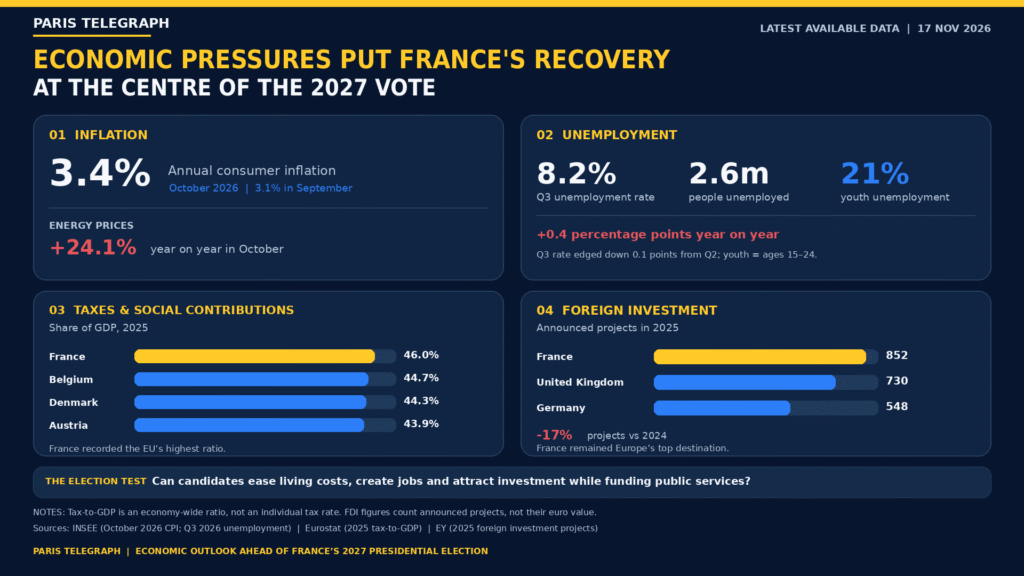
Unemployment stood at 8.2% in the third quarter of 2026, or approximately 2.6 million people, according to INSEE. The rate dipped slightly over the quarter, but was 0.4 percentage points higher than a year earlier, with 150,000 more people unemployed. Youth unemployment reached 21%. The figures put jobs, training and pathways into work—especially for young people—among the likely priorities of the campaign.
Taxation will be another major dividing line. Taxes and social contributions represented 46% of France’s GDP in 2025, the highest share among EU countries. This is an economy-wide ratio, not the tax rate paid by each person or company. The OECD has noted that complexity in the tax system can weaken France’s appeal to foreign investors, while also finding that the effective average tax burden on profitable investment is close to the OECD average.
The investment picture is mixed. EY recorded 852 foreign investment projects in France in 2025, a 17% fall from the previous year. France nevertheless remained Europe’s leading destination, ahead of the United Kingdom, with 730 projects, and Germany, with 548. The decline signals weaker momentum and tougher competition; it does not, by itself, prove that investors are leaving France en masse.
Who are the main candidates?
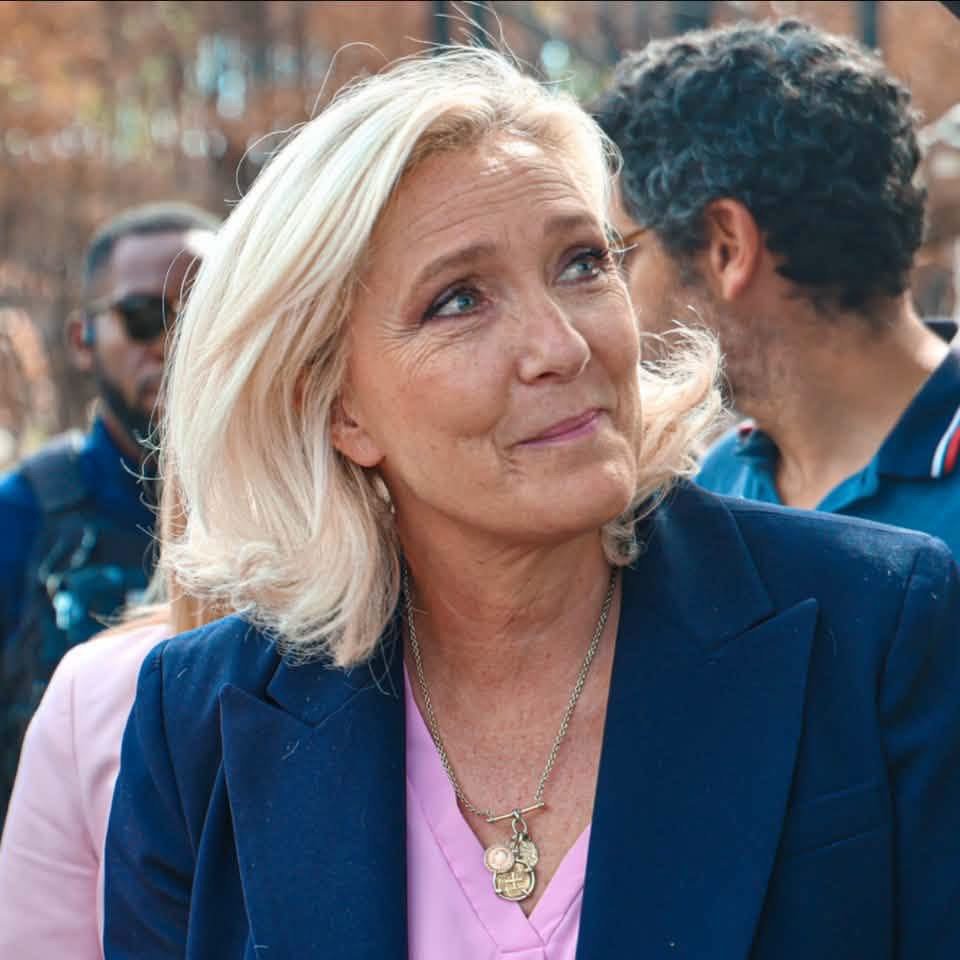
Marine Le Pen, 58, is the National Rally’s candidate. Born in Neuilly-sur-Seine, France, she studied law and criminal law and worked as a lawyer before entering politics. Her programme centres on immigration controls, “national preference” in access to jobs and social benefits, and French energy sovereignty. The RN has also proposed an additional annual charge for employers hiring workers from outside the European Union and has backed an expanded role for nuclear power. Some elements of its full programme remain to be announced.
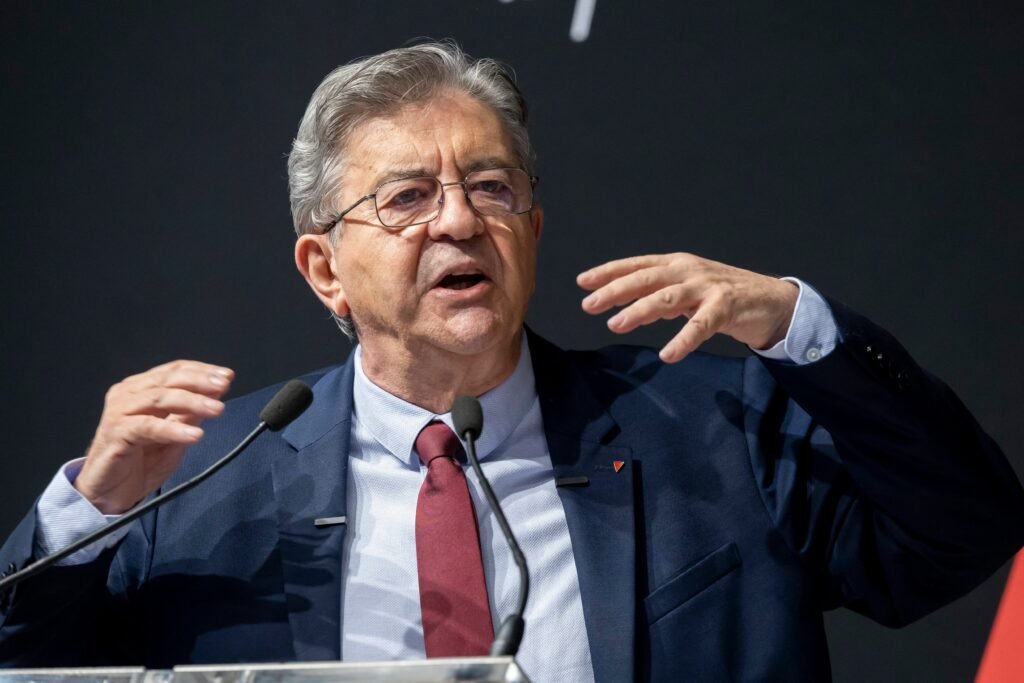
Jean-Luc Mélenchon, 75, is running for La France Insoumise (LFI). Born in Tangier, now in Morocco, he studied philosophy and modern literature and has served as a senator and government minister. LFI’s published programme prioritises ecological transformation, proposes reversing the recent pension reform and supports retirement at 60. It also pledges action against racism and discrimination.
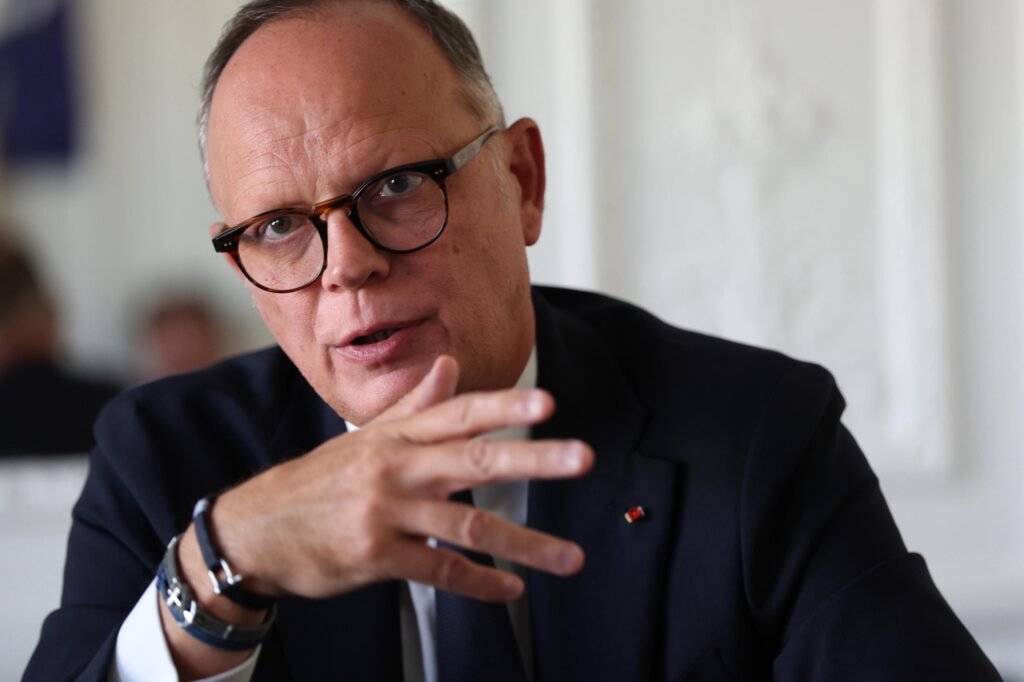
Édouard Philippe, 56, leads the centre-right Horizons party. Born in Rouen, France, he graduated from Sciences Po and the École nationale d’administration, served as prime minister from 2017 to 2020 and is mayor of Le Havre. His proposals include raising the retirement age to 65, cutting production taxes on businesses and reducing immigration by half. He has also proposed suspending family reunification for five years and introducing quotas for work-related immigration.
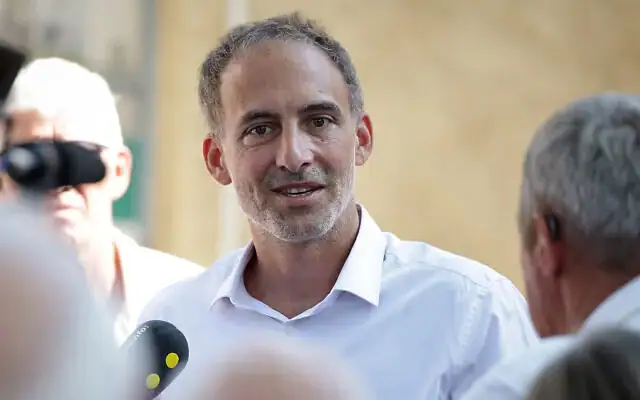
Raphaël Glucksmann, 47, is running with Place Publique, backed by the Socialist Party. Born in Boulogne-Billancourt, France, he studied at Sciences Po and is a member of the European Parliament. He proposes a green industrial transition, with investment in renewable energy, electric vehicles, rail and climate adaptation. He supports retaining a role for nuclear power and has proposed higher taxes on very large inheritances and fortunes.
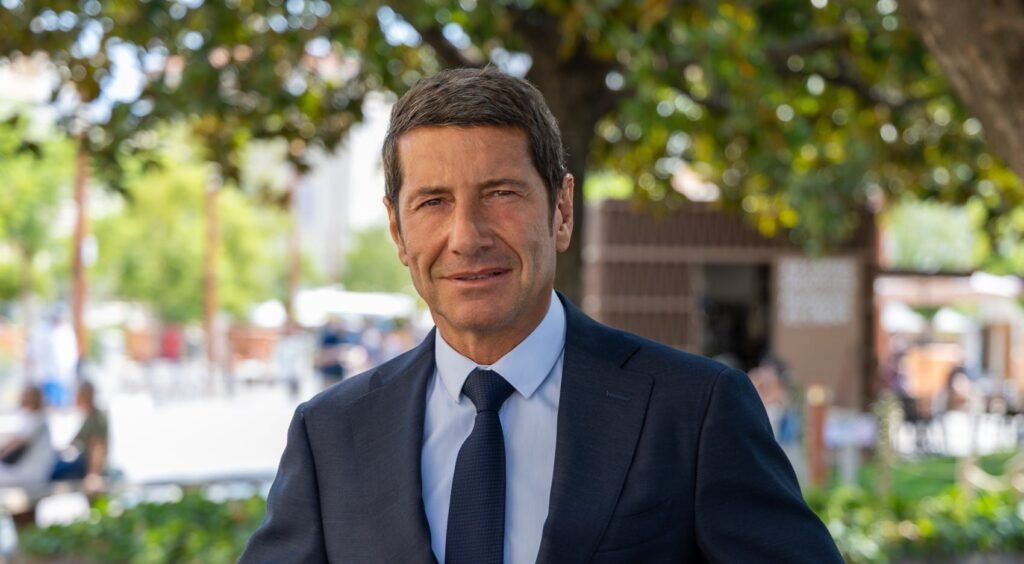
David Lisnard, 57, is running with his Nouvelle Énergie movement. Born in Limoges, France, he studied political science and public law and has been mayor of Cannes since 2014. His platform emphasises lower public spending, fewer administrative restrictions and a smaller role for the state in the economy.
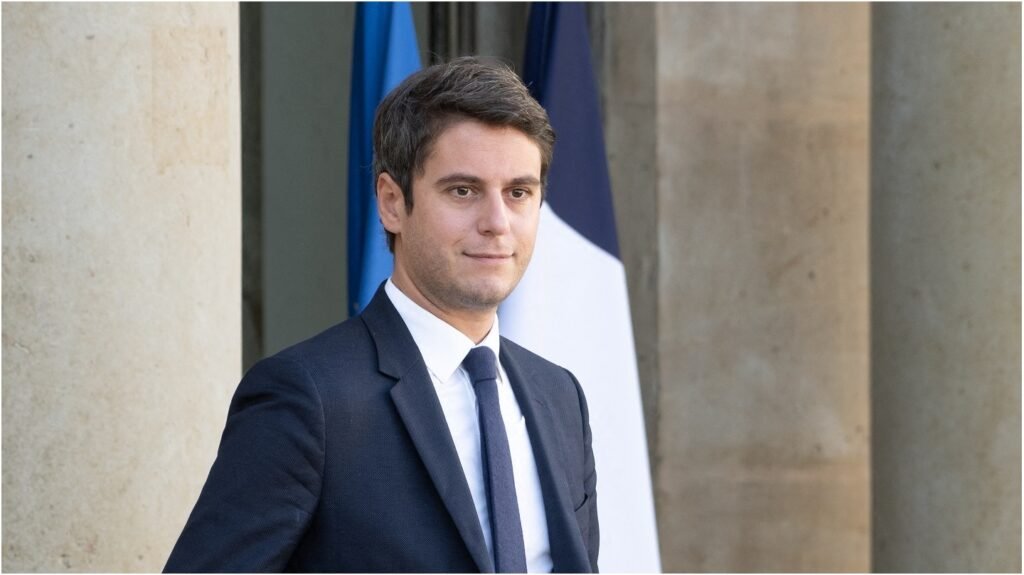
Gabriel Attal, 37, is the candidate of Renaissance, the party associated with President Emmanuel Macron. Born in Clamart, France, he has served as education minister and prime minister. He has made education reform a central theme and called for a long-term plan to improve school standards. On immigration, he has backed a tougher approach, including discussion of quotas. His campaign must also define its distance from Macron’s record.
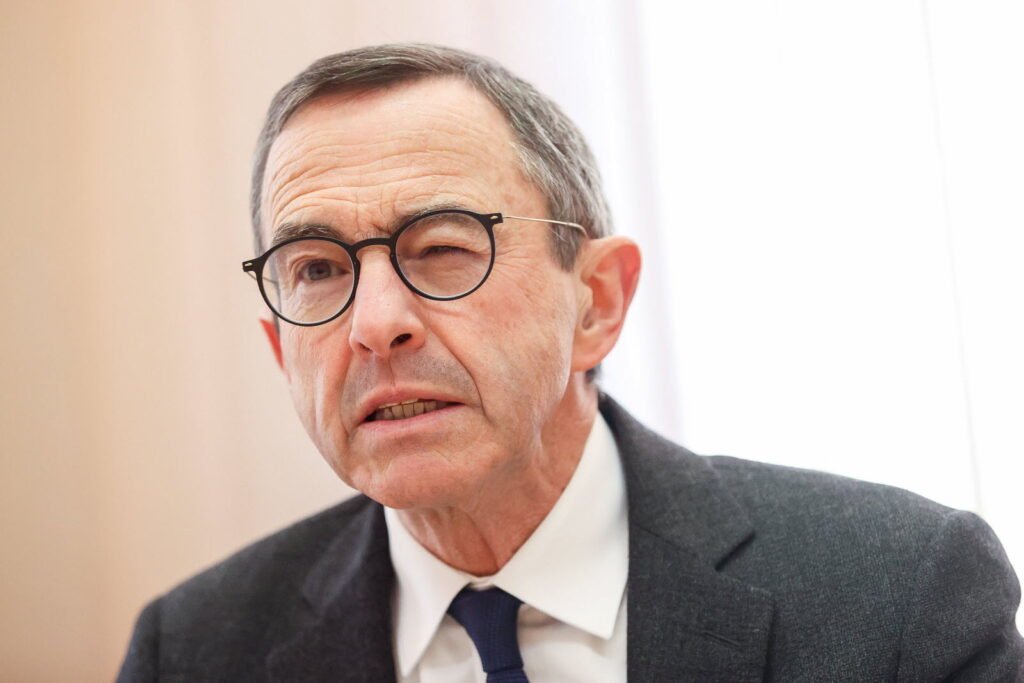
Bruno Retailleau, 65, is the Republicans’ (Les Républicains) candidate. Born in Cholet, France, he is a senator and former interior minister. His proposals include parliamentary immigration quotas, changes to birthright citizenship rules and restricting access to some social benefits for foreign residents.
Other figures, including Éric Zemmour of Reconquête!, Communist Party candidate Fabien Roussel and Green politician Marine Tondelier, are also part of the wider contest. The left remains divided: LFI is pursuing its own candidacy, while Place Publique and the Socialists have rallied behind Glucksmann.
What the latest polling shows
In an ELABE survey conducted on November 12–13, Le Pen received 32.4% in one first-round scenario. Mélenchon followed with 17.5%, ahead of Glucksmann at 13.1% and Philippe at 12.4%. Lisnard registered 9.2%, Attal 7% and Retailleau 5.8%. The survey included 1,500 adults, of whom 1,391 were registered voters. These figures reflect one polling scenario; they are not a forecast of the final result.
Le Pen’s lead is clear in current polling, but the election remains open. The left’s divisions could make it difficult for one candidate to reach the second round. On the centre-right, Philippe, Attal, Lisnard and Retailleau are competing for overlapping groups of voters. Alliances or a common candidacy could alter that balance.
The voter’s test: how to rebuild France
The campaign will ask voters to weigh competing promises against practical questions. Can candidates ease the cost of living while funding their proposals? Will their plans create stable jobs and improve opportunities for young people? Can tax changes make France more attractive to businesses without weakening public services or worsening the deficit?
The decision is not simply between lower taxes and higher public spending. Voters will also be judging whether candidates can offer policy stability, address energy and production costs, support skills and employment, and make France a competitive place to invest.
For now, the polling shows Le Pen in front, with Mélenchon, Glucksmann and Philippe among the strongest challengers. But the final candidate list, campaign alliances and detailed programmes have yet to be settled. The question for voters will be which proposals offer a credible and affordable route to rebuilding France.
By Hyder Ali Paris Telegraph Political Desk


Hyder Ali is the Editor – Global Affairs at Paris Telegraph, writing at the fault lines of power, politics, and global transformation. His commentary challenges conventional narratives and examines how emerging powers, shifting alliances, and strategic rivalries are reshaping the international order.
From Paris, he analyzes Europe’s geopolitical recalibration, the rise of Asia, the assertiveness of the Global South, and the strategic competition defining the 21st century. His work explores diplomacy, defence, energy security, economic realignment, and the ideological battles shaping world politics.
With a direct and analytical voice, Hyder Ali offers perspective-driven commentary that goes beyond headlines — interrogating power structures, questioning policy orthodoxy, and highlighting the deeper forces driving global change.