
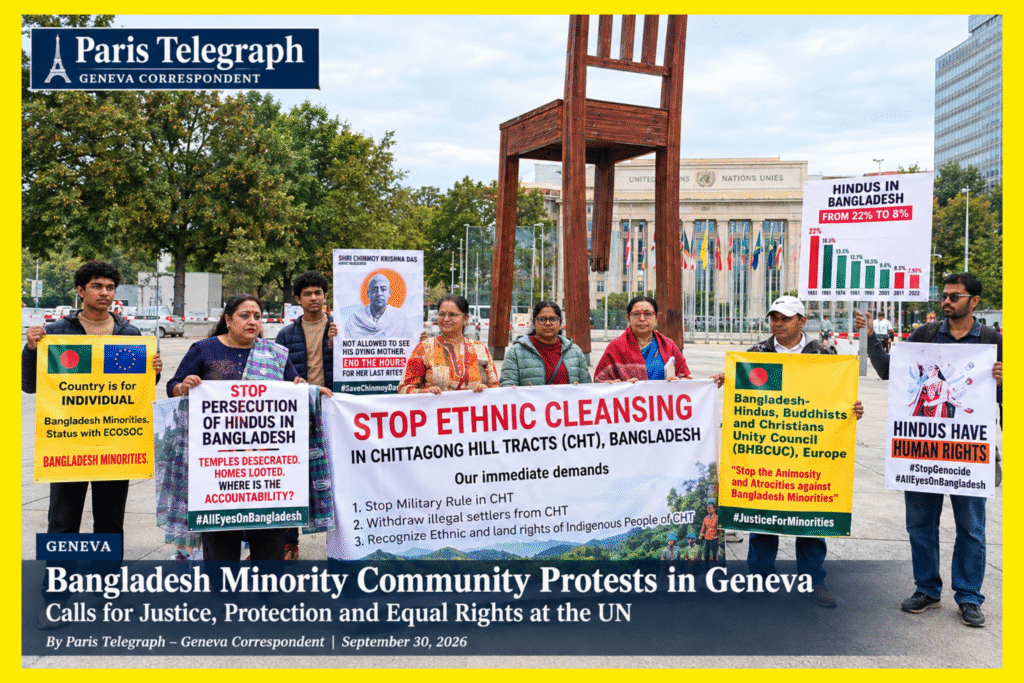
Bangladesh Minority Protest in Geneva Demands Protection, Justice and Equal Rights
Geneva, September 30, 2026 — Paris Telegraph
A small but vocal gathering of members of the Bangladeshi minority diaspora staged a protest in Geneva on Wednesday, raising concerns over the reported treatment of Hindu and other minority communities in Bangladesh.
The demonstration took place near the Broken Chair at Place des Nations, close to the United Nations Office at Geneva, as the UN Human Rights Council’s 63rd regular session continues at the Palais des Nations. The current Council session runs from September 7 to October 7, 2026.
Holding banners and placards, protesters called for greater international attention to what they described as violence, intimidation, attacks on homes and places of worship, land disputes, and restrictions affecting Bangladesh’s minority communities.
One of the banners displayed at the protest read “Stop Ethnic Cleansing in Chittagong Hill Tracts (CHT), Bangladesh”, while another called for recognition of the ethnic and land rights of Indigenous peoples in the region. Other placards highlighted concerns over alleged attacks against Hindus and the destruction of temples and homes.
“No citizen should be a second-class citizen”
A statement distributed at the demonstration called for independent, transparent and timely investigations into allegations of violence and destruction of property.
It also appealed for a fair judicial process for Chinmoy Krishna Das, the Hindu monk whose detention has become a major issue for sections of Bangladesh’s Hindu diaspora.
Das has remained in custody since November 2024. Bangladesh courts have granted him bail in several cases during 2026, but he has not been released because other cases remain pending, including proceedings connected to the death of lawyer Saiful Islam Alif during violence outside a Chattogram court in November 2024.
The protesters’ statement emphasised that their demands were not directed against any religion or community, but instead focused on justice, security, accountability and equal rights.
“Religion may be different, but human rights must be equal.”
The statement further called on the United Nations and the international community to monitor, document and help prevent alleged human-rights violations in Bangladesh.
Concerns over the Hindu minority
Bangladesh is a Muslim-majority country, while Hindus constitute the country’s largest religious minority. The UK government’s 2025 country information, updated in April 2026, puts the Hindu population at approximately 8%, or around 13 million people. It also notes that Bangladesh’s constitution provides equal status and rights for other religions, although incidents of communal violence have occurred, particularly during periods of political upheaval.
The Bangladesh Hindu Buddhist Christian Unity Council (BHBCUC) reported in July that it had documented 257 incidents of communal violence during the first six months of 2026, including 44 deaths, attacks on places of worship, attacks on homes and businesses, and other alleged abuses. These figures are the organisation’s own documentation and have not been independently verified in full.
The protesters in Geneva used these concerns to urge the international community to pay closer attention to the situation of minority communities.
A message from a small diaspora gathering
Although the Geneva demonstration was relatively small, the protesters sought to use the international setting to amplify concerns they say are difficult for vulnerable communities to express inside Bangladesh.
Placards carried messages including “Stop Persecution of Hindus in Bangladesh,” “Temples Desecrated. Homes Looted. Where is the Accountability?” and “Country is for ALL — Religion is for INDIVIDUAL.”
Another poster highlighted a decline in the proportion of Hindus in Bangladesh over successive censuses, displaying figures from 1951 to 2022.
The demonstration also included banners concerning the Chittagong Hill Tracts, where protesters raised separate concerns about Indigenous peoples, land rights and militarisation.
For the participants, Geneva was chosen deliberately: the gathering took place within sight of the UN human-rights institutions where governments, diplomats, NGOs and civil-society groups are debating international human-rights issues.
Their message was ultimately framed around a simple demand: minority and majority communities should enjoy equal protection, equal dignity and equal rights under the law.
The protesters appealed to the United Nations to listen to their concerns and to ensure that allegations of human-rights violations are properly investigated.
Paris Telegraph — Geneva Correspondent – Muhlis W.

Paris Telegraph is an independent France-based digital news platform covering Paris news, French politics, European affairs, global business, diplomacy and artificial intelligence.
Publishing timely reporting and in-depth analysis, Paris Telegraph provides international perspectives on geopolitics, economic developments, technology innovation and cultural trends shaping Europe and the world.
As a growing online media outlet, Paris Telegraph is committed to credible journalism, global insight and forward-looking analysis for readers seeking reliable news from Paris and beyond.