
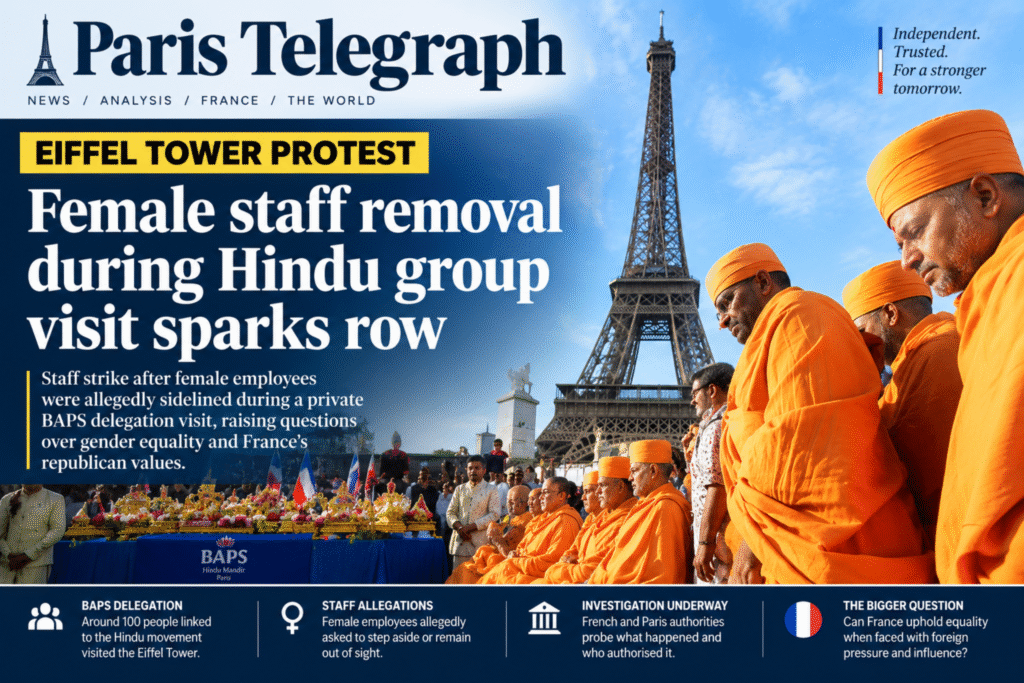
Eiffel Tower Row: Where Is Égalité When Women Are Asked to Step Aside?
Staff strike after alleged sidelining of female workers during BAPS Hindu delegation visit sparks fierce debate over France’s republican values
PARIS — September 8, 2026 — Paris Telegraph
The Eiffel Tower — one of the most recognisable symbols of France — has become the centre of a growing national controversy after staff went on strike over the alleged sidelining of female employees during a private visit by a Hindu delegation linked to the BAPS movement.
The controversy has triggered a fundamental question in France:
Where is Égalité?
Employees and union representatives alleged that female staff were instructed to step aside, leave certain positions or remain out of sight during the visit by the delegation.
The group reportedly included around 100 people associated with BAPS, during events surrounding the inauguration of a major BAPS Hindu temple in France.
The Eiffel Tower was closed on Monday as employees protested over the alleged treatment of female workers.
The incident has now prompted scrutiny from French and Paris authorities.
A question France cannot ignore
The Eiffel Tower is not simply another tourist attraction.
It is a symbol of Paris and of France.
And France’s national motto is known throughout the world:
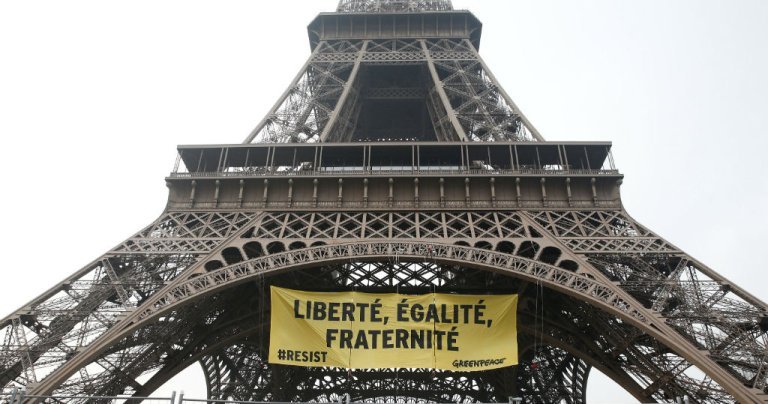
Liberté — Égalité — Fraternité.
That makes the allegations particularly serious.
If female employees were indeed asked to make themselves invisible because members of a visiting delegation did not wish to interact with women, the issue goes far beyond a disagreement over visitor arrangements.
It becomes a question of gender equality and discrimination in a French workplace.
A woman working at the Eiffel Tower has the same professional dignity and rights as a male colleague.
She should not have to disappear because a visitor prefers not to see or interact with women.
SETE admits the arrangement should not have happened
The Eiffel Tower’s operating company, SETE, has acknowledged that arrangements were made concerning interactions between the visiting delegation and female employees.
SETE subsequently said that such conditions should not have been accepted.
That acknowledgement raises serious questions about how the visit was organised and who approved the arrangements.
If a private visitor can request that female employees be removed from view — and management agrees — then France must ask how such a decision was ever considered acceptable.
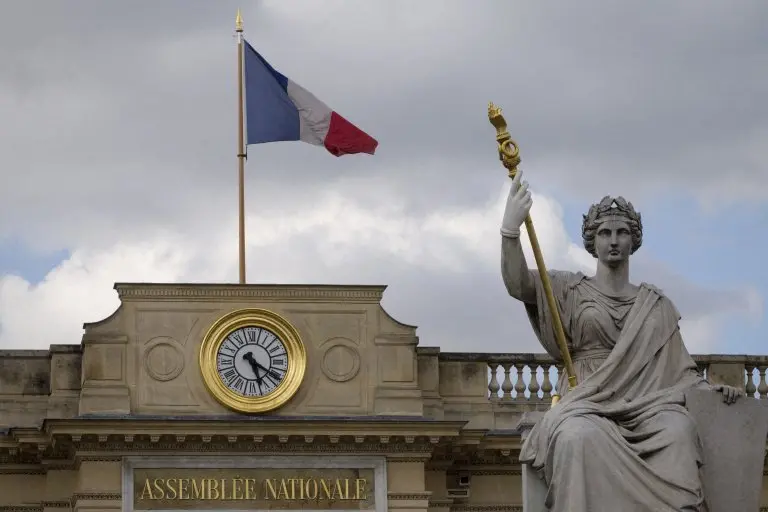
France welcomes the world — but not at the price of equality
France welcomes millions of visitors every year.
People come from different countries, religions and cultural traditions.
That diversity is part of modern France.
Religious freedom must be respected.
Cultural differences should be understood.
Visitors should be welcomed.
But welcome does not mean surrender.
France cannot be expected to abandon fundamental principles simply because a visiting group has different cultural or religious preferences.
Respecting another religion does not require discrimination against women.
Respecting cultural traditions does not require French workers to surrender their equality.
And hospitality cannot mean allowing visitors to determine who may appear in a French workplace.
Foreign money cannot buy French values
The controversy also raises an uncomfortable economic question.
France depends heavily on international tourism and benefits from foreign visitors, investment and spending.
But there must be a red line.
French values cannot be bought.
No amount of tourism revenue, foreign investment or international prestige should determine whether women receive equal treatment in France.
France can welcome wealthy visitors.
France can welcome religious delegations.
France can welcome international organisations.
But French law and French republican principles must remain above financial considerations.
If economic interests begin influencing fundamental equality, France risks undermining the very values that make the country attractive to the world.
This is not an attack on Hinduism
The controversy should not be turned into an attack on Hinduism or Hindu people.
That would miss the central issue.
The question is not what religion the visitors follow.
The same standard must apply to every organisation visiting France.
Whether a delegation is Hindu, Muslim, Christian, Jewish, Buddhist or secular, French workplaces remain governed by French law and principles.
No religion should be used to justify discrimination.
And no organisation should be permitted to demand unequal treatment of French workers.

Where is Laïcité?
France’s principle of laïcité is often misunderstood outside the country.
Laïcité does not mean hostility toward religion.
It means that the Republic does not allow religious authority to replace the rules of the Republic.
That principle becomes especially important when religious preferences collide with equality.
A religious organisation is free to practise its faith.
Visitors are free to hold their beliefs.
But French employees are also entitled to their rights.
Religious freedom cannot become a licence for gender discrimination.
Women cannot be made invisible
This is perhaps the simplest point in the entire controversy.
Women work everywhere in France.
They are doctors.
Teachers.
Engineers.
Police officers.
Journalists.
Managers.
Scientists.
Transport workers.
Public servants.
Tourism workers.
And employees at the Eiffel Tower.
They do not become less equal when a foreign delegation arrives.
They do not become less professional because a visitor has a particular cultural preference.
And they certainly should not be expected to become invisible.
Who gave the order?
The investigation must now provide clear answers.
Who requested that female employees be kept away?
Who approved the arrangement?
What exactly were employees told?
Were female employees consulted?
Was management aware that the arrangement could be perceived as discriminatory?
Were French employment and equality principles respected?
And why did the Eiffel Tower’s management allow the situation to develop in the first place?
These questions cannot simply be dismissed as a misunderstanding.
The employees’ concerns deserve serious examination.
France must draw the line
France has every right to welcome international religious and cultural delegations.
But France also has the responsibility to protect its own citizens and workers.
The principle is simple:
Visitors are welcome.
Religions are respected.
Cultures are respected.
But discrimination is not.
If the allegations are confirmed, those responsible must explain why women were treated differently and why such an arrangement was permitted at one of France’s most important public landmarks.
The Eiffel Tower must stand for equality
The Eiffel Tower is visited by people from across the world.
What happens there sends a message far beyond Paris.
That message should not be that French equality can be temporarily suspended to accommodate the preferences of a visiting delegation.
It should be the opposite.
France should be able to say proudly:
We welcome you.
We respect your faith.
We respect your culture.
But our women have equal rights.
Our workers have dignity.
And our republican principles are not negotiable.
The Eiffel Tower may have reopened after the staff strike.
But the questions raised by the controversy remain.
France must now establish the facts and ensure that such an incident cannot happen again.
Because in the country of Liberté, Égalité, Fraternité, there should be no place for making women invisible.
Égalité is not optional.
Women cannot be made invisible in France.
French values are not for sale.
By Paris Telegraph Editorial

Paris Telegraph is an independent France-based digital news platform covering Paris news, French politics, European affairs, global business, diplomacy and artificial intelligence.
Publishing timely reporting and in-depth analysis, Paris Telegraph provides international perspectives on geopolitics, economic developments, technology innovation and cultural trends shaping Europe and the world.
As a growing online media outlet, Paris Telegraph is committed to credible journalism, global insight and forward-looking analysis for readers seeking reliable news from Paris and beyond.