
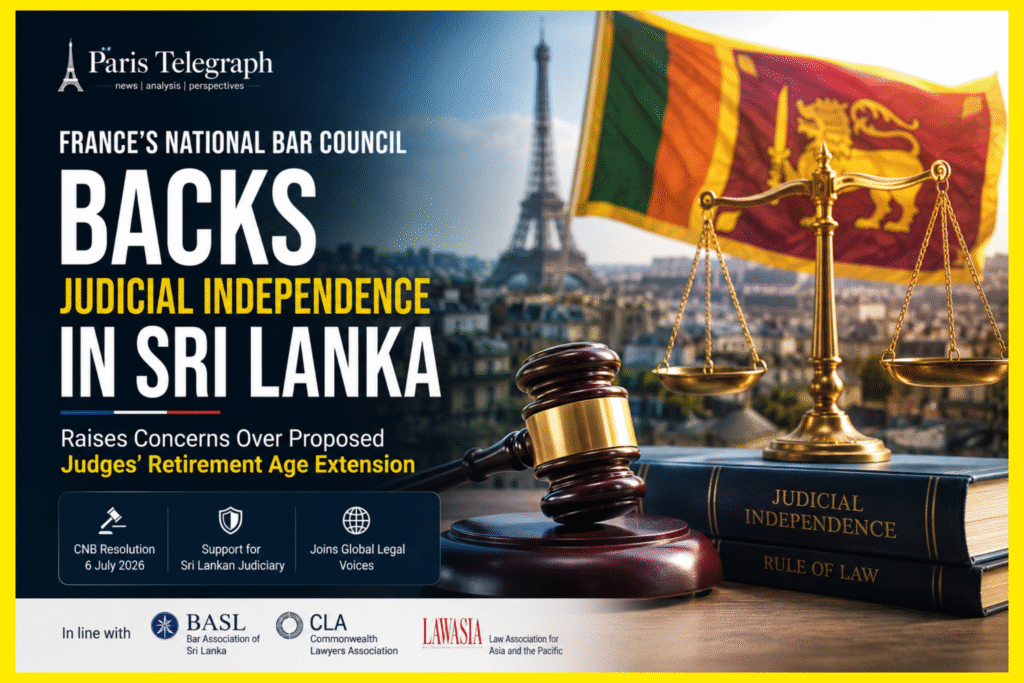
France’s National Bar Council Backs Judicial Independence in Sri Lanka, Raises Concerns Over Judges’ Retirement Age Proposal .
PARIS / COLOMBO 01-08- 2026
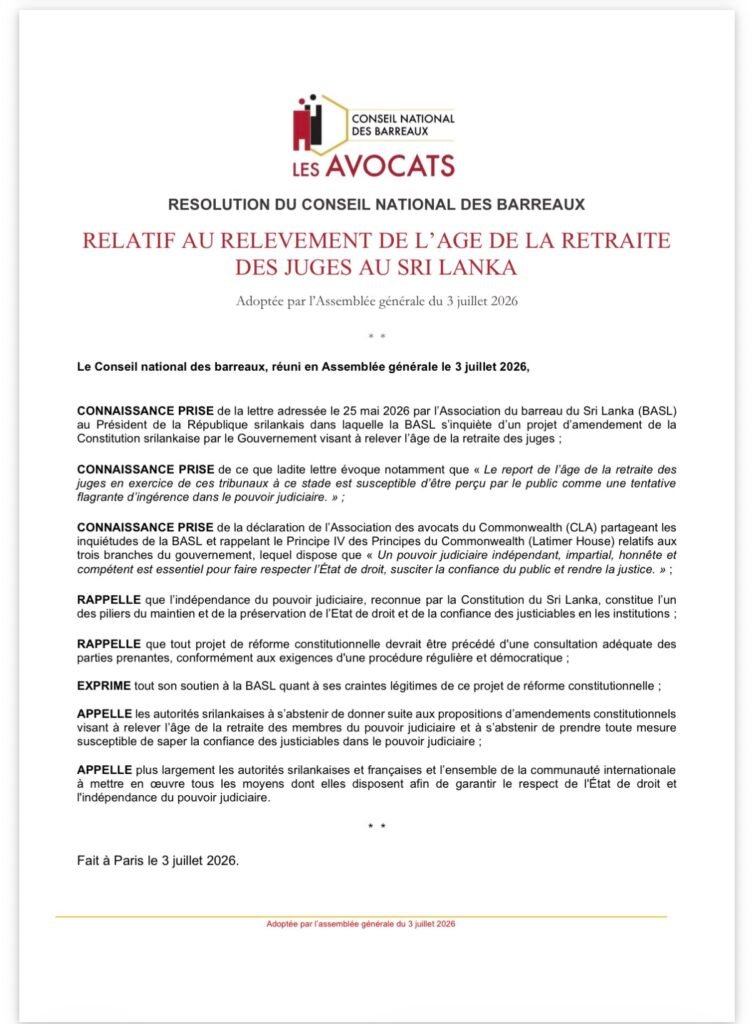
France’s National Bar Council (Conseil national des barreaux – CNB), the representative body of the French legal profession, has adopted a resolution expressing support for judicial independence in Sri Lanka while voicing concern over the Sri Lankan Government’s proposed constitutional amendment to extend the retirement age of senior judges.
The resolution, adopted on 6 July 2026, places the CNB among a growing number of international legal organisations that have warned against constitutional changes that could affect public confidence in the independence of Sri Lanka’s judiciary.
The French Bar Council’s intervention follows similar statements by the Bar Association of Sri Lanka (BASL), the Commonwealth Lawyers Association (CLA) and LAWASIA, all of which have urged the Sri Lankan authorities to reconsider the proposal and ensure that any constitutional reforms are carried out through transparent consultation and in accordance with democratic principles.
International concern over judicial independence
The controversy centres on a proposal to amend Sri Lanka’s Constitution to increase the retirement age of judges serving on the Supreme Court and Court of Appeal. Under the current Constitution, Supreme Court judges retire at 65, while Court of Appeal judges retire at 63. Any change requires a constitutional amendment approved by a two-thirds majority in Parliament.
Critics argue that altering the retirement age of sitting judges at this stage risks creating a perception of executive influence over the judiciary, potentially undermining public trust in one of the country’s key democratic institutions. Supporters of judicial independence stress that reforms affecting the judiciary should be undertaken only after broad consultation with legal stakeholders and civil society.
French legal profession joins international voices
The CNB resolution underscores the importance of maintaining an independent judiciary as a cornerstone of the rule of law and democratic governance. By adopting the resolution, France’s legal profession has aligned itself with international legal organisations that have expressed concern over the proposed constitutional amendment.
The Commonwealth Lawyers Association has similarly stated that constitutional reforms should not be introduced on an ad hoc basis and warned that any measure capable of diminishing public confidence in the judiciary should be avoided. LAWASIA has echoed those concerns, emphasising that judicial independence is fundamental to democracy and that constitutional amendments should follow proper consultation and due process.
Proposal moves forward
Despite criticism from legal bodies, Sri Lanka’s Cabinet recently approved the proposal to extend judges’ retirement ages, meaning the constitutional amendment is expected to be presented to Parliament. If enacted, the measure would require the support of a two-thirds parliamentary majority.
The debate has become one of the most closely watched constitutional issues in Sri Lanka during 2026, with legal professionals, civil society organisations and opposition figures continuing to emphasise the importance of safeguarding judicial independence and preserving public confidence in the courts.
Paris Telegraph News Desk

Paris Telegraph is an independent France-based digital news platform covering Paris news, French politics, European affairs, global business, diplomacy and artificial intelligence.
Publishing timely reporting and in-depth analysis, Paris Telegraph provides international perspectives on geopolitics, economic developments, technology innovation and cultural trends shaping Europe and the world.
As a growing online media outlet, Paris Telegraph is committed to credible journalism, global insight and forward-looking analysis for readers seeking reliable news from Paris and beyond.