
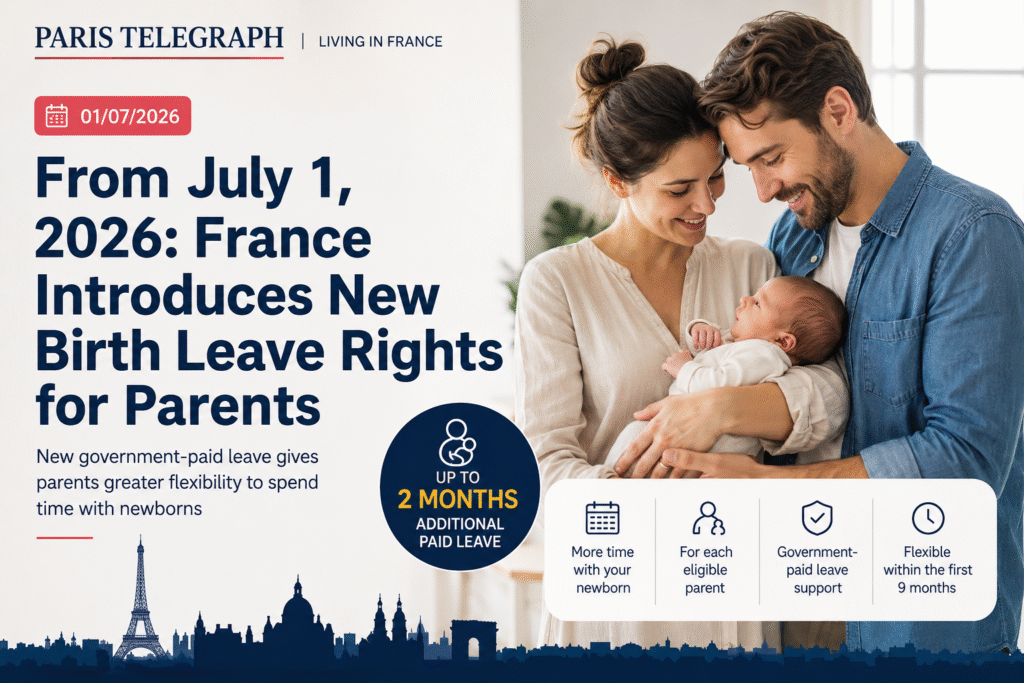
From July 1, 2026: France Introduces New Birth Leave Rights for Parents
Paris – 01 July 2026
New government-paid leave gives parents greater flexibility to spend time with newborns
France has introduced a significant expansion of family support measures, with new birth leave rules officially coming into force on 1 July 2026. The reform gives eligible parents additional paid time away from work following the birth or adoption of a child, marking one of the country’s most notable family policy changes in recent years.
The new measure, known as supplementary birth leave, is designed to help parents spend more time with their newborn while improving work-life balance and encouraging greater equality in childcare responsibilities.
What Changes from 1 July 2026?
Under the new legislation, each eligible parent can take up to two months of additional government-paid birth leave following maternity, paternity, or adoption leave.
Unlike existing maternity and paternity leave, this new entitlement provides families with greater flexibility by allowing parents to decide when to use the leave during the child’s first months of life.
The leave is available for children born or adopted from 1 January 2026, with the practical implementation beginning on 1 July 2026.
Key Features of the New Birth Leave
The reform includes several important provisions:
- Each parent may receive up to two months of additional paid leave.
- The leave is available after maternity, paternity or adoption leave has ended.
- Parents can generally take the leave in one-month blocks.
- Both parents may take the leave at the same time or separately.
- The leave must normally be used within nine months following the child’s birth or adoption.
- Government compensation is provided under the national social security system, subject to eligibility conditions and payment limits.
Payment During Leave
The new scheme provides income support during the leave period.
According to the government’s framework:
- The first month is compensated at approximately 70% of gross salary.
- The second month is compensated at around 60% of gross salary.
- Payments are subject to a maximum earnings ceiling established by the French social security system.
Employers are not generally required to pay full salaries during this additional leave unless collective agreements provide more favourable conditions.
Transitional Arrangements
Families whose child was born or adopted between 1 January and 30 June 2026 will also benefit from transitional rules.
They may take the new supplementary birth leave after 1 July 2026, provided it is used within the applicable time limits established by the government.
Parents of children born from 1 July 2026 onwards can access the new leave immediately after completing their maternity, paternity or adoption leave.
Why France Is Introducing the Reform
The French government says the new leave aims to:
- Improve the well-being of newborn children.
- Give parents more quality time during the first months of life.
- Encourage fathers and second parents to take a greater role in childcare.
- Support gender equality in both family life and the workplace.
- Help parents better balance professional and family responsibilities.
France already has one of Europe’s most comprehensive family support systems, and this reform further strengthens protections for working parents.
What Employees Should Do
Employees planning to use the new birth leave should:
- Discuss their plans with their employer in advance.
- Check eligibility with their employer or social security office.
- Review collective agreements that may provide additional benefits.
- Ensure leave is requested within the required deadlines.
Looking Ahead
Family organisations have welcomed the reform as an important step toward giving parents greater flexibility during the early months of a child’s life.
Employment experts also note that businesses will need to adapt workforce planning as more employees become eligible for the additional leave.
The new birth leave forms part of France’s wider effort to modernise family policy while encouraging stronger participation from both parents in raising young children.
For thousands of families welcoming a child in 2026 and beyond, the changes represent additional support during one of life’s most important moments. (Service Public)

Paris Telegraph is an independent France-based digital news platform covering Paris news, French politics, European affairs, global business, diplomacy and artificial intelligence.
Publishing timely reporting and in-depth analysis, Paris Telegraph provides international perspectives on geopolitics, economic developments, technology innovation and cultural trends shaping Europe and the world.
As a growing online media outlet, Paris Telegraph is committed to credible journalism, global insight and forward-looking analysis for readers seeking reliable news from Paris and beyond.