
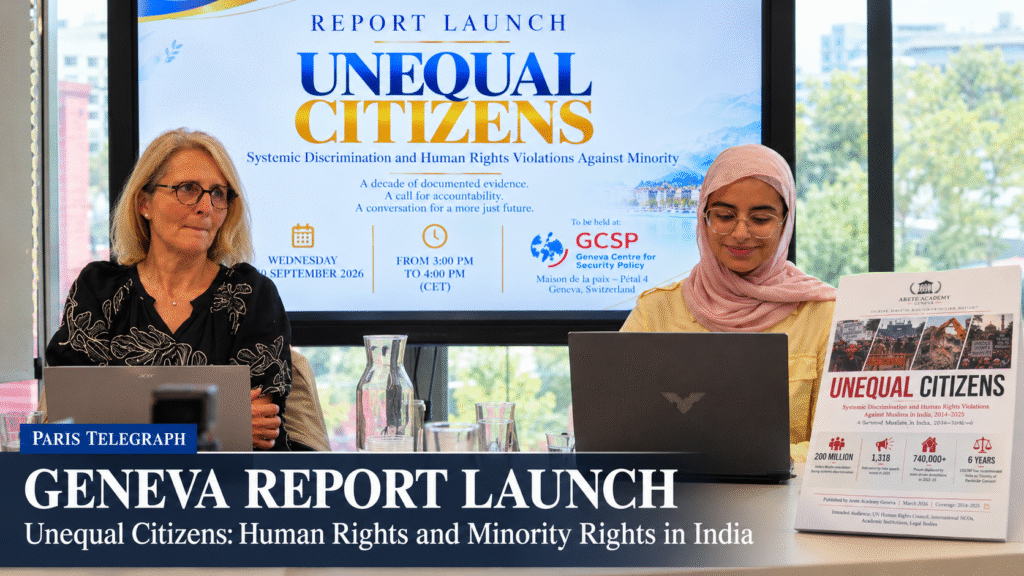
Geneva Report Examines Allegations of Systemic Discrimination and Human Rights Violations Against Muslims in India
GENEVA, Switzerland — September 30, 2026 — A new report examining allegations of discrimination, violence, arbitrary detention and other human rights violations affecting Muslims in India was formally presented in Geneva on Wednesday, as researchers, legal experts, academics and youth advocates gathered to discuss the findings and their wider implications.
The report, titled “Unequal Citizens: Systemic Discrimination and Human Rights Violations Against Muslims in India, 2014–2025,” was published by Arete Academy Geneva in March 2026. According to the publication, it examines developments over an 11-year period and brings together legal analysis, documented cases, statistical information and material from international human rights sources.
The launch was held from 3:00 p.m. to 4:00 p.m. CET at the Geneva Centre for Security Policy (GCSP), Maison de la paix – Pétal 4, Geneva.
The discussion was moderated by Ms. Imen Belhoucine of Jean Moulin Lyon III University, France.
Four perspectives at the Geneva discussion
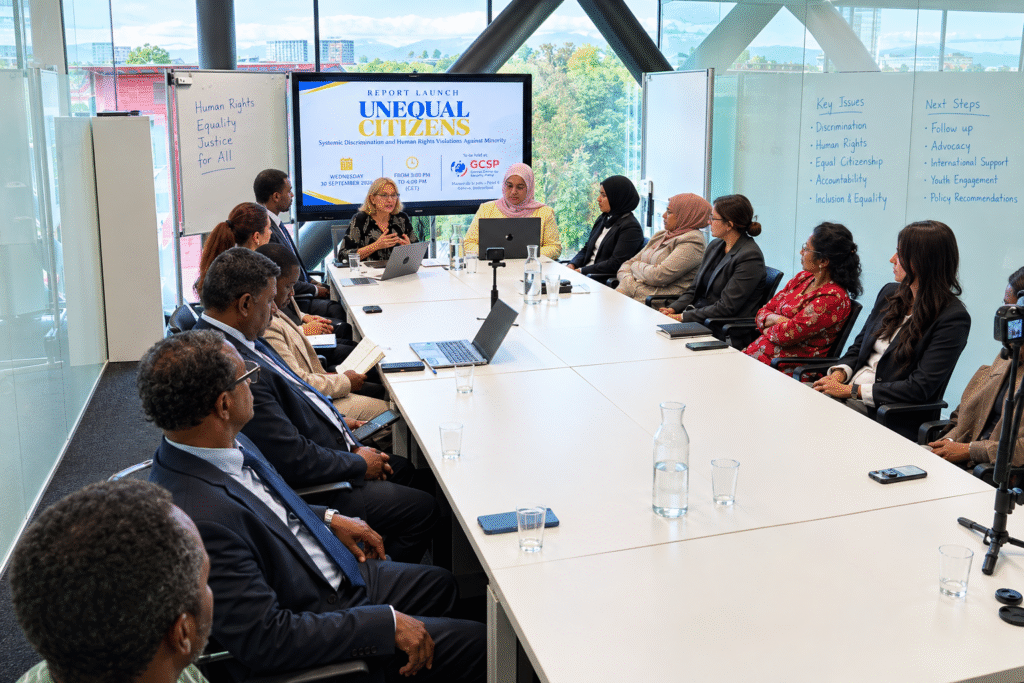
The panel brought together speakers from legal, academic, advocacy and youth backgrounds.
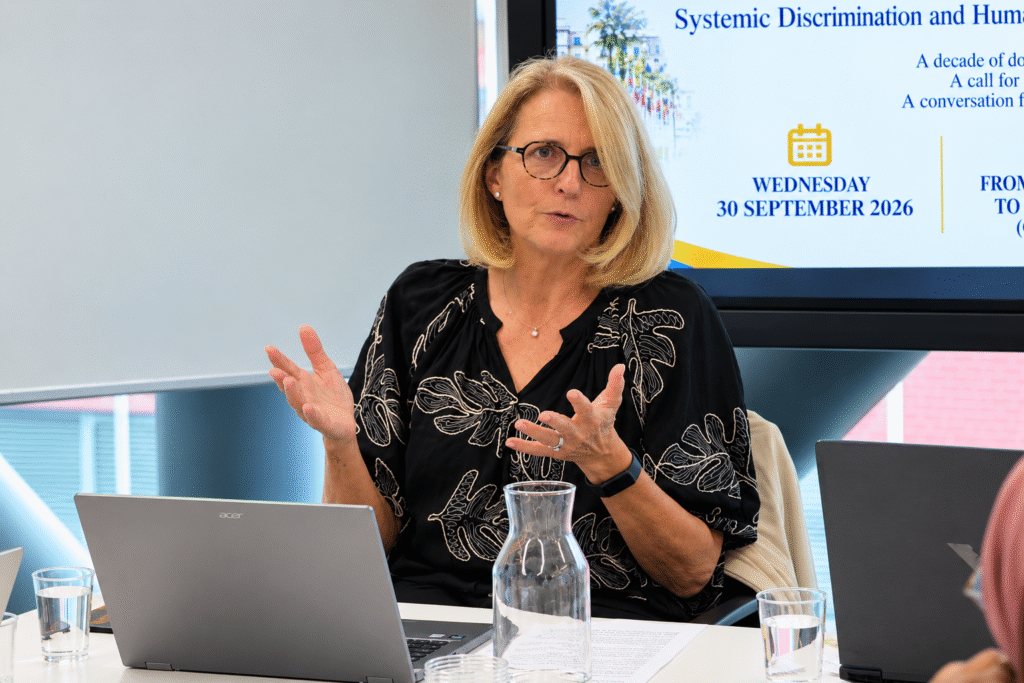
Sibylle Rupprecht, an international advocacy and ethical-leadership specialist with experience working with the European Union, United Nations, development banks and governmental institutions, contributed an international advocacy perspective. Her professional background includes senior positions in companies and international non-governmental organisations.
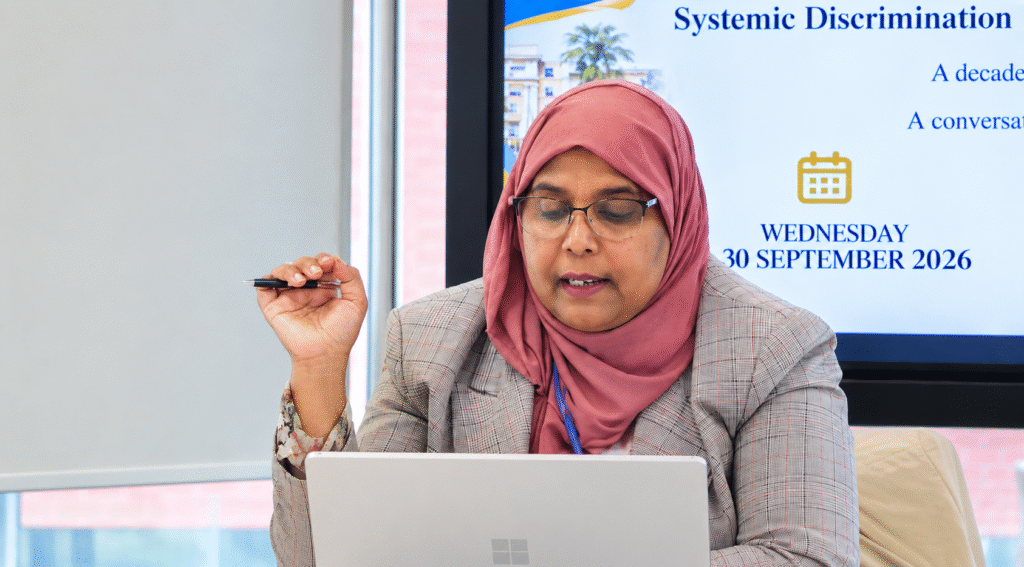
Zareena Abdul Azeez, an attorney and international human-rights activist, addressed the legal dimension of the issues raised by the report. Her areas of expertise include discrimination, equality, due process, religious freedom, freedom of expression, arbitrary detention and access to effective remedies.
The academic perspective was represented by Solomon Ngoussi of Jean Moulin Lyon III University. His participation focused on the role of universities and academic communities in examining complex human-rights questions through evidence, research and critical discussion.
The panel also included Amal Muzammil, a youth advocate for minority rights and empowerment, bringing a youth perspective to the discussion. Her participation highlighted the role of younger generations in debates concerning inclusion, equality, discrimination and human dignity.
Report focuses on 2014–2025
According to the report presented at the event, its coverage extends from 2014 through 2025 and examines several areas, including legislation, policing, detention, property demolitions, communal violence, religious freedom, hate speech and social marginalisation.
The publication says its research draws on publicly available material from sources including United Nations human-rights mechanisms, the Office of the UN High Commissioner for Human Rights (OHCHR), Human Rights Watch, Amnesty International, the U.S. Commission on International Religious Freedom, judicial records, media reports and other documentation.
Several of the issues discussed in the report have also been raised independently by international human-rights mechanisms.
In a 25 February 2026 statement, UN Special Rapporteurs Alice Jill Edwards and Morris Tidball-Binz called for independent investigations into allegations of extrajudicial killings, torture-related deaths and injuries involving law-enforcement officials in India. The experts said that, if substantiated, the allegations could amount to serious violations of the rights to life, freedom from torture and non-discrimination.
The UN statement specifically referred to reports concerning policing in Uttar Pradesh and Assam, while noting allegations affecting Muslims, Dalits and Adivasis. The experts called for incidents to be investigated promptly, independently and transparently.
Figures presented in the report
Among the statistics displayed in the report are figures concerning alleged police encounter killings, deaths in custody, judicial-custody deaths and violence against Muslim victims.
One chart in the publication cites 132 alleged encounter killings between January and August 2025, alongside figures for police and judicial custody deaths. The report attributes the material to sources including India’s National Human Rights Commission (NHRC), Human Rights Watch and OHCHR.
The publication also examines the December 2019 anti-Citizenship Amendment Act protests in Uttar Pradesh, presenting figures relating to deaths, arrests, FIRs and property demolitions. These figures are presented by the report as part of its broader examination of the treatment of Muslim communities.
Independent reporting and official sources provide additional context on policing and custodial deaths in India. A UK government country-information report, for example, cites NHRC data showing 105 encounter-death cases registered in 2023–24, alongside thousands of custodial-death cases across police and judicial custody during the period reviewed.
Discussion framed around evidence and accountability
The Geneva event placed particular emphasis on the interaction between human rights, law, academic research, international advocacy and youth participation.
Rather than focusing solely on individual incidents, the report seeks to examine whether patterns identified across different periods and institutions raise broader questions about equality before the law, due process and protection of minority rights.
The organisers said the publication is intended for an international audience including the UN Human Rights Council, international NGOs, academic institutions and legal bodies.
The launch took place in Geneva during a period of continuing international discussion over human-rights conditions in India. India is currently a member of the UN Human Rights Council, and its government has stated its commitment to promoting and protecting human rights on the basis of equality, openness and respect.
The Geneva discussion therefore brought together different professional perspectives around a report whose central focus is the treatment of India’s Muslim minority and the application of human-rights standards.
Paris Telegraph Geneva Correspondent – Veroniq B.

Paris Telegraph is an independent France-based digital news platform covering Paris news, French politics, European affairs, global business, diplomacy and artificial intelligence.
Publishing timely reporting and in-depth analysis, Paris Telegraph provides international perspectives on geopolitics, economic developments, technology innovation and cultural trends shaping Europe and the world.
As a growing online media outlet, Paris Telegraph is committed to credible journalism, global insight and forward-looking analysis for readers seeking reliable news from Paris and beyond.