
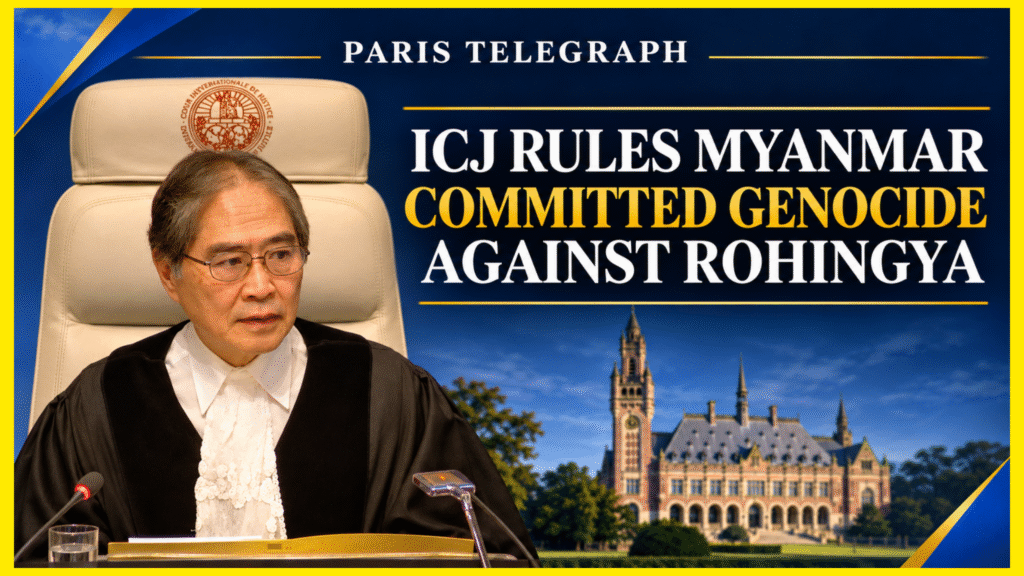
ICJ finds Myanmar committed genocide against Rohingya
THE HAGUE, 21 November 2026 — The International Court of Justice (ICJ), the United Nations’ highest court, has ruled that Myanmar committed genocide against the Rohingya in northern Rakhine State during the 2017 military “clearance operations.”
In its judgment on 19 November, the Court found that Myanmar violated the Genocide Convention. The finding was reached by nine votes to six. The judgment is final, binding on the parties and cannot be appealed.
The judges found that Myanmar’s security forces killed thousands of Rohingya civilians, committed widespread sexual violence, inflicted extreme violence on children and attacked people as they fled. The Court said the evidence supported an estimate of at least 10,000 Rohingya killed during the operations.
The ICJ concluded that the only reasonable inference from Myanmar’s actions was an intention to destroy a substantial part of the Rohingya group in northern Rakhine State. That finding met the legal threshold for genocide.
The 2017 crackdown drove more than 700,000 Rohingya across the border into Bangladesh, according to UNHCR. They joined Rohingya who had fled in earlier waves of violence.
The case was brought by The Gambia in 2019 under the 1948 Genocide Convention. The Court also found that Myanmar failed to prevent genocide by individuals acting alongside its security forces, failed to punish genocide and related acts, and failed to enact the required domestic legislation. It found, however, that Myanmar had not directly and publicly incited private persons to commit genocide against the Rohingya.
The judgment orders Myanmar to investigate people reasonably suspected of committing acts prohibited by the Convention and to prosecute and punish them where warranted. It also requires Myanmar to provide guarantees against repetition and adopt restitution measures, including safe, voluntary and dignified return for Rohingya displaced by Myanmar’s wrongful acts and the reunification of families.
The Court further ruled that Myanmar must compensate the Rohingya for the damage caused. The amount and terms of compensation will be decided in a later phase. Myanmar must submit a report to the Court within two years on restitution measures and compensation.
The ruling concerns Myanmar’s responsibility as a state under the Genocide Convention. The ICJ does not conduct criminal trials of individuals; the judgment’s order to investigate and prosecute suspected perpetrators is a separate obligation placed on Myanmar.
Myanmar has denied that its military committed genocide, saying its operations were a counterterrorism response. Following the ruling, its foreign ministry said the judgment was a “great disappointment” and pointed to the dissenting opinions.
The decision marks a major legal milestone for the Rohingya’s pursuit of justice. Carrying out the Court’s orders—including accountability, compensation and safe return—will now be central to the case’s next phase. The ICJ has also found that Myanmar violated an earlier order to protect evidence related to the genocide allegations.
Paris Telegraph International News Desk



Paris Telegraph is an independent France-based digital news platform covering Paris news, French politics, European affairs, global business, diplomacy and artificial intelligence.
Publishing timely reporting and in-depth analysis, Paris Telegraph provides international perspectives on geopolitics, economic developments, technology innovation and cultural trends shaping Europe and the world.
As a growing online media outlet, Paris Telegraph is committed to credible journalism, global insight and forward-looking analysis for readers seeking reliable news from Paris and beyond.