

Kazakhstan’s Digital Expansion Offers Lessons for Regional Cooperation
Rural internet investment, reusable government technology and new international data routes highlight opportunities—and practical challenges—for digital development across Central Asia.
By Paris Telegraph International Desk 02/11/2026
Kazakhstan is expanding rural internet access, developing digital government systems and investing in computing infrastructure as it seeks to strengthen its digital economy. Together, these initiatives offer a case study in how national technology projects can generate practical lessons for regional and international cooperation.
The country’s experience addresses challenges shared by many governments: connecting communities far from major cities, enabling public institutions to work across information systems and maintaining reliable infrastructure as demand for data grows.
Its relevance extends beyond the deployment of new technology. The wider question is how countries can document their experience in ways that allow others to examine, adapt and improve it, while accounting for differences in geography, regulation, institutional capacity and resources.
Extending connectivity beyond urban centres

Kazakhstan’s large territory and uneven population density make rural connectivity a significant infrastructure challenge.
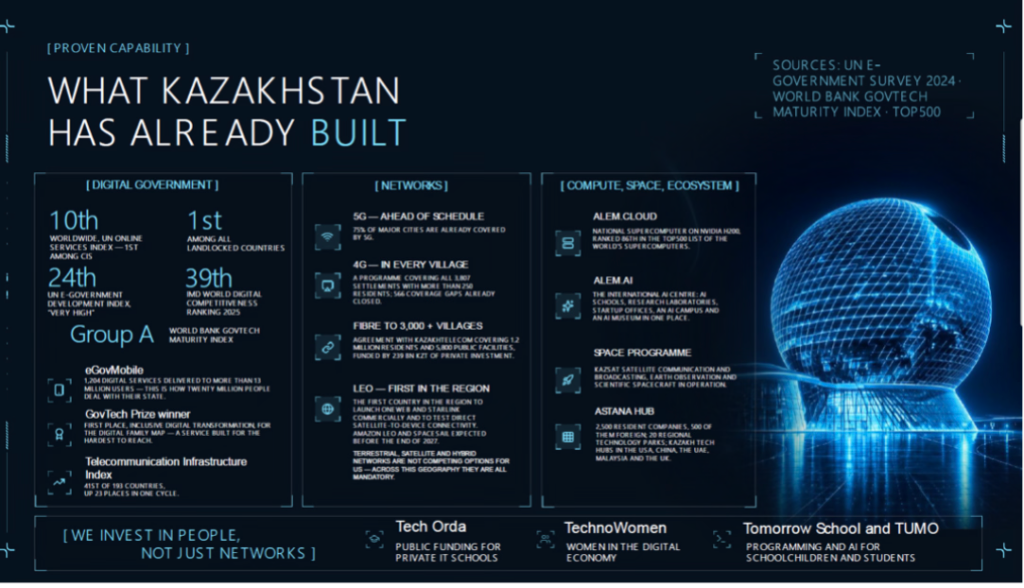
The government has reported plans to connect more than 3,000 rural settlements, targeting 99 per cent high-speed internet availability across villages by the end of 2027. The programme combines fibre-optic infrastructure with satellite technologies for more remote locations.
However, extending network coverage is only one measure of progress. The International Telecommunication Union’s framework for universal and meaningful connectivity also considers quality, affordability, access to devices, digital skills and security.
For remote communities, meeting these requirements simultaneously can be difficult. A connection must be sufficiently reliable and affordable to support education, healthcare and public services, while remaining financially sustainable over time.
Kazakhstan’s programme therefore raises questions relevant to other countries with dispersed populations: which combination of fibre, mobile and satellite technologies best serves different settlements, how investment in low-density areas can be sustained, and how improvements in access should be measured.
The most useful international exchange would centre on implementation experience and measurable outcomes, recognising that infrastructure models cannot always be transferred directly between countries.
Turning government technology into shared knowledge

Kazakhstan’s digital government development provides a more specific example of how a national system can acquire international relevance.
In September 2026, the ITU reported that technical specifications for an Analytics Building Block based on Kazakhstan’s Smart Data Ukimet had been added to its Global Repository under the GovStack approach. The material includes technical specifications and a country case. Related work has also been discussed in consultations involving Kyrgyzstan and Tajikistan.
Smart Data Ukimet is designed to integrate and analyse information from government systems. According to the ITU, its architecture supports data integration, real-time collection and analysis to inform government decision-making.
The broader significance lies in how that experience is documented. A platform operating within one national administration can be difficult for another government to reproduce. Published architecture, specifications, use cases and implementation lessons make its underlying approach easier to assess and adapt.
This reflects a central principle of GovStack: governments can develop digital services using interoperable building blocks tailored to national requirements, rather than constructing every component independently.
Technical reusability nevertheless requires local adaptation. Data-protection rules, procurement arrangements, cybersecurity requirements, administrative processes and public-sector information systems differ between countries.
The value of sharing such components therefore rests on making both their technical design and their implementation experience available.
Diversifying international data routes
International connectivity is another important element of Kazakhstan’s digital development strategy.
In October 2026, Kazakhstan and Azerbaijan launched a submarine fibre-optic connection across the Caspian Sea, providing an additional link between Kazakhstan and digital infrastructure in the South Caucasus.
Kazakhstan has also been developing east-west fibre infrastructure and additional international interconnection capacity.
These developments reflect a wider regional concern: as economies become more dependent on cloud services, digital trade, artificial intelligence and cross-border data flows, access to multiple international routes becomes increasingly important.
Additional connections can provide alternative paths during disruption, but their existence alone does not guarantee resilience. Their effectiveness depends on interconnection arrangements, traffic management, redundancy and the ability to redirect data when necessary.
Submarine cables, terrestrial fibre and satellite communications consequently form part of a broader regional cooperation agenda, alongside the operational arrangements needed to keep networks functioning.
Building computing capacity
The expansion of digital services is also increasing demand for infrastructure beyond communications networks.
Artificial intelligence, scientific computing and large-scale data analysis require substantial processing capacity. Kazakhstan has begun developing domestic high-performance computing infrastructure to support these activities.
The country’s Ministry of Artificial Intelligence and Digital Development reported that the Alem.Cloud supercomputer ranked 86th on the TOP500 list and is intended for artificial intelligence, high-performance computing and big-data applications.
The policy significance extends beyond the ranking itself. Access to computing resources can influence research, education, public-sector applications and private-sector innovation.
Such infrastructure also carries substantial capital, energy and operating requirements. Its contribution therefore depends on utilisation, the availability of skilled users, access arrangements and long-term economic sustainability.
Keeping digital public services accessible
As governments expand digital services and introduce artificial intelligence, accessibility remains a central concern.
Online services can reduce administrative barriers, provided that people with different levels of digital literacy and different physical or technological capabilities can use them.
The ITU’s meaningful connectivity framework recognises these wider conditions, including affordability, devices, skills, quality and security.
For AI-enabled public services, the quality of underlying data, accessibility and appropriate safeguards become particularly important. Introducing artificial intelligence does not automatically improve outcomes; results depend on institutional processes and on how systems are governed and used.
Kazakhstan’s investment in digital public services and AI infrastructure offers a national context in which these issues can be examined alongside the expansion of technical capacity.
Opportunities for practical cooperation
The country’s experience points to three areas for international exchange.
The first is government technology: documenting system architectures, specifications and implementation lessons so that other administrations can assess their relevance.
The second is meaningful connectivity for remote communities, including technology choices, financing, service quality and evidence of improvements in access to essential services.
The third is inclusive digital government and artificial intelligence, with an emphasis on accessibility, digital skills, responsible data use and the measurement of public benefits.
These exchanges could take place through existing ITU programmes and international initiatives, avoiding the creation of parallel structures.
Kazakhstan’s approach does not offer a universal blueprint. Infrastructure costs, population density, regulatory frameworks and institutional capabilities vary substantially between countries.
Its wider contribution lies in making particular practices and implementation lessons available for scrutiny and adaptation. The inclusion of a Smart Data Ukimet-based component in the ITU Global Repository illustrates one mechanism for doing so.
Similar exchanges could help governments assess rural connectivity models, computing investments and international network resilience without assuming that one country’s arrangements will suit another.
For the ITU and its Member States, the practical challenge is to turn national projects into shared evidence and technical knowledge. Kazakhstan’s experience places rural connectivity, government technology, resilient infrastructure and inclusive AI within that same discussion about sustainable digital development.

Paris Telegraph is an independent France-based digital news platform covering Paris news, French politics, European affairs, global business, diplomacy and artificial intelligence.
Publishing timely reporting and in-depth analysis, Paris Telegraph provides international perspectives on geopolitics, economic developments, technology innovation and cultural trends shaping Europe and the world.
As a growing online media outlet, Paris Telegraph is committed to credible journalism, global insight and forward-looking analysis for readers seeking reliable news from Paris and beyond.