
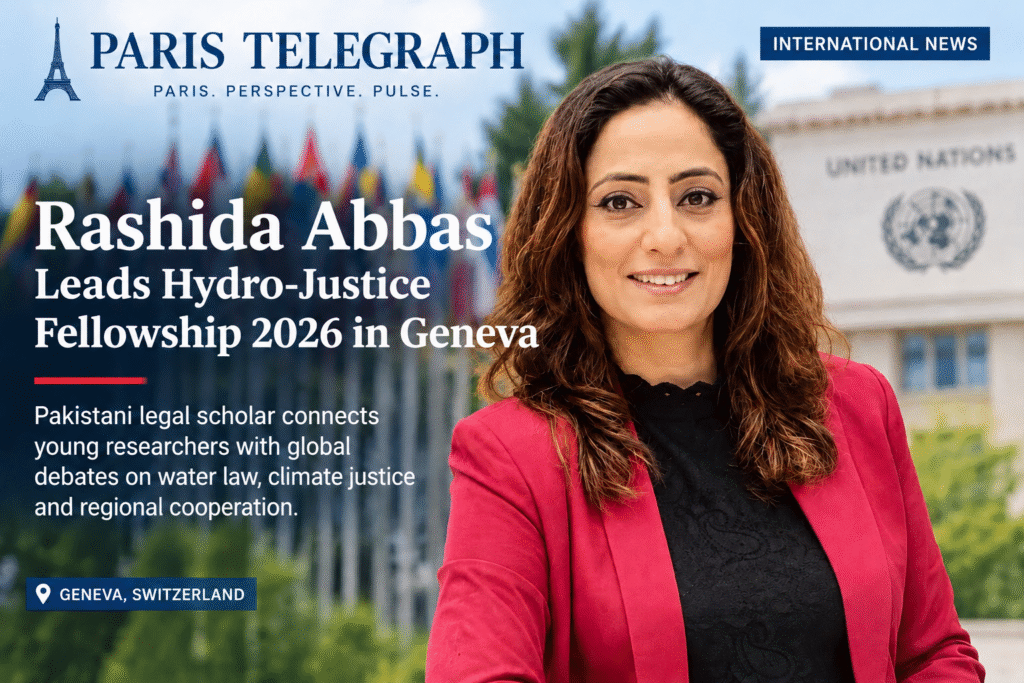
Pakistani Scholar Rashida Abbas Takes Hydro-Justice Initiative to Geneva’s International Policy Arena
Geneva, Switzerland | Paris Telegraph News Desk
21-10-2026
As water security, climate change and transboundary river disputes become increasingly important to international law and regional cooperation, Pakistani legal scholar Rashida Abbas is working to bring these issues into wider academic and policy discussions through the Hydro-Justice Student Research & Policy Fellowship 2026.
Abbas, a lawyer and PhD researcher in International Law at the University of Geneva, is leading the fellowship initiative, which aims to equip young Pakistani law students and emerging researchers with the knowledge and practical skills needed to address complex challenges involving water governance, environmental protection and human rights.
The initiative seeks to connect emerging researchers with international experts, legal practitioners and policymakers, creating opportunities for young scholars to contribute to debates on water justice and international cooperation.
Water security beyond national borders
Pakistan’s water challenges extend beyond domestic resource management. The Indus Basin, a vital river system for agriculture, livelihoods, energy and food security, is central to discussions about transboundary water governance, environmental protection and regional stability.
Through the Hydro-Justice Fellowship, Abbas aims to encourage research into international water law, equitable water use, climate-related risks, dispute resolution and the protection of communities that depend on shared rivers.
The programme also addresses issues such as groundwater depletion, water pollution, flood and drought management, access to safe drinking water and sanitation, and the relationship between water security and human rights.
The fellowship’s central approach is to examine water not merely as a natural resource, but as an issue connected to justice, sustainable development, public health and peace.
Empowering the next generation of researchers
A key objective of the initiative is to provide young researchers with structured, practical training that may otherwise be difficult to access.
Participants are expected to engage in expert-led online sessions, case studies, guided discussions, collaborative research and mentorship. They will also develop research papers, legal analyses, policy briefs and advocacy materials addressing national and international water challenges.
The programme places particular emphasis on the Indus Waters Treaty and the broader principles governing shared rivers, international legal obligations and peaceful dispute resolution.
By encouraging students to examine real-world cases and develop evidence-based policy recommendations, the initiative seeks to strengthen the contribution of young researchers to water governance debates.
Geneva engagement and international dialogue
Abbas’s work also extends to international discussions in Geneva. According to the information provided for this report, she is associated with a United Nations side event scheduled for 27 October 2026 addressing access to food and water, human security and the right to development.
She is also scheduled to moderate a high-level online webinar titled “Water Justice, International Law and Transboundary Cooperation” on Thursday, 29 October 2026.
The webinar is expected to bring together experts from Pakistan and the international community, including Professor Dr Zafar Nawaz Jaspal, Syed Muhammad Mehar Ali Shah, Pakistan’s Commissioner for Indus Waters, Dr Mara Tignino of the University of Geneva and Geneva Water Hub, South African legal scholar Ramona Maria Grewan, and Pedro Arrojo-Agudo, the United Nations Special Rapporteur on the human rights to safe drinking water and sanitation.
The discussion is intended to examine the Indus Waters Treaty, international legal obligations, regional security, peaceful dispute resolution and the protection of communities dependent on shared water resources.
Linking law, climate justice and human rights
The Hydro-Justice Fellowship reflects a broader effort to strengthen the relationship between legal research, environmental protection and public policy.
Its proposed research areas include transboundary water disputes, climate change and the Indus Basin, arbitration, hydropower, environmental flows, groundwater governance, gender equity and food security.
The programme also aims to produce a student research compendium, policy briefs, legal explainers and recommendations for national and international stakeholders.
For Abbas, the initiative provides a platform through which emerging researchers can engage with complex water-related questions and develop the analytical skills needed to contribute to future policy discussions.
As water scarcity, climate pressures and competing demands for shared resources continue to challenge governments and communities, initiatives connecting academic research with international legal dialogue offer an opportunity to explore cooperative and rights-based approaches to water governance.
The Hydro-Justice Fellowship 2026 aims to ensure that young researchers are not simply observers of these debates, but are equipped to participate in shaping them.
Upcoming event: Water Justice, International Law and Transboundary Cooperation
Date: Thursday, 29 October 2026
Time: 12:05 PM Geneva time / 4:05 PM Pakistan Standard Time
Format: Online
Webinar link: https://kmeet.infomaniak.com/rjxy-yons-pepq-xbrn
Paris Telegraph | Paris. Perspective. Pulse.

Paris Telegraph is an independent France-based digital news platform covering Paris news, French politics, European affairs, global business, diplomacy and artificial intelligence.
Publishing timely reporting and in-depth analysis, Paris Telegraph provides international perspectives on geopolitics, economic developments, technology innovation and cultural trends shaping Europe and the world.
As a growing online media outlet, Paris Telegraph is committed to credible journalism, global insight and forward-looking analysis for readers seeking reliable news from Paris and beyond.