
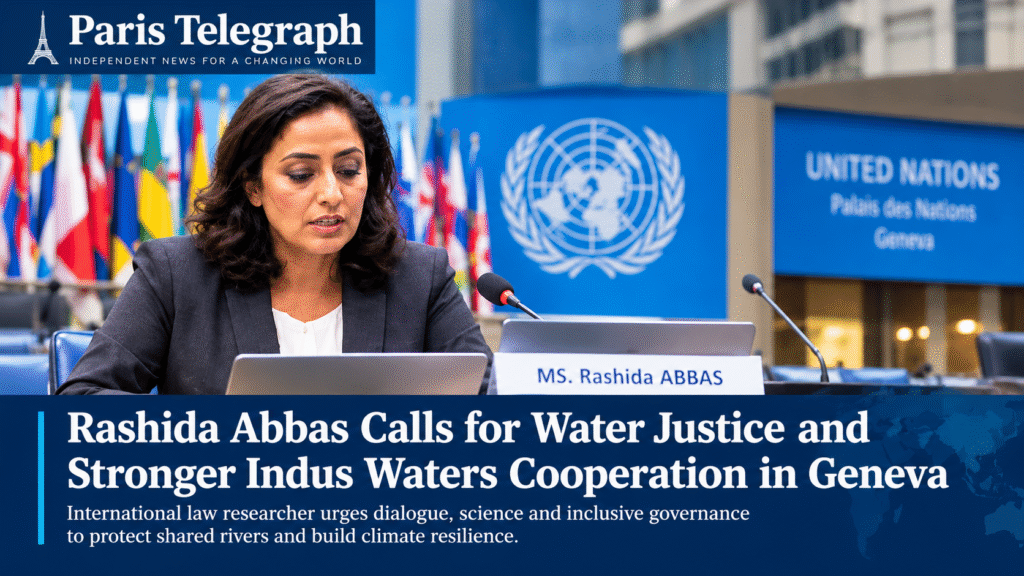
Geneva: Rashida Abbas Calls for Water Justice, Legal Cooperation and Stronger Protection of Shared Rivers
GENEVA, October 2, 2026 — Paris Telegraph
An international law researcher has called for stronger legal, scientific and institutional cooperation over shared water resources, warning that transboundary rivers should not become instruments of political pressure between states.
Speaking at the United Nations Palais des Nations in Geneva on Friday, Rashida Abbas PhD brought a South Asian perspective to a discussion on water justice, climate resilience and transboundary cooperation.
Her remarks formed part of the session “From Water Scarcity to Water Justice: Strengthening Transboundary Cooperation in South Asia and the Middle East.”
Focus on the Indus Basin
A major part of Abbas’s speech focused on the Indus Waters Treaty, the 1960 agreement between India and Pakistan governing the use of the Indus river system.
The Treaty was signed in Karachi on September 19, 1960, with the World Bank playing a role in its development and implementation framework.
Abbas noted that the agreement had continued to provide a framework for managing water-related disagreements between the two countries despite wars and periods of severe diplomatic tension.
“International law is not tested only when States agree. Its real test comes when they do not.”
The current dispute over the Treaty has intensified since India’s April 2025 decision to place the agreement in abeyance. The Permanent Court of Arbitration has continued proceedings in a case brought by Pakistan under the Treaty.
In June 2025, the Court of Arbitration stated that India’s decision concerning the Treaty’s “abeyance” did not affect the Court’s competence over the existing dispute.
On 31 August 2026, the Court issued an Award on the Status of the Indus Waters Treaty in Respect of India’s Decision on Abeyance, alongside an order concerning interim measures relating to the Ratle hydro-electric project.
Abbas referred to the differing positions of the two countries and said the wider question extended beyond the immediate India-Pakistan dispute.
“From water sharing to water justice”
Abbas argued that discussions about transboundary water should not focus exclusively on how much water each country receives.
She described Hydro Justice through three dimensions:
- Distributive justice — who receives the benefits of water development and who carries the environmental and social costs.
- Procedural justice — who participates in decision-making, receives information and has their voice heard.
- Recognition justice — whether the needs, vulnerabilities, knowledge and interests of affected communities are recognised.
“Rivers are not experienced only by States,” Abbas said. “They are experienced by people.”
She connected water governance with human rights, arguing that decisions about rivers ultimately affect drinking water, agriculture, livelihoods, communities and health.
Climate change adds new pressure
The speech called for stronger scientific cooperation, reliable data sharing, greater attention to environmental flows, climate resilience and stronger community participation.
Abbas also referred to the Kishenganga arbitration, a previous India-Pakistan case under the Indus Waters Treaty concerning the Kishenganga/Neelum hydroelectric project. The Permanent Court of Arbitration records the case as concluded under the 1960 Treaty.
A call to keep institutions functioning
Abbas said that maintaining institutional mechanisms is particularly important when relations between countries deteriorate.
She argued that shared water resources should be governed through law, dialogue, science and functioning institutions, rather than unilateral action
The discussion also highlighted the Hydro Justice Fellowship 2026, an initiative aimed at connecting legal education and emerging researchers with international discussions on water justice, transboundary water governance and climate resilience.
Concluding her address, Abbas said the future of South Asia’s shared waters should be built through “law, dialogue, science, functioning institutions and justice.”
The Geneva event brought together discussion of international law, water governance, climate change and regional cooperation, placing the question of how shared rivers can be governed fairly at the centre of the debate.
Paris Telegraph — Geneva Correspondent

Paris Telegraph is an independent France-based digital news platform covering Paris news, French politics, European affairs, global business, diplomacy and artificial intelligence.
Publishing timely reporting and in-depth analysis, Paris Telegraph provides international perspectives on geopolitics, economic developments, technology innovation and cultural trends shaping Europe and the world.
As a growing online media outlet, Paris Telegraph is committed to credible journalism, global insight and forward-looking analysis for readers seeking reliable news from Paris and beyond.