
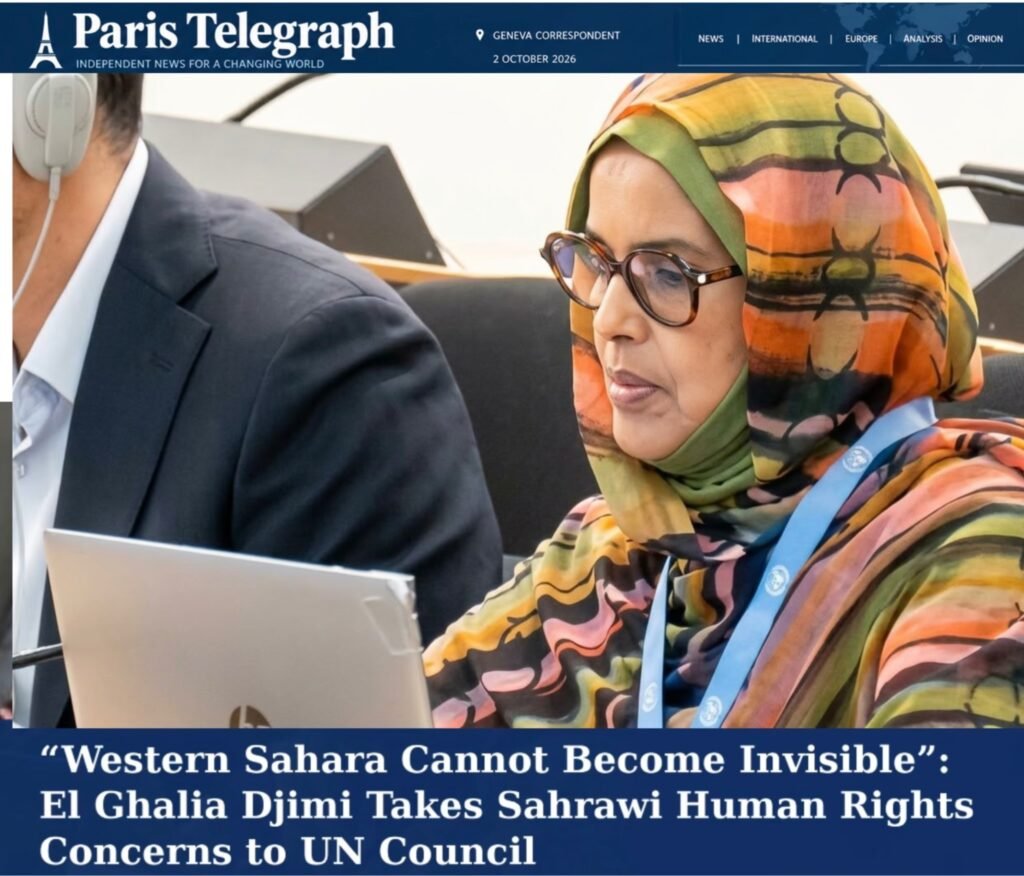
“Western Sahara Cannot Become Invisible”: El Ghalia Djimi Takes Sahrawi Human Rights Concerns to UN Council
Geneva | Paris Telegraph 03 /10 /2026
A long-standing Sahrawi human rights defender, El Ghalia Djimi, used the United Nations Human Rights Council in Geneva to deliver a series of forceful interventions on the human rights situation in Western Sahara, calling for stronger international monitoring, protection of human rights defenders and greater access to the territory for independent observers.
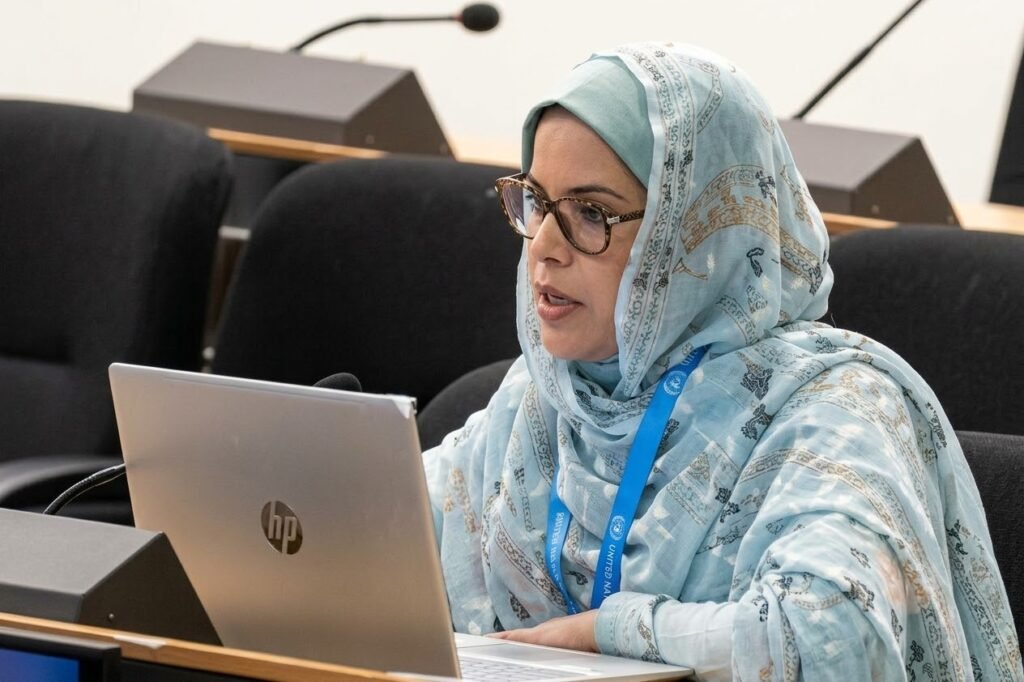
Speaking during the 63rd session of the UN Human Rights Council, Djimi addressed several aspects of the Western Sahara situation, including alleged discrimination, restrictions on fundamental freedoms, enforced disappearances, treatment of activists and the absence of independent human-rights monitoring.
Her interventions were delivered under different agenda items, including Item 9, which concerns racism, racial discrimination, xenophobia and related forms of intolerance. A contemporaneous report on her Item 9 intervention said she called on the Council to apply the Durban Declaration and relevant international humanitarian-law obligations in Western Sahara.
A woman speaking from personal experience
Djimi’s intervention was not simply a political statement. She also referred to her own experience as a survivor of enforced disappearance.
“I am a survivor of enforced disappearance,” she said in her testimony, describing what she said had been years of restrictions affecting her access to electricity despite obtaining two favourable judgments from Moroccan administrative courts, at first instance and on appeal.
Her personal testimony formed an important part of her wider argument: that human-rights defenders who document violations should be protected rather than subjected to reprisals.
Djimi has a long record of human-rights advocacy concerning Western Sahara. Earlier international documentation identifies her as a Sahrawi human-rights defender and vice-president of the Sahrawi Association of Victims of Grave Human Rights Violations. UN Special Procedures have also previously documented allegations concerning restrictions and reprisals against her in connection with her cooperation with UN human-rights mechanisms.
Occupation, discrimination and the Durban Declaration
In her Item 9 intervention, Djimi argued that occupation and racial discrimination are closely connected.
She alleged that Sahrawis face what she described as structural and systematic discrimination because of their identity and their political positions concerning self-determination and independence.
She highlighted three areas.
First, she alleged that settlement policies had altered the demographic composition of Western Sahara and referred to Article 49 of the Fourth Geneva Convention.
Second, she referred to the work of the UN Committee on the Elimination of Racial Discrimination (CERD) and raised concerns about employment discrimination and the exploitation of natural resources without what she described as the consent and consultation of the territory’s Indigenous population.
Third, she highlighted what she described as linguistic and cultural discrimination, particularly the marginalisation of the Hassaniya language and Sahrawi culture in education, administration and public life.
A contemporaneous account of her Item 9 statement similarly reported that she raised employment discrimination, natural resources, Hassaniya cultural heritage and alleged repression of human-rights defenders.
Djimi also alleged that Sahrawis defending their rights face stigmatization, incitement and hate speech that portrays them as a threat.
Her appeal to the Council was for the Durban framework and international human-rights obligations to be implemented without selectivity.
Enforced disappearances, torture and treatment of activists
In another intervention, Djimi described what she characterized as systematic and continuing violations affecting fundamental rights in Western Sahara.
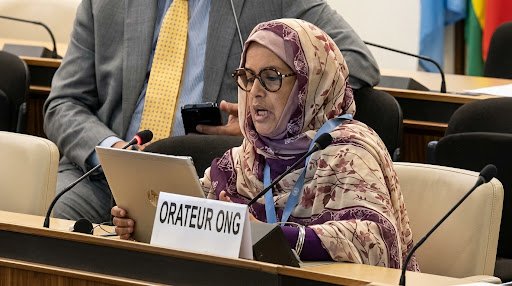
She referred to allegations of:
- enforced disappearance;
- torture and ill-treatment;
- reprisals against activists;
- unfair trials;
- lengthy sentences she described as unjustified;
- and restrictions on freedom of expression and peaceful assembly.
She also raised the situation of Sahrawi activists and human-rights defenders imprisoned in connection with the Gdeim Izik case.
Her intervention called for strong and independent human-rights mechanisms capable of monitoring the situation without waiting for a final political settlement of the Western Sahara dispute.
“This is not simply about individual cases”
Perhaps the strongest theme running through Djimi’s interventions was the question of independent international access.
She argued that preventing independent observers, journalists and other witnesses from entering the territory makes it more difficult for the international community to independently assess allegations.
“This is not simply a matter concerning individual cases,” she argued. “It concerns the ability of the international human-rights protection system to function in a place where independent monitoring is obstructed.”
The issue of access has been raised repeatedly in international human-rights discussions. UN Special Procedures have previously recorded allegations concerning restrictions on Sahrawi activists and human-rights organisations.
International human-rights organisations have also documented earlier cases involving Djimi herself. The International Federation for Human Rights and the World Organisation Against Torture reported allegations of harassment against her in 2009, including an incident involving international observers visiting Laayoune.
“A territory cannot become invisible”
In one of her most striking appeals to the Council, Djimi argued that Western Sahara should not become invisible simply because access to the territory is restricted or because the dispute is political.
She called on the Council to protect people who bring alleged violations to the attention of the international community.
Her message was direct: human-rights defenders documenting alleged abuses should not face punishment or retaliation for doing so.
She also called for access to Western Sahara for UN human-rights mechanisms and for independent and objective assessment of the human-rights situation.
A continuing voice in Geneva
Djimi’s appearance at the 63rd session follows a long history of her engagement with international human-rights institutions.
In June 2026, she participated in a Geneva side event presenting a report on human rights in Western Sahara, alongside other Sahrawi human-rights defenders and researchers.
Her name also appears in UN documentation concerning cooperation with UN human-rights mechanisms. In a previous case, UN Special Procedures recorded allegations that restrictions had been imposed on her ability to travel to Geneva to participate in Human Rights Council-related activities.
The UN’s official transcript for the Council’s 63rd session also lists Djimi El Ghalia among speakers during the session.
A voice demanding to be heard
For Djimi, the Geneva intervention was ultimately about more than one case or one activist.
It was about whether an international human-rights system can effectively protect people in a territory where independent access and monitoring remain contested.
Her testimony combined personal experience with a broader appeal for international scrutiny, protection of human-rights defenders and respect for the rights of the Sahrawi population.
Whatever the political future of Western Sahara, Djimi’s message to the Human Rights Council was that human rights should not have to wait for a political settlement.
Standing before the international community in Geneva, she called for those documenting alleged violations to be protected, for victims to have access to international mechanisms, and for Western Sahara not to disappear from the world’s human-rights agenda.
Paris Telegraph — Geneva Correspondent
Editor’s note: This report describes statements and allegations made by El Ghalia Djimi during interventions at the UN Human Rights Council. Paris Telegraph distinguishes the speaker’s allegations and political positions from independently established facts.

Paris Telegraph is an independent France-based digital news platform covering Paris news, French politics, European affairs, global business, diplomacy and artificial intelligence.
Publishing timely reporting and in-depth analysis, Paris Telegraph provides international perspectives on geopolitics, economic developments, technology innovation and cultural trends shaping Europe and the world.
As a growing online media outlet, Paris Telegraph is committed to credible journalism, global insight and forward-looking analysis for readers seeking reliable news from Paris and beyond.