
France Expands €1 University Meals to All Students in Major Cost-of-Living Reform
07/08/2026. Paris Telegraph |
France Expands €1 University Meals to All Students in Major Cost-of-Living Reform
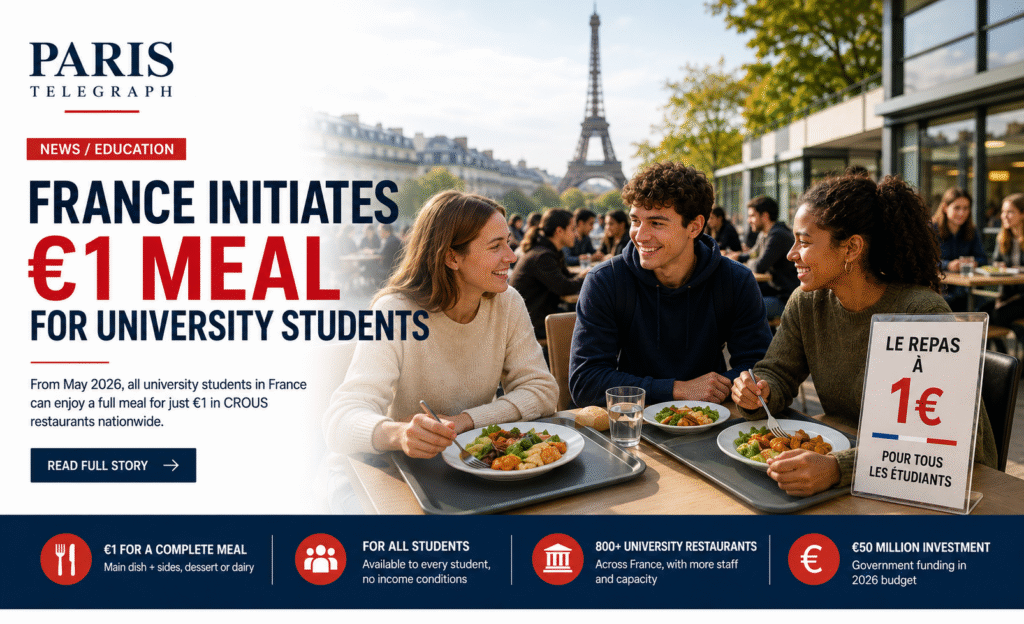
In a significant move to tackle student poverty and rising living costs, French Government has officially extended its flagship €1 meal scheme to all university students across the country, marking one of the most ambitious student welfare reforms in recent years.
A Nationwide Rollout From May 2026
Since 4 May 2026, every student in France—regardless of income—can access subsidized meals priced at just €1 in university dining facilities operated by CROUS (Centres régionaux des œuvres universitaires et scolaires).
Previously, the scheme was limited to scholarship recipients and those in financial hardship. The universal rollout represents a decisive shift toward broader social support for the country’s nearly 3 million students.
What the €1 Meal Includes
The subsidized meal is not symbolic—it is a full, balanced offering, typically consisting of:
- One main dish
- Up to two additional items (starter, dessert, fruit, or dairy)
Students must present a valid student ID and use the Izly digital payment system to access the discounted pricing. The offer applies to both lunch and, where available, dinner services.
Government Investment and Scale
To support the nationwide expansion, the government has allocated approximately €50 million in the 2026 budget.
This funding is designed to:
- Offset the real cost of meals (estimated at €8–€9 each)
- Expand capacity across roughly 800 university restaurants
- Recruit additional staff to meet expected demand
Officials anticipate a surge in attendance, particularly among non-scholarship students who previously paid around €3.30 per meal.
Tackling Student Poverty
The reform comes amid growing concern over student living conditions in France. Studies and policy debates in recent years have highlighted:
- Increasing food insecurity among students
- Rising housing and daily living costs
- A growing number of students skipping meals due to financial pressure
The €1 meal initiative is therefore positioned as a direct intervention against student precarity, ensuring affordable access to at least one nutritious meal per day.
Political and Social Context
The idea of universal €1 meals gained traction after years of advocacy from student unions and political groups. It builds on a system temporarily expanded during the COVID-19 pandemic, when all students briefly benefited from subsidized meals.
While widely welcomed, the policy has also sparked debate:
- Some policymakers warn of financial strain on university catering services
- Others argue for a more targeted, income-based pricing model
- Operational challenges, including long queues and staffing pressures, are expected during peak periods
A Test Ahead of the 2026 Academic Year
Authorities view the current rollout—launched in May, a relatively quiet academic period—as a trial phase ahead of the full-scale test in September 2026.
The success of the initiative will depend on:
- Sustained funding beyond 2026
- Infrastructure readiness
- Maintaining meal quality despite increased demand
A European Signal?
France’s decision could set a precedent across Europe, where student cost-of-living crises are becoming a political priority. By universalizing access rather than targeting only the poorest, the policy reflects a broader shift toward inclusive social welfare models.
France’s €1 meal expansion is more than a subsidy—it is a structural response to economic pressures facing young people. Its long-term success will likely shape future debates on student welfare not only in France, but across the continent.
Paris Telegraph France News Desk

Paris Telegraph is an independent France-based digital news platform covering Paris news, French politics, European affairs, global business, diplomacy and artificial intelligence.
Publishing timely reporting and in-depth analysis, Paris Telegraph provides international perspectives on geopolitics, economic developments, technology innovation and cultural trends shaping Europe and the world.
As a growing online media outlet, Paris Telegraph is committed to credible journalism, global insight and forward-looking analysis for readers seeking reliable news from Paris and beyond.