
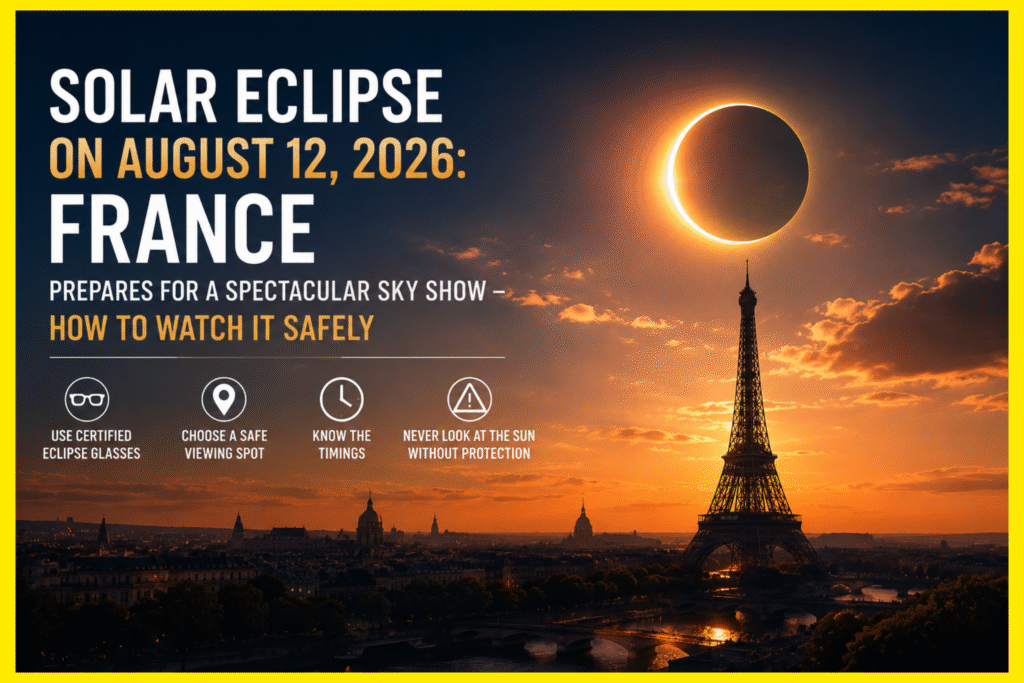
Solar Eclipse on August 12, 2026: France Prepares for a Spectacular Sky Show — How to Watch It Safely
Paris, August 11, 2026 — Skywatchers across France are preparing for a spectacular astronomical event on Wednesday, August 12, 2026, when the Moon will pass in front of the Sun and create a major solar eclipse visible across Europe.
While the eclipse will be total in parts of Spain and along a narrow path elsewhere, people across metropolitan France will experience a partial solar eclipse. NASA says the August 12 event will also be visible as a partial eclipse across much of Europe and northwestern Africa. (NASA Science)
For millions of people in France, the event will provide a rare opportunity to watch the Moon gradually cover a large portion of the Sun.
But authorities are warning the public not to underestimate the danger of looking at the Sun.
When Can France See the Solar Eclipse?
The exact timing and percentage of the Sun covered will depend on the observer’s location.
In Paris, the eclipse will take place during the evening, with the maximum occurring at around 8:17 p.m. local time, when approximately 92% of the Sun will be obscured.
Because the Sun will be relatively low in the western sky, observers should choose a location with a clear view toward the west.
People should check the precise local timings for their town or city because the beginning, maximum and end of the eclipse vary depending on location.
France Will See a Partial Eclipse — Not Totality
One of the most important points for viewers in France is that metropolitan France will not experience totality.
The Moon will cover most of the Sun in some areas, but a portion of the Sun will remain visible.
The path of totality will pass through parts of Spain, making Spain one of the major destinations for people seeking to experience the brief period when the Sun is completely covered. NASA lists Spain among the regions where the eclipse will be total. (NASA Science)
For viewers remaining in France, however, the partial eclipse will still be an impressive astronomical event.
Why Is a Solar Eclipse Dangerous to Watch?
The most important safety message is simple:
Never look directly at the Sun without proper solar eye protection.
Even when most of the Sun is covered by the Moon, the remaining sunlight can be powerful enough to cause serious retinal injury.
The French government has specifically warned that appropriate eclipse glasses are essential for observing the Sun safely. (Presse – Ministère des Finances)
Damage to the retina can occur without immediate pain, meaning people may not realise that their eyes have been injured until later.
Eclipse Glasses Are Essential
Ordinary sunglasses are not sufficient.
People watching the eclipse directly should use specially designed solar-viewing glasses that meet appropriate safety requirements.
Before using eclipse glasses, check them carefully for:
- Scratches
- Holes
- Tears
- Damage to the filter
- Signs of deterioration
If the protective filter is damaged, do not use the glasses.
French authorities have urged the public to use suitable protective glasses rather than improvised alternatives. (Presse – Ministère des Finances)
Do Not Use Ordinary Sunglasses
A common misconception is that very dark sunglasses can protect the eyes during an eclipse.
They cannot.
Do not attempt to observe the Sun using:
- ❌ Ordinary sunglasses
- ❌ Two or more pairs of sunglasses
- ❌ Smoked glass
- ❌ X-ray films
- ❌ Photographic negatives
- ❌ Homemade filters
- ❌ Other improvised materials
These methods do not provide reliable protection from the intense solar radiation reaching the eye.
What About Binoculars and Telescopes?
Extra caution is required when using optical equipment.
Never look at the Sun through binoculars or a telescope unless the equipment has a properly designed and correctly installed solar filter.
Magnifying the Sun without appropriate filtration can cause severe eye injury extremely quickly.
Solar filters must be designed for the specific optical equipment and placed correctly according to the manufacturer’s instructions.
Can You Photograph the Eclipse With a Smartphone?
Yes, but photography also requires caution.
A smartphone camera does not make it automatically safe to look at the Sun.
People using cameras or other optical equipment should follow proper solar-photography guidance and use appropriate solar filters where required.
Never concentrate on taking photographs while driving or standing in an unsafe location.
For casual observers, indirect viewing methods such as a simple pinhole projection can provide a safer way to observe the shape of the partially eclipsed Sun without looking directly at it.
Parents Should Pay Special Attention to Children
Children are likely to be fascinated by the eclipse.
Parents, teachers and adults supervising children should explain the risks before the event begins.
Children should:
- Wear appropriate eclipse glasses when directly observing the Sun.
- Never remove the glasses while looking toward the Sun.
- Never use ordinary sunglasses.
- Never look through an unfiltered telescope or binoculars.
- Be supervised throughout the observation.
Choose Your Viewing Location Carefully
Because the eclipse will occur during the evening, visibility will depend heavily on the horizon.
The best locations will have:
A clear western horizon + minimal buildings + few tall trees + safe public access.
People should arrive early if they are travelling to a popular viewing location.
Do not climb onto rooftops, barriers, unsafe structures or other dangerous locations simply to obtain a better view.
Drivers Urged to Take Extra Care
The eclipse may attract crowds to viewpoints, parks, roads and open spaces.
Drivers should never attempt to watch or photograph the eclipse while driving.
Do not stop on motorways, emergency lanes, railway tracks or other dangerous locations.
If you want to watch the eclipse while travelling:
Park legally → leave the vehicle safely → move to an appropriate viewing location → observe the eclipse with proper protection.
What If the Weather Is Cloudy?
Clouds could prevent people from seeing the eclipse directly.
If the sky is cloudy, people should not take unnecessary risks trying to find a clear view by looking toward the Sun without protection.
Astronomy organisations and space agencies are also expected to provide online coverage, allowing people to follow the event remotely.
NASA has published dedicated information about the August 12, 2026 eclipse and its visibility across different parts of the world. (NASA Science)
What Will People See?
As the eclipse progresses, the Moon will appear to move across the face of the Sun.
In areas experiencing a high degree of partial coverage, daylight may become noticeably different and the surrounding environment can take on an unusual appearance.
However, observers in France should remember that the Sun will not completely disappear.
That is why eye protection remains necessary throughout the period of direct observation.
The Eclipse Is a Rare Astronomical Opportunity
Solar eclipses occur when the Moon passes between Earth and the Sun and the three bodies become sufficiently aligned for the Moon to block some or all of the Sun’s light from a particular location.
A total solar eclipse is visible only along a relatively narrow path, while a partial eclipse can be seen across a much wider area.
The August 12, 2026 event will therefore offer different experiences depending on where people are located.
For France, the partial eclipse will still be a major astronomical spectacle.
France’s Safety Message: Protect Your Eyes
French authorities have made the safety message particularly clear ahead of the event: appropriate protective glasses are indispensable for direct observation of the Sun. (Presse – Ministère des Finances)
The excitement surrounding the eclipse should never come at the expense of eye safety.
A few seconds of unsafe observation can have lasting consequences.
Eclipse Safety Checklist
Before the eclipse
✅ Get proper solar-viewing glasses.
✅ Check that the filters are undamaged.
✅ Find a safe location with a clear western horizon.
✅ Check the local eclipse timetable.
✅ Prepare cameras and other equipment correctly.
During the eclipse
✅ Use proper solar protection for direct viewing.
✅ Supervise children.
✅ Follow local safety instructions.
✅ Keep away from roads and dangerous locations.
Never do this
❌ Look directly at the Sun with the naked eye.
❌ Use ordinary sunglasses.
❌ Use homemade filters.
❌ Look through binoculars without a solar filter.
❌ Look through a telescope without a proper solar filter.
❌ Watch the eclipse while driving.
❌ Use damaged or questionable eclipse glasses.
A Spectacular Evening for France
The August 12, 2026 solar eclipse promises to be one of the year’s most memorable astronomical events.
Although France will experience a partial eclipse rather than totality, a large part of the Sun will be covered in many areas, creating an unusual and potentially spectacular evening sky.
For those planning to watch it, the message from authorities and astronomers is clear:
Enjoy the eclipse — but protect your eyes.
Choose a safe location, use proper solar-viewing equipment and never look directly at the Sun without appropriate protection.
Paris Telegraph will continue to bring readers the latest updates on major events in France, Europe and around the world.
Official Sources
French Government / DGCCRF: Safety guidance on observing the solar eclipse and the need for appropriate protective glasses. (Presse – Ministère des Finances)
NASA: Information about the August 12, 2026 total solar eclipse and its visibility across the world. (NASA Science)

Paris Telegraph is an independent France-based digital news platform covering Paris news, French politics, European affairs, global business, diplomacy and artificial intelligence.
Publishing timely reporting and in-depth analysis, Paris Telegraph provides international perspectives on geopolitics, economic developments, technology innovation and cultural trends shaping Europe and the world.
As a growing online media outlet, Paris Telegraph is committed to credible journalism, global insight and forward-looking analysis for readers seeking reliable news from Paris and beyond.