
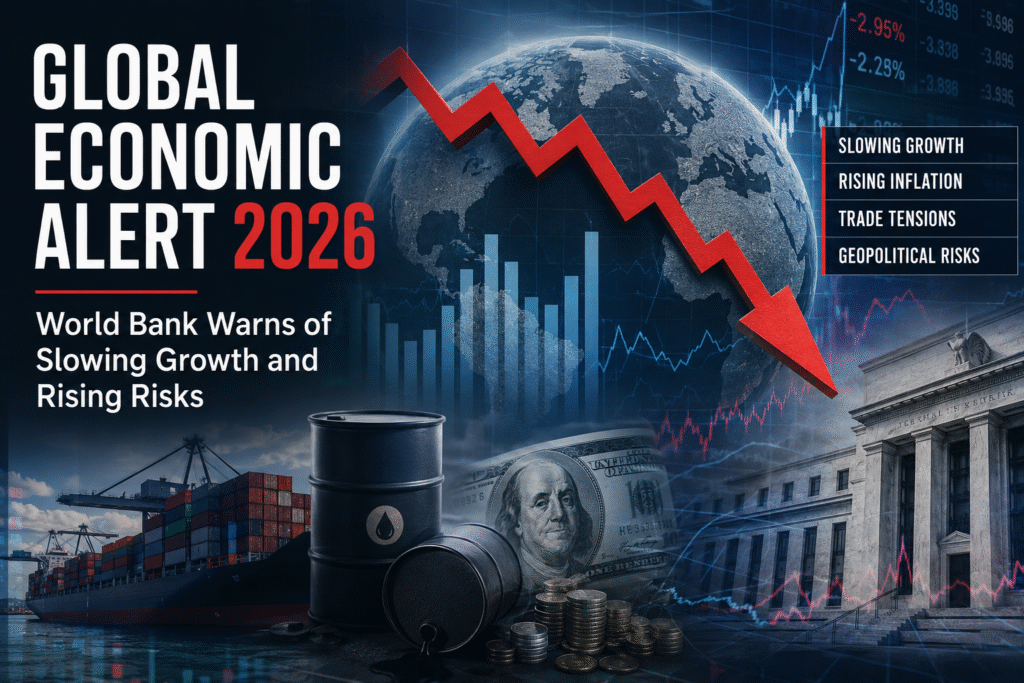
Global Economic Alert: World Bank Warns of Rising Risks to Growth, Trade and Stability
By Paris Telegraph Business Desk
June 12, 2026
PARIS, FRANCE — The global economy is entering a period of heightened uncertainty, with the World Bank issuing a stark warning that economic growth is slowing, inflation pressures are returning, and geopolitical conflicts are threatening global stability.
According to the World Bank’s Global Economic Prospects June 2026 report, global growth is projected to slow to 2.5 percent in 2026, down from 2.9 percent in 2025. The downgrade affects nearly two-thirds of the world’s economies and reflects the combined impact of conflict, trade disruptions, rising energy costs, and weakening investment. (World Bank)
The report arrives at a time when governments, businesses, and financial institutions are already grappling with a fragile post-pandemic recovery. While the global economy demonstrated remarkable resilience in recent years, economists now warn that a series of interconnected risks could create a more dangerous environment for growth.
The Middle East Conflict Becomes a Global Economic Shock
One of the most significant threats highlighted by the World Bank is the ongoing conflict in the Middle East.
The disruption of energy markets, particularly around the Strait of Hormuz, has caused oil prices to surge and reignited inflation concerns worldwide. The World Bank expects Brent crude oil prices to average around $94 per barrel this year, approximately 36 percent higher than 2025 levels if current disruptions continue. Fertilizer and food prices are also expected to rise, adding pressure on households already struggling with the cost of living.
For consumers, higher fuel prices mean more expensive transportation, logistics, and goods. For businesses, rising energy costs reduce profitability and discourage investment. For governments, the return of inflation complicates efforts to lower interest rates and stimulate economic activity.
The consequences are especially severe for developing countries, many of which rely heavily on imported energy and food supplies.
Inflation Returns as a Major Concern
After years of progress in bringing inflation under control, global price pressures are once again moving upward.
The World Bank forecasts global inflation to rise to approximately 4 percent in 2026, significantly above the 3.3 percent recorded in 2025. Higher energy and commodity prices are expected to filter through supply chains, increasing costs for manufacturers and consumers alike.
Central banks now face a difficult balancing act. Lowering interest rates could support growth but risk reigniting inflation. Keeping rates high could suppress inflation but weaken economic activity and investment.
Recent market expectations suggest policymakers in Europe, the United Kingdom, and several emerging economies remain cautious as inflation risks continue to build.
Trade Tensions Continue to Threaten Growth
Beyond geopolitical conflicts, the World Bank warns that trade tensions remain a major source of uncertainty.
Global trade growth has slowed considerably compared with previous decades. Businesses are increasingly facing tariff barriers, supply-chain adjustments, and shifting geopolitical alliances that complicate international commerce. The World Bank notes that escalating trade disputes could further weaken investment and undermine confidence across global markets.
Economists warn that prolonged trade fragmentation could reduce productivity gains, increase costs for consumers, and slow economic growth across both advanced and emerging economies.
At the same time, global trade imbalances are re-emerging as a concern. Large current-account deficits in some countries and growing surpluses in others have reached levels historically associated with financial instability. Analysts fear that if these imbalances unwind abruptly, the result could be severe market volatility and renewed financial stress.
Developing Nations Face the Greatest Risks
The World Bank’s warning is particularly significant for developing economies.
Growth in developing countries is expected to slow to 3.6 percent in 2026, marking the weakest post-pandemic performance. While some countries in Asia continue to show resilience, many low-income nations remain burdened by high debt levels, rising borrowing costs, and limited fiscal capacity.
The World Bank also notes a troubling long-term trend: despite the global recovery, one in four developing countries remains poorer than before the pandemic when measured in per-capita income. This suggests that economic gains have been unevenly distributed and that many nations are still struggling to recover lost ground.
For governments already facing budget pressures, higher interest rates and slower growth could make debt repayment increasingly difficult. This raises concerns about future financial crises, particularly in vulnerable emerging markets.
Europe Faces New Economic Headwinds
Europe is not immune from these challenges.
Economic growth across Europe and Central Asia is expected to slow as higher energy costs, weak industrial activity, and cautious consumer spending weigh on economic performance. The World Bank forecasts regional growth of around 2.1 percent in 2026 before a modest recovery in 2027.
Germany, Europe’s largest economy, illustrates the challenge. According to the Bundesbank, government spending on infrastructure and defense has become one of the main factors preventing a deeper economic slowdown. Yet inflation concerns and weak private-sector investment continue to cloud the outlook.
Across the continent, policymakers are increasingly focused on balancing fiscal support with the need to control inflation and maintain financial stability.
Financial Markets Remain Vulnerable
The World Bank also warns that financial market sentiment could deteriorate rapidly if geopolitical tensions escalate or growth slows more sharply than expected.
Global debt levels remain elevated, while uncertainty surrounding trade, energy markets, and political developments continues to influence investor behavior. Financial markets have shown resilience so far, but economists caution that confidence can change quickly during periods of uncertainty.
The International Monetary Fund has similarly warned that rising commodity prices, inflation expectations, and tighter financial conditions are testing the resilience of the global economy.
A Decade of Slower Growth?
Perhaps the most concerning message from the World Bank is its long-term outlook.
Even if current forecasts prove accurate, the average growth rate of the 2020s is expected to be the weakest of any decade since the 1960s. This represents a significant shift from the rapid globalization and expansion that characterized previous decades.
The World Bank argues that stronger international cooperation, improved trade relations, climate resilience, and structural reforms will be essential if countries hope to reverse this trend.
Without decisive action, the world could face a prolonged period of slower growth, weaker investment, and increased economic inequality.
The World Bank’s June 2026 Global Economic Prospects report serves as a warning that the global economy is entering a more dangerous phase. Rising geopolitical tensions, higher energy prices, persistent inflation, growing trade fragmentation, and mounting debt risks are creating a challenging environment for governments and businesses alike.
While a global recession is not currently the base-case scenario, the margin for error is narrowing. Policymakers around the world face difficult choices as they attempt to maintain growth while safeguarding financial stability.
For investors, businesses, and consumers, the message is clear: the era of economic uncertainty is far from over, and the risks facing the global economy are growing more serious by the day.
By Paris Telegraph Business Desk

Paris Telegraph is an independent France-based digital news platform covering Paris news, French politics, European affairs, global business, diplomacy and artificial intelligence.
Publishing timely reporting and in-depth analysis, Paris Telegraph provides international perspectives on geopolitics, economic developments, technology innovation and cultural trends shaping Europe and the world.
As a growing online media outlet, Paris Telegraph is committed to credible journalism, global insight and forward-looking analysis for readers seeking reliable news from Paris and beyond.