
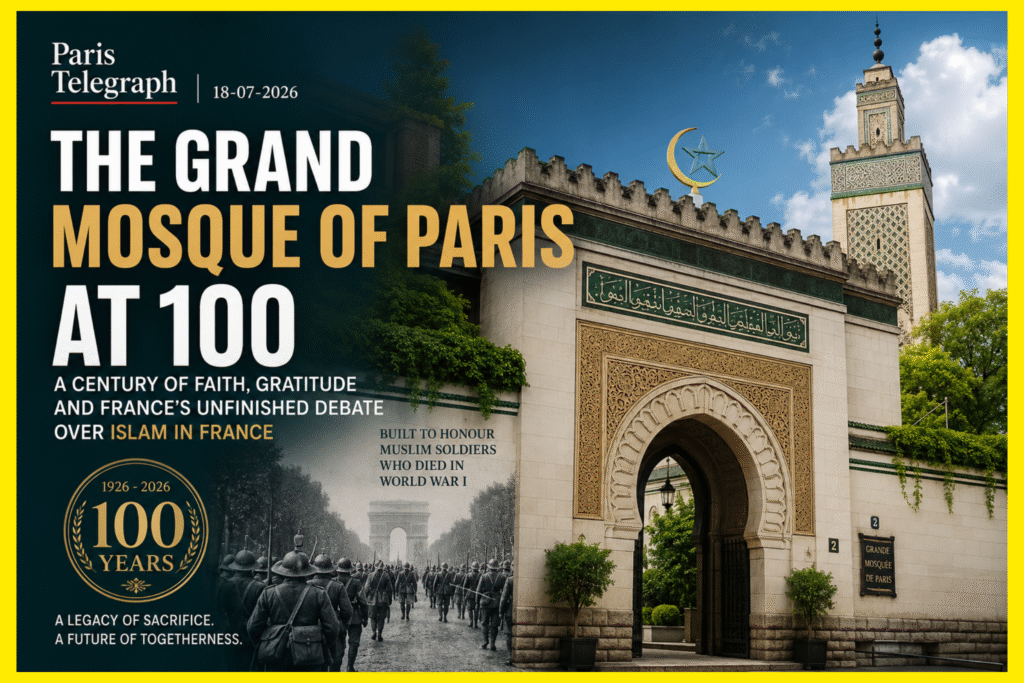
The Grand Mosque of Paris at 100: A Century of Faith, Gratitude and the Unfinished Debate Over Islam in France
By Paris Telegraph Editorial 18 July 2026
One hundred years ago, Paris inaugurated one of its most remarkable monuments—not only as a place of worship, but as a national promise.
On 16 July 1926, French President Gaston Doumergue officially inaugurated the Grand Mosque of Paris, fulfilling a commitment to honour the tens of thousands of Muslim soldiers from France’s colonies who fought and died during the First World War. Built in the heart of the French capital, near the Jardin des Plantes, the mosque stood as a visible expression of gratitude from a republic that had long defined itself through secularism rather than religion.
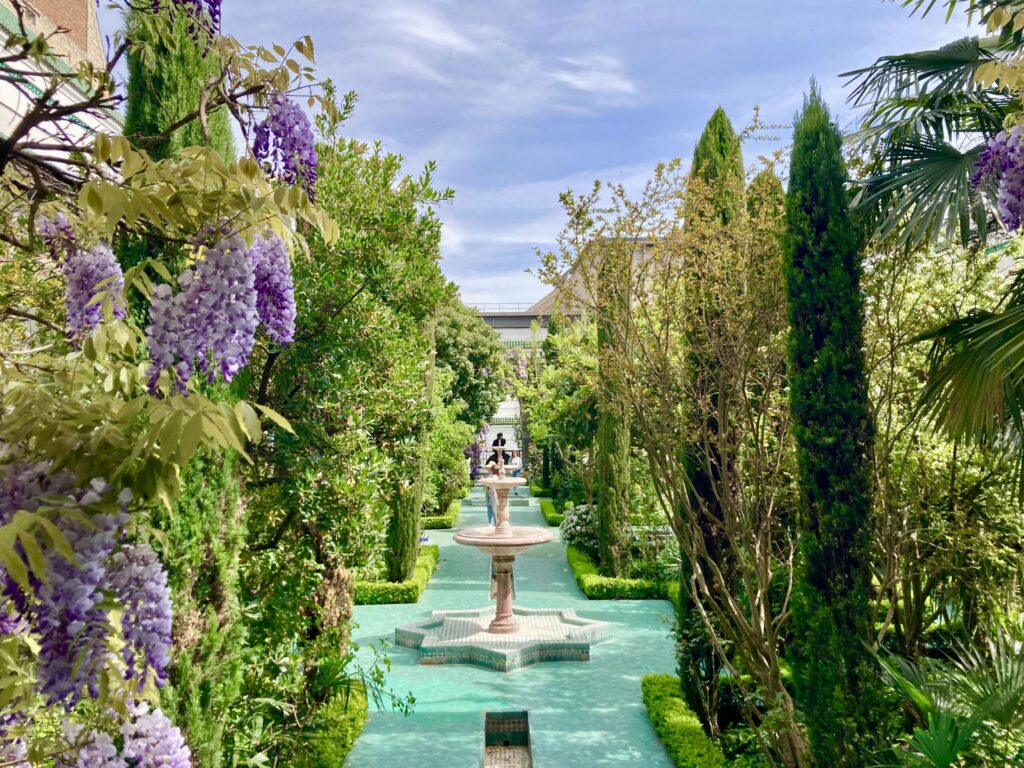
A century later, the Grand Mosque remains one of France’s most important Islamic institutions. Yet its history mirrors the country’s own evolving relationship with Islam—a journey marked by recognition, migration, integration, political conflict, security concerns and continuing debates over national identity.
Its centenary is therefore more than an architectural milestone. It is an opportunity to ask whether France has fully honoured the ideals that inspired the mosque’s creation.
Born from the Sacrifice of Muslim Soldiers
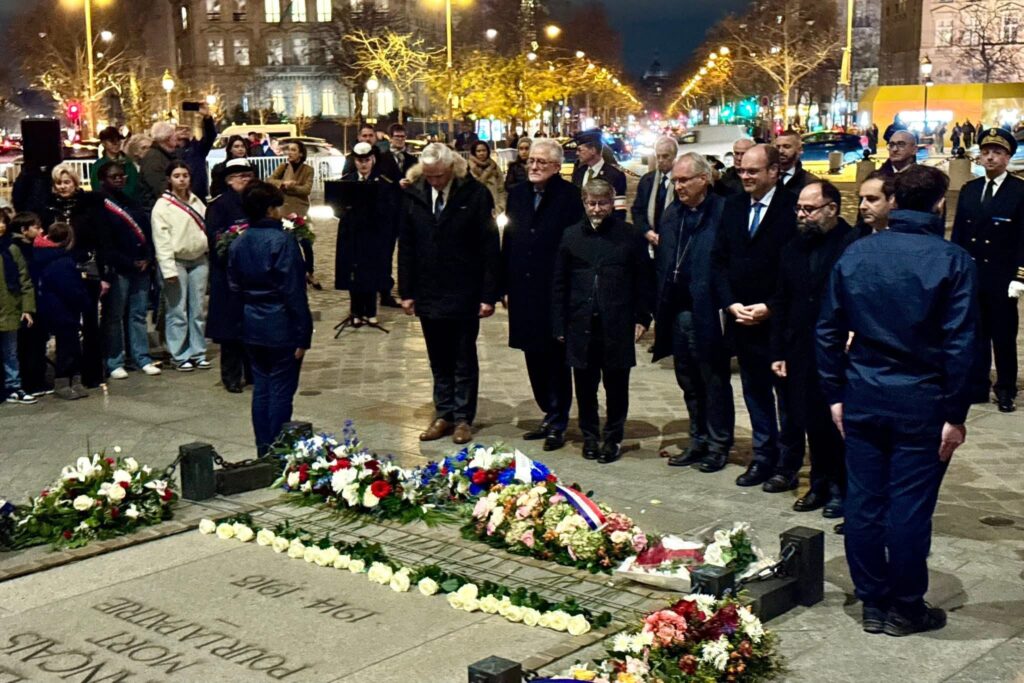
During the First World War, approximately 100,000 Muslim soldiers from North and West Africa fought under the French flag. Thousands never returned home.
Men from Algeria, Morocco, Tunisia, Senegal and other territories defended a country many had never seen before they enlisted.
Following the war, growing public recognition of their sacrifice encouraged the French Parliament to support the construction of a national mosque. The project also reflected France’s historical links with its Muslim populations across the empire.
When completed in 1926, the Grand Mosque represented both remembrance and reconciliation.
Its magnificent Andalusian-inspired architecture, intricate mosaics and towering minaret became symbols of France’s acknowledgement that Muslims had helped shape the nation’s history.
More Than a Place of Worship
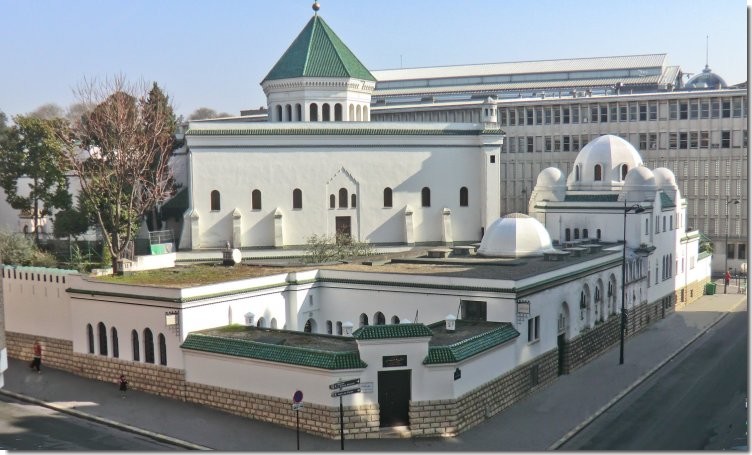
Throughout the twentieth century, the mosque evolved beyond its religious function.
It became:
- A centre for Islamic scholarship.
- A cultural bridge between France and the Muslim world.
- A diplomatic meeting place.
- A symbol of Muslim visibility within the French Republic.
During the Second World War, historical accounts indicate that the mosque also provided refuge to a number of Jews by helping conceal identities and offering sanctuary during the Nazi occupation. While historians continue to debate the exact number of lives saved, the mosque’s humanitarian role has become an important part of its legacy.
Its influence today extends well beyond Paris.
The Grand Mosque participates in religious education, halal certification, interfaith dialogue and public discussions surrounding Islam’s place in modern France.
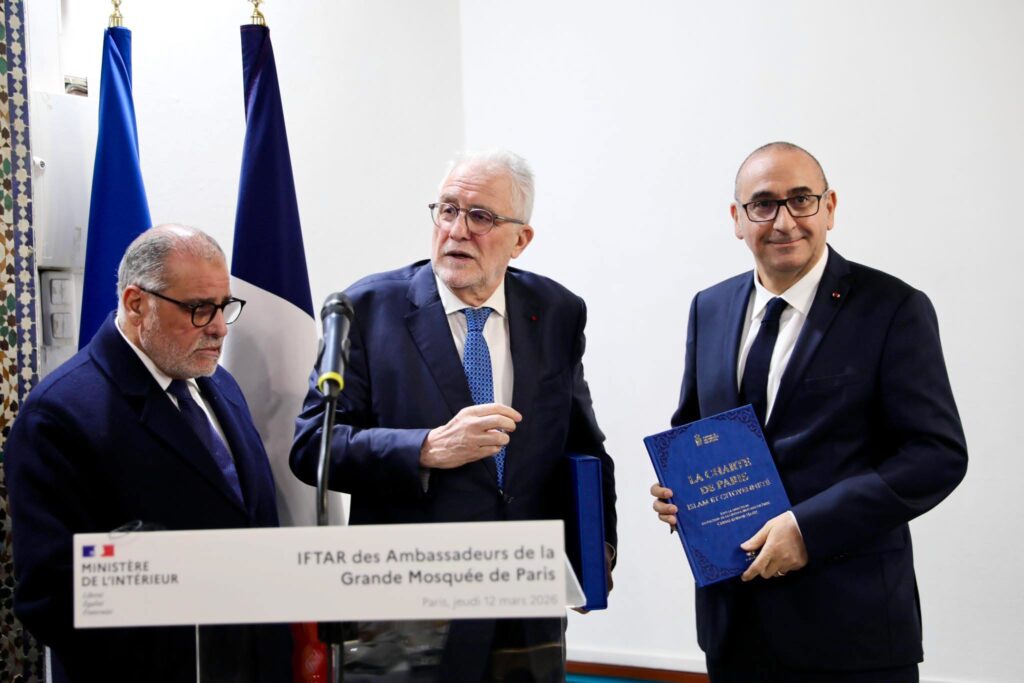
The Changing Face of French Islam
The France that inaugurated the mosque in 1926 is dramatically different from the France of 2026.
After the Second World War, labour shortages encouraged migration from former French colonies, particularly Algeria, Morocco and Tunisia.
Today, France has Europe’s largest Muslim population.
For many families, the Grand Mosque became not only a spiritual centre but also a symbol of belonging.
However, demographic change has also transformed Islam into one of the country’s most politically contested subjects.
Questions surrounding immigration, integration, radicalisation, secularism and national identity increasingly dominate political debate.
The mosque itself often finds itself caught between these competing narratives.
Laïcité: The French Balancing Act
France’s model of laïcité, or state secularism, seeks to guarantee religious freedom while ensuring that public institutions remain neutral.
Supporters argue that this principle protects equality among all citizens.
Critics contend that, in practice, Muslim communities sometimes experience disproportionate scrutiny through legislation affecting religious clothing, public expressions of faith and mosque administration.
Successive governments have defended such measures as necessary to preserve republican values and combat extremism.
Many Muslim organisations, meanwhile, insist that the overwhelming majority of French Muslims are peaceful citizens whose religious identity should not automatically become a political issue.
This tension continues to shape contemporary France.
The Mosque in an Era of Political Polarisation
Over the past two decades, terrorism committed by extremist groups has profoundly affected public debate.
Each attack has renewed discussions about security, immigration and Islam’s place within French society.
The Grand Mosque has repeatedly condemned terrorism and supported efforts against violent extremism.
Yet public discourse often struggles to distinguish between extremist ideology and the everyday lives of millions of French Muslims.
This distinction matters.
One concerns criminal violence.
The other concerns ordinary citizens exercising their constitutional right to practise their religion.
Maintaining that distinction remains one of the greatest challenges facing democratic societies.
A Symbol Still Carrying the Weight of History
The Grand Mosque of Paris occupies a unique position.
It represents:
- gratitude for military sacrifice,
- France’s colonial history,
- religious freedom,
- cultural diversity,
- and the ongoing search for national cohesion.
Few buildings carry such a complex historical burden.
Its centenary reminds France that its national story has never belonged to one culture alone.
From the battlefields of Verdun to the streets of modern Paris, Muslim citizens have contributed to the Republic in countless ways—as soldiers, doctors, teachers, entrepreneurs, artists and public servants.
Remembering that shared history strengthens rather than weakens the ideals of the Republic.
Paris Telegraph Editorial View
The centenary of the Grand Mosque should not become another chapter in France’s political divisions.
Instead, it should serve as a reminder of an undeniable historical fact: Muslim soldiers shed blood for France long before today’s debates about immigration and identity emerged.
History deserves honesty.
France has every right to defend secularism, national security and democratic values.
At the same time, those principles are strongest when they protect every citizen equally, regardless of religion.
The Grand Mosque of Paris was never intended to symbolise separation.
It was built to symbolise gratitude.
One hundred years later, preserving that original spirit may be more important than ever.

Paris Telegraph is an independent France-based digital news platform covering Paris news, French politics, European affairs, global business, diplomacy and artificial intelligence.
Publishing timely reporting and in-depth analysis, Paris Telegraph provides international perspectives on geopolitics, economic developments, technology innovation and cultural trends shaping Europe and the world.
As a growing online media outlet, Paris Telegraph is committed to credible journalism, global insight and forward-looking analysis for readers seeking reliable news from Paris and beyond.