
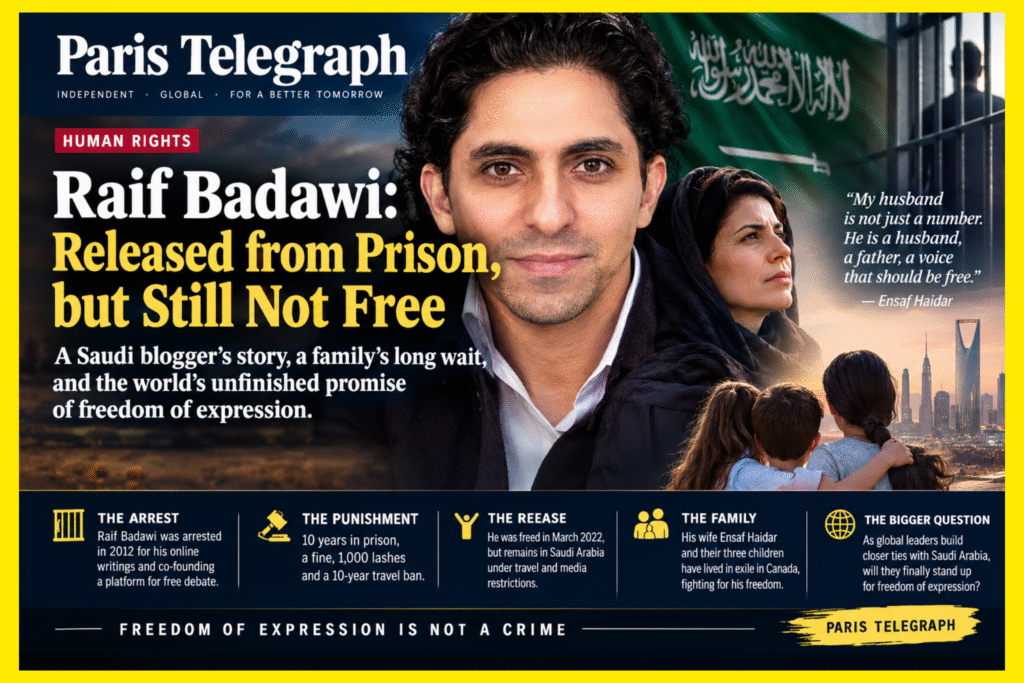
Raif Badawi: Released from Prison, but Still Not Free — A Family’s Long Wait and the World’s Unfinished Promise
Saudi blogger Raif Badawi has completed a decade behind bars, but a reported travel ban and restrictions on public expression continue to separate him from his wife and children. As governments deepen their relationships with Riyadh, his case raises a difficult question: how far is the world willing to go to defend freedom of expression?
By U.H.Hyder Paris Telegraph
PARIS — 17 October 2026
There are prison doors that open, yet freedom remains out of reach. There are families who survive years of separation, hoping that one day a husband will return, a father will embrace his children, and a long nightmare will finally end.
The story of Saudi blogger and human-rights advocate Raif Badawi is one of those stories.
Badawi was released from prison on 11 March 2022 after serving a 10-year sentence. Yet his release did not restore the life he had before his arrest. He remains subject to restrictions on foreign travel and participation in the media, according to international press-freedom organisations. His wife and three children live in Canada, while he remains in Saudi Arabia.
For his family, the end of imprisonment was not the end of the struggle. It was the beginning of another painful chapter: waiting for the freedom to live together again.
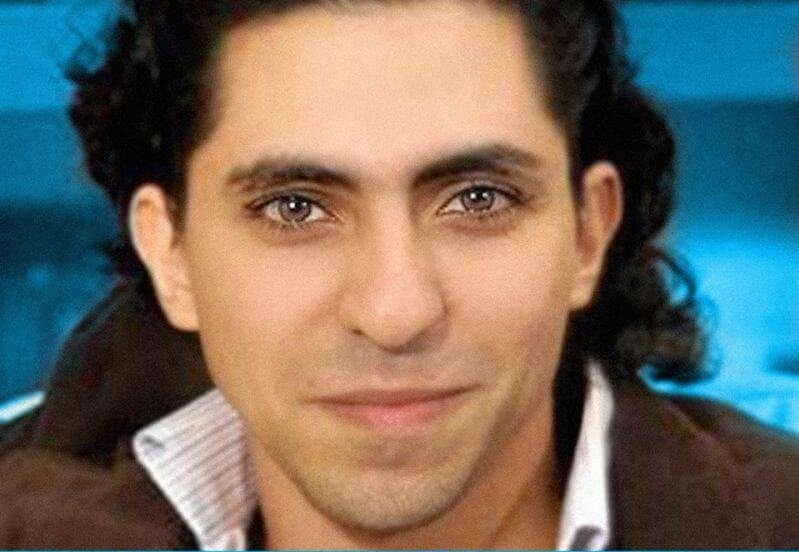
A blog, an arrest and a punishment that shocked the world
Raif Badawi was arrested on 17 June 2012. He had co-founded the online platform Free Saudi Liberals, which encouraged debate about religion, society and public life.
In 2014, a Saudi court sentenced him to 10 years in prison, a fine of one million Saudi riyals and 1,000 lashes. The judgment also imposed a 10-year travel ban and restrictions on media activity following his release.
The case drew international condemnation because the punishment was linked to his online expression and public debate. Amnesty International and other human-rights organisations called for his immediate and unconditional release.
On 9 January 2015, Badawi received the first 50 lashes in public in Jeddah. The remaining lashes were not carried out after the punishment was suspended amid international criticism and concerns about his health.
The image of a man punished for his words became an enduring symbol in the international campaign for freedom of expression.
A person should not have to pay for peaceful debate with years of imprisonment, physical punishment and separation from their family. Yet that was the reality Badawi and his loved ones were forced to confront.
Sources: Amnesty International and Human Rights Watch.
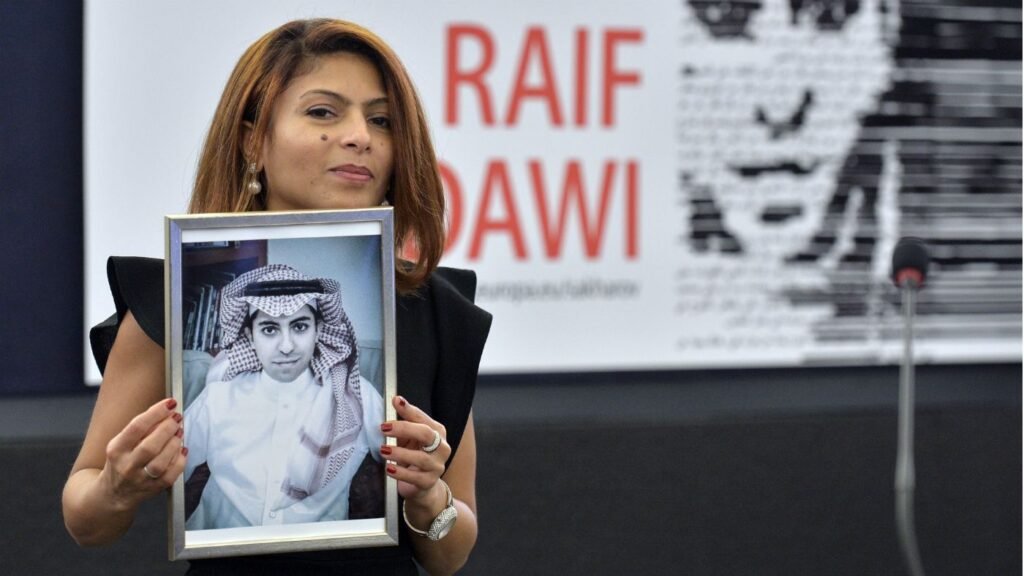
Ensaf Haidar: A wife forced to become a campaigner
Behind the international headlines is another story of endurance: that of Badawi’s wife, Ensaf Haidar.
When her husband was imprisoned, Haidar and their three children eventually found refuge in Canada. Their lives were transformed by a separation they had not chosen. Instead of raising their children alongside their father, she had to build a life in exile while fighting for his release.
The struggle of a family separated by imprisonment is difficult to measure. Children grow older. Birthdays pass. School years end. Ordinary family moments become memories made without one of the people who should have been there.
For Haidar, the fight for her husband’s freedom became a public responsibility as well as a deeply personal ordeal.
She took her appeal beyond Canada, meeting political figures, engaging with human-rights advocates and speaking publicly about her husband’s case. She sought support from governments and organisations that defend freedom of expression. Her efforts helped bring Badawi’s name to international attention and kept his case in public debate.
She also co-authored Raif Badawi, The Voice of Freedom: My Husband, Our Story, published in 2016 with journalist Andrea Claudia Hoffmann. The book recounts their relationship, his imprisonment and her campaign to secure his freedom and reunite their family.
Her story is not simply about waiting for a loved one. It is about the burden placed on a woman who had to turn private suffering into a public campaign because the ordinary routes to family life had been taken away.
Yet even after her husband was released, the central objective remained unfulfilled: the family could not simply return to living together in Canada.
Source: Penguin Random House — Raif Badawi, The Voice of Freedom.
Released, but the family remains separated
Badawi’s release in March 2022 was an important development. But it was not the full freedom that his family and international supporters had sought.
According to Reporters Without Borders, he remained unable to travel abroad or freely participate in public and media discussions. These restrictions have continued to prevent him from joining his wife and children in Canada.
The distinction matters. Release from prison ends physical confinement within prison walls, but a travel ban can continue to shape a person’s entire life. Restrictions on public expression can also prevent a writer or blogger from returning to the profession that brought his ideas to the world.
For a father separated from his children, the passage of time carries a particular cost. Children do not remain children forever. Their lives move forward while the family waits for a legal barrier to be lifted.
There is no need to invent a private conversation or imagine a particular family reunion to understand the human consequences. The documented separation itself tells a painful story.
The authorities have ended Badawi’s prison sentence, but the restrictions that remain mean his family has yet to obtain the freedom of movement and reunion for which they have campaigned.
Source: Reporters Without Borders — One year after his release, Raif Badawi is still not free.
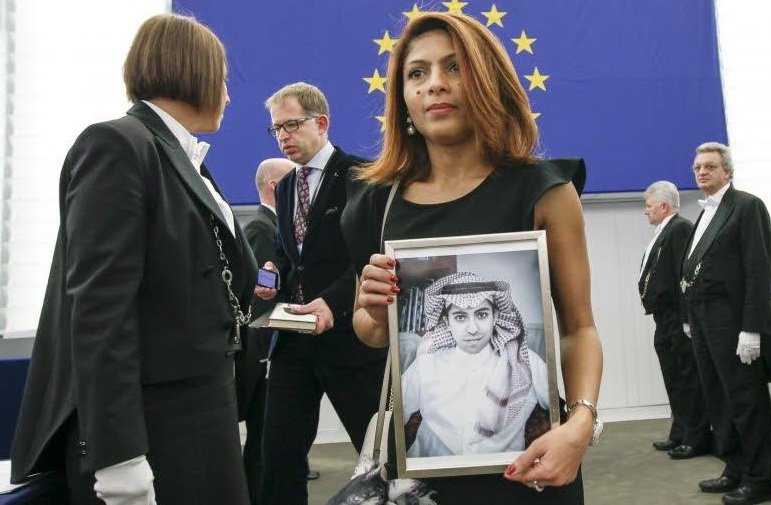
The international community: Strong words, limited results?
Badawi’s case also raises uncomfortable questions for governments that speak about human rights while maintaining close political, economic and strategic relationships with Saudi Arabia.
Saudi Arabia is an important international partner for many countries. Governments engage with the kingdom on trade, investment, energy, security and regional diplomacy. Such relationships are not, by themselves, evidence of indifference to human rights. But they raise a legitimate question: how consistently are human-rights commitments pursued when they intersect with strategic interests?
Badawi’s case has received international recognition. The European Parliament awarded him the Sakharov Prize for Freedom of Thought in 2015. Amnesty International, PEN America and Reporters Without Borders have repeatedly raised his situation and called for restrictions on his freedom to be lifted.
These efforts show that the world has not been entirely silent.
But recognition and statements of solidarity have not yet achieved the outcome his family seeks. His release did not bring an end to the reported travel ban or restore his freedom to participate in public debate.
The question for governments is therefore not simply whether they support freedom of expression in principle. It is whether they are prepared to raise specific cases consistently in diplomatic discussions, seek concrete remedies and explain what progress they have secured.
When leaders meet Saudi officials, they have an opportunity to ask directly whether Badawi can be permitted to travel, reunite with his family and resume his public life without punitive restrictions.
Such requests would not require governments to abandon diplomatic relations. They would require them to demonstrate that human rights remain part of those relationships.
What does freedom of expression mean if the consequences last for decades?
Freedom of expression is often defended as an abstract principle. Badawi’s case shows what is at stake when that principle becomes a personal struggle.
A blogger writes. Authorities arrest him. A court imposes a prison sentence and corporal punishment. His family leaves the country. Years pass. He eventually walks out of prison, but cannot freely leave the country or return to public expression.
The consequences extend beyond the individual. They affect his wife, his children, his ability to work and the wider community of people who may be discouraged from expressing dissenting views.
Saudi Arabia has promoted economic and social reforms and sought a larger role in international affairs. But the continued restrictions reported in Badawi’s case remain a serious test of the kingdom’s treatment of peaceful expression and its willingness to permit a critic to live without the lingering penalties attached to his words.
This article does not suggest that every Saudi citizen shares the same views, or that the actions of the authorities represent an entire society. The issue is more specific: the legal treatment of an individual whose case has become internationally recognised as a freedom-of-expression concern.
Ensaf Haidar’s fight is not over
For Ensaf Haidar, the campaign has lasted far longer than anyone should have to fight for a family to live together.
She has spoken, travelled, written and sought support from people with the power to make a difference. Her husband’s release was a milestone, but it did not deliver the complete outcome she had pursued for years.
Her story also exposes the limits of international attention. A case can receive awards, headlines, statements and public solidarity while the central problem remains unresolved.
The international community should not confuse the passage of time with justice, or a prisoner’s release with the restoration of all his rights.
The next meaningful step would be clear: the Saudi authorities should lift the restrictions preventing Badawi from travelling and participating freely in public life, allowing him to reunite with his wife and children in Canada. Governments that have the opportunity to raise the case should press for that outcome and publicly explain their efforts.
A question the world must continue to ask
Raif Badawi is no longer behind prison walls. But his case remains a reminder that freedom cannot be measured by the opening of a prison gate alone.
It must also be measured by whether a person can travel, speak, work and live with their family without continuing restrictions imposed because of peaceful expression.
For Ensaf Haidar and her children, the years cannot be returned. No diplomatic statement can restore the family moments already lost. But meaningful action could prevent the separation from continuing indefinitely.
The world has recognised Raif Badawi’s name. The question now is whether that recognition can be translated into change.
If freedom of expression is a universal human right, it must mean more than words in international declarations. It must mean that a man who has served his sentence can reclaim his freedom, and that a family which has endured years of separation can finally have the chance to live together again.
Paris Telegraph will continue to follow developments in Raif Badawi’s case and the wider question of freedom of expression in Saudi Arabia.

Paris Telegraph is an independent France-based digital news platform covering Paris news, French politics, European affairs, global business, diplomacy and artificial intelligence.
Publishing timely reporting and in-depth analysis, Paris Telegraph provides international perspectives on geopolitics, economic developments, technology innovation and cultural trends shaping Europe and the world.
As a growing online media outlet, Paris Telegraph is committed to credible journalism, global insight and forward-looking analysis for readers seeking reliable news from Paris and beyond.