
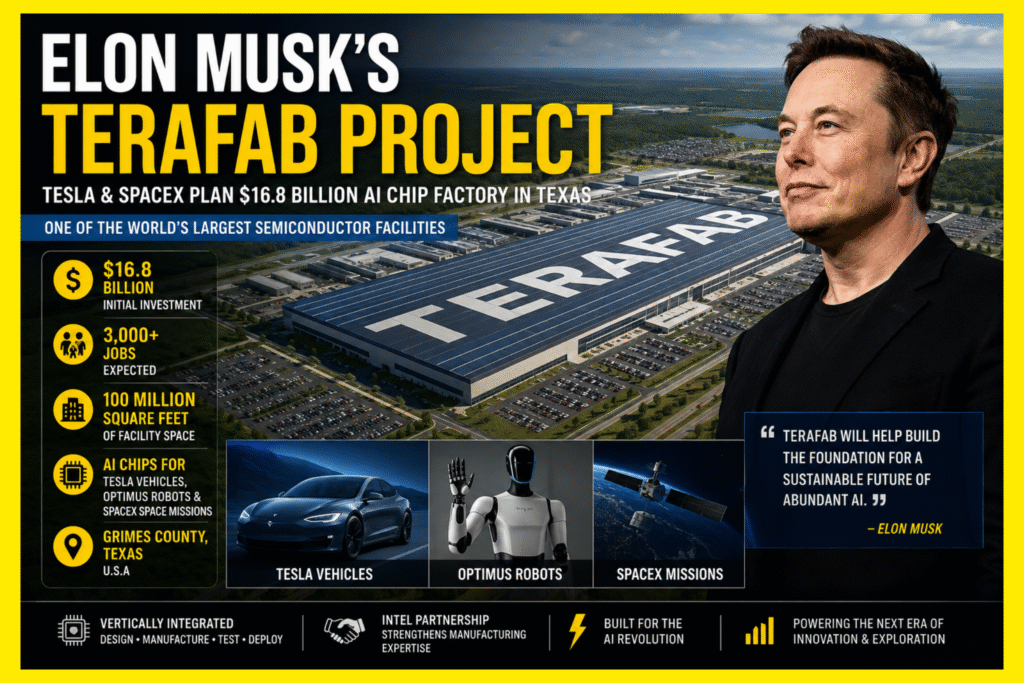
Elon Musk’s $16.8 Billion Terafab: Tesla and SpaceX Plan One of the World’s Biggest AI Chip Factories in Texas
Texas, United States — August 8, 2026
Elon Musk’s technology empire is taking another major step into the semiconductor industry as Tesla and SpaceX move ahead with Terafab, an enormous new chip-manufacturing project planned for Grimes County, Texas.
The companies say the initial phase of the project will involve an investment of approximately $16.8 billion and create at least 3,000 jobs. The planned facility is expected to cover roughly 100 million square feet, potentially making it one of the largest buildings ever constructed.
The project is designed to address one of the biggest strategic challenges facing Musk’s companies: securing enough advanced computer chips to power artificial intelligence, autonomous vehicles, humanoid robots and future space-based computing infrastructure.
Texas Governor Greg Abbott announced the SpaceX expansion in Grimes County on August 6, confirming the location and highlighting the project’s expected economic impact. (Texas.gov)
What is Terafab?
Terafab is Musk’s ambitious plan to build a highly integrated semiconductor manufacturing operation capable of producing advanced processors and other components required for AI systems.
The name “Terafab” reflects the project’s ultimate ambition: producing enough semiconductor capacity to support more than one terawatt of AI computing power per year.
Unlike the traditional semiconductor supply chain, in which chip design, wafer fabrication, memory production, packaging and testing can be distributed among different companies and locations, Terafab is intended to bring many of these activities together.
The objective is simple but extremely ambitious: design the chip, manufacture it, package it, test it and improve it within a tightly integrated production ecosystem.
Where will Terafab be built?
The full-scale Terafab project will be located in Grimes County, Texas, near the College Station area.
The location strengthens Texas’s position as one of the most important emerging technology and semiconductor hubs in the United States.
Tesla already has a major manufacturing presence in Texas through Gigafactory Texas, while SpaceX has expanded its operations throughout the state.
The Terafab project will add semiconductor manufacturing to that growing industrial ecosystem.
According to current reports, the initial facility is planned to cover approximately 100 million square feet. (Houston Chronicle)
How much will Terafab cost?
The currently announced initial investment is approximately $16.8 billion.
However, that figure represents the initial phase rather than necessarily the final cost of the entire long-term project.
Earlier planning documents and reports have suggested that the project could eventually become substantially larger, with some estimates putting the potential total investment across multiple phases at approximately $119 billion.
That means Terafab could ultimately become one of the largest private industrial investments in Texas.
The distinction between the initial $16.8 billion investment and longer-term expansion estimates is important: the larger figure should not be interpreted as money already committed to construction.
Reuters reported that SpaceX and Tesla initially plan to invest $16.8 billion in the Grimes County semiconductor complex, with the long-term project potentially expanding considerably beyond the first phase. (Reuters)
What will Terafab manufacture?
Terafab is intended to manufacture advanced semiconductor technology for several areas of Musk’s business empire.
1. Tesla Optimus robots
One of the most important customers could be Tesla’s Optimus humanoid robot.
Humanoid robots require powerful processors to interpret their environment, make decisions and control their movements.
Tesla’s strategy increasingly depends on AI and robotics, making a secure supply of custom-designed chips strategically important.
2. Autonomous vehicles and Cybercab
Terafab is also expected to supply processors for Tesla’s autonomous-driving systems, including the company’s future Cybercab robotaxi program.
Self-driving vehicles require enormous amounts of computing power to process cameras, sensors, maps and real-time environmental information.
Producing specialized AI inference chips internally could give Tesla greater control over the hardware used in its autonomous vehicles.
3. Space-based data centres
SpaceX has another major reason for wanting advanced semiconductor capacity.
Musk has proposed using satellites and space-based infrastructure for AI computing.
Terafab is therefore expected to support specialized processors for future space-based data centres, where computing hardware could operate outside traditional terrestrial data centres.
This represents one of the most unusual aspects of the project: Terafab is not simply being designed for smartphones, computers or conventional servers.
Its intended customers include robots, autonomous vehicles and space infrastructure. (Houston Chronicle)
Why does Elon Musk want his own chip factory?
The global semiconductor industry is highly concentrated.
Advanced chips depend on a relatively small number of manufacturers, specialized equipment suppliers and packaging facilities.
For Tesla and SpaceX, dependence on outside semiconductor manufacturers could become a strategic limitation as demand for AI hardware increases.
Musk’s companies expect their requirements for computing power to grow dramatically as Tesla develops autonomous vehicles and humanoid robots and SpaceX develops AI-related space infrastructure.
Terafab is therefore intended to provide greater control over:
- Chip design
- Semiconductor manufacturing
- Memory
- Advanced packaging
- Testing
- Production capacity
- Supply-chain security
- Product development cycles
The strategy is similar to vertically integrating other critical parts of a technology business.
The “one trillion watts” ambition
One of the most striking claims surrounding Terafab is its target of producing enough semiconductor capacity for more than one terawatt of computing power annually.
One terawatt equals one trillion watts.
The figure should not be confused with the electrical power consumed continuously by the factory. It refers to the computing capacity represented by the chips the project aims to produce.
The scale illustrates Musk’s expectation that AI computing demand will increase dramatically over the coming years.
Intel joins the Terafab project
Terafab is not solely a Tesla-SpaceX effort.
Intel joined the project earlier in 2026, bringing semiconductor manufacturing expertise to Musk’s initiative.
Reuters reported in April that Intel would participate in the Terafab project, helping develop processors intended for applications including humanoid robots and space-based data infrastructure. (Reuters)
The involvement of Intel is significant because building a modern semiconductor fabrication facility requires highly specialized knowledge, equipment and manufacturing processes.
Intel’s participation could therefore become an important component of Terafab’s technical ambitions.
A vertically integrated semiconductor factory
One of Terafab’s biggest differences from conventional semiconductor manufacturing is its proposed vertical integration.
A typical chip can pass through numerous stages and companies before becoming part of a finished product.
Terafab aims to bring major stages together, including:
Chip design → wafer fabrication → memory → packaging → testing → deployment
The goal is to reduce the time required to move between different suppliers and facilities.
For Tesla, this could potentially allow engineers to design a chip, manufacture test batches, identify problems and modify the design more quickly.
Tesla has already been working on chip manufacturing
Terafab did not appear out of nowhere.
Tesla has already been developing semiconductor manufacturing capabilities in Texas.
A smaller advanced technology fabrication operation near Tesla’s Gigafactory Texas has been described as a precursor to the much larger Terafab project.
The concept is to create a rapid development environment where Tesla engineers can experiment with new semiconductor designs without relying entirely on external manufacturing partners.
How big will the factory be?
The planned 100-million-square-foot footprint makes Terafab extraordinary even by semiconductor-industry standards.
The project is expected to consist of multiple enormous buildings and supporting infrastructure.
Reports indicate that the completed development could involve four major buildings and employ at least 3,000 workers.
The scale is considerably larger than a normal semiconductor fabrication facility and reflects Musk’s ambition to create a complete industrial ecosystem rather than a conventional single-purpose factory. (Tom’s Hardware)
Thousands of jobs expected
The project is expected to create at least 3,000 jobs, many of which are expected to be high-skilled positions.
Potential employment areas include:
- Semiconductor engineering
- Electrical engineering
- Mechanical engineering
- Manufacturing
- Robotics
- AI hardware
- Equipment maintenance
- Construction
- Facility management
- Quality control
- Research and development
The construction phase itself could also generate significant temporary employment.
For the surrounding communities, the project could bring new workers, suppliers, contractors, housing demand and business activity.
Texas offers strong support
Texas officials have strongly welcomed Terafab.
Governor Greg Abbott has promoted the project as another example of Texas becoming a centre for advanced manufacturing, artificial intelligence and high-technology investment.
The state has also offered financial support.
A $30 million Texas Enterprise Fund grant has been reported in connection with the project. (Houston Chronicle)
Local tax incentives have also become part of the project’s economic-development structure.
Local concerns
Despite the economic opportunities, the project has also generated concerns among some local residents.
Large semiconductor and AI infrastructure projects can place significant demands on:
- Water
- Electricity
- Roads
- Housing
- Local public services
- Land
Some residents have questioned the scale of tax incentives and the degree of local oversight.
These concerns illustrate a broader debate emerging across the United States: how should communities balance the economic benefits of massive AI infrastructure investments against their environmental and social costs? (Business Insider)
Water supply and cooling
Semiconductor manufacturing requires substantial amounts of water, particularly for sophisticated cleaning and manufacturing processes.
Terafab’s plans reportedly include using water from Gibbons Creek Reservoir while incorporating wastewater-treatment infrastructure.
The companies have indicated that their plans are intended to reduce pressure on local community water supplies. (Houston Chronicle)
Water availability could nevertheless remain an important issue as the project expands.
Power requirements
A facility of this scale will also require an enormous amount of electricity.
Terafab is expected to incorporate its own power-generation capabilities as part of the broader infrastructure plan.
This is particularly important because AI computing is becoming one of the fastest-growing sources of electricity demand.
The combination of semiconductor manufacturing and AI infrastructure could make energy availability a critical factor in the project’s future expansion.
Why Terafab matters to the global chip industry
Terafab is significant because it represents an attempt by one of the world’s most prominent technology entrepreneurs to challenge the traditional semiconductor supply chain.
The global advanced-chip industry is dominated by a relatively small group of manufacturers and technology providers.
Companies such as TSMC, Samsung and Intel operate at enormous scale.
Musk’s plan is effectively to create another major vertically integrated semiconductor ecosystem designed around the specific needs of Tesla, SpaceX and related AI operations.
If successful, Terafab could reduce Musk’s companies’ dependence on external chip suppliers.
A potential competitive advantage for Tesla
For Tesla, access to custom-designed chips could become a major competitive advantage.
The company would potentially be able to optimize chips specifically for:
- Autonomous driving
- Robot control
- Computer vision
- AI inference
- Energy efficiency
- Vehicle computing
- Optimus robotics
Instead of designing software around commercially available processors, Tesla could increasingly design its hardware and software together.
That could help the company optimize performance and costs at very large production volumes.
SpaceX’s unusual requirements
SpaceX has a different set of requirements.
Space-based AI computing requires hardware capable of operating under demanding environmental conditions.
Weight, energy consumption, radiation resistance, reliability and thermal management can all become critical engineering considerations.
The chips required for satellites and orbital computing may therefore differ considerably from those used in Tesla vehicles.
Terafab could give SpaceX the ability to develop processors specifically for these environments.
Terafab and the future of AI
The project also reflects a larger transformation taking place in the technology industry.
AI development is no longer just about software and algorithms.
It increasingly depends on physical infrastructure:
chips + memory + data centres + electricity + cooling + networking + manufacturing capacity.
Musk’s Terafab strategy focuses directly on the semiconductor layer of that infrastructure.
The project therefore represents a bet that the next major constraint on AI growth will not simply be software capability, but the ability to manufacture enough specialized hardware.
The biggest risks
Despite its extraordinary ambition, Terafab faces significant challenges.
Cost
Semiconductor fabrication is one of the most expensive industrial activities in the world.
The final cost could rise significantly if the project expands.
Technical complexity
Building a state-of-the-art chip factory is far more complicated than constructing a conventional manufacturing plant.
It requires specialized equipment, clean rooms, process technology and highly trained personnel.
Supply chain
Even a vertically integrated factory cannot necessarily eliminate dependence on the global semiconductor equipment supply chain.
Advanced lithography and other critical technologies depend on specialized international suppliers.
Talent
Texas will need thousands of engineers, technicians and semiconductor specialists to support the project.
Energy and water
The project’s enormous scale creates long-term questions about electricity and water availability.
Execution
Perhaps the biggest risk is execution.
Terafab combines several extremely difficult projects: semiconductor manufacturing, AI hardware, robotics, autonomous vehicles and space computing.
What could Terafab mean for Texas?
If successfully completed, Terafab could strengthen Texas’s position in the global semiconductor and AI economy.
Texas already hosts major operations from companies involved in semiconductors, electronics, automobiles, aerospace and technology.
Terafab could attract additional:
- Semiconductor suppliers
- Engineering companies
- AI companies
- Equipment manufacturers
- Construction firms
- Research institutions
- Technology startups
The economic impact could therefore extend far beyond the 3,000 direct jobs announced for the facility.
The bigger Elon Musk strategy
Terafab should also be viewed as part of a much larger Musk strategy.
Tesla is moving deeper into:
AI + robotics + autonomous transportation
SpaceX is expanding into:
rockets + satellites + space infrastructure + AI
And Musk’s broader technology ecosystem is increasingly connected through computing and artificial intelligence.
Terafab provides a potential hardware foundation for these businesses.
Instead of relying entirely on outside chip suppliers, Musk wants to control more of the technology stack.
What happens next?
The immediate priority will be construction and development of the Grimes County site.
The first phase is expected to require billions of dollars and thousands of workers.
Tesla, SpaceX and their technology partners will then have to demonstrate that they can translate the ambitious Terafab concept into a functioning semiconductor production operation.
The project’s success will ultimately depend on whether the companies can manufacture advanced chips at the required quality, volume and cost.
A new industrial race
Terafab is more than another Tesla factory.
It represents a new type of industrial competition in which technology companies increasingly seek control over the physical infrastructure behind artificial intelligence.
From Nvidia’s AI processors to TSMC’s manufacturing capacity, from hyperscale data centres to advanced energy infrastructure, the AI economy is creating enormous demand for physical resources.
Musk’s response is to build the manufacturing capacity himself.
With an initial $16.8 billion investment, a planned 100-million-square-foot complex, at least 3,000 jobs, Intel involvement and an eventual ambition exceeding one terawatt of AI computing capacity, Terafab could become one of the most consequential industrial projects of the decade.
For Texas, it is another enormous technology investment.
For Tesla and SpaceX, it could become a strategic weapon in the race for AI hardware.
And for the global semiconductor industry, Terafab is a signal that the next stage of the AI race may increasingly be fought not only in software and data centres — but inside the chip factory itself. (Reuters)

Paris Telegraph is an independent France-based digital news platform covering Paris news, French politics, European affairs, global business, diplomacy and artificial intelligence.
Publishing timely reporting and in-depth analysis, Paris Telegraph provides international perspectives on geopolitics, economic developments, technology innovation and cultural trends shaping Europe and the world.
As a growing online media outlet, Paris Telegraph is committed to credible journalism, global insight and forward-looking analysis for readers seeking reliable news from Paris and beyond.