
By Geneva Correspondent
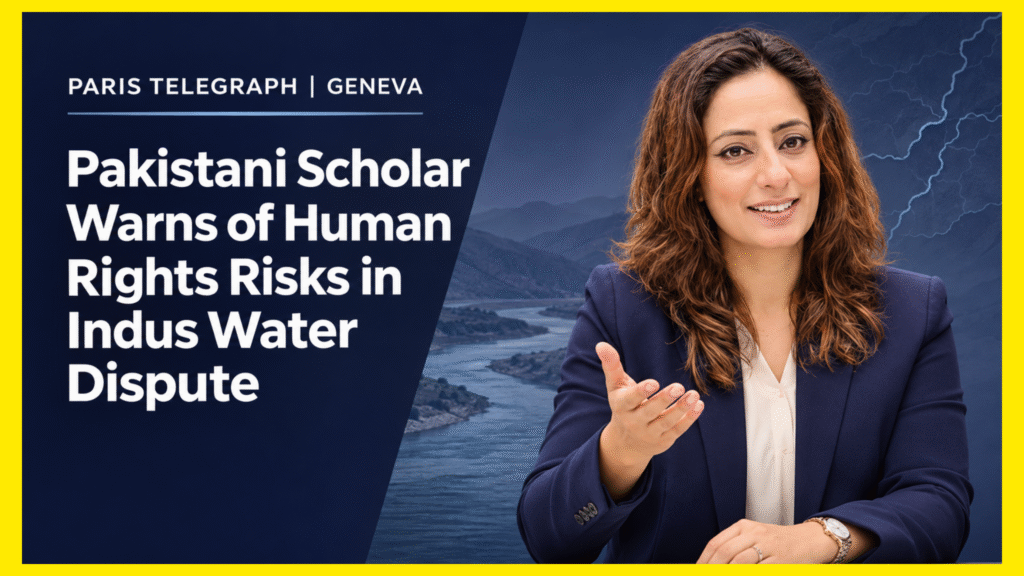
GENEVA, 8 November 2026 — A Geneva webinar has brought renewed attention to the Indus Waters Treaty dispute, focusing on how changes to water-sharing arrangements can affect human rights, regional security and the lives of communities downstream.
The discussion, titled Water Justice, International Law and Transboundary Cooperation, was held on 29 October and organized and moderated by Pakistani legal scholar and University of Geneva PhD researcher Rashida Abbas. Speakers included Dr Mara Tignino of the University of Geneva and Geneva Water Hub; Syed Muhammad Mehar Ali Shah, Pakistan’s Commissioner for Indus Waters; Professor Zafar Nawaz Jaspal; South African legal scholar Ramona Maria Grewan; and Pedro Arrojo-Agudo, the UN Special Rapporteur on the human rights to safe drinking water and sanitation.
The webinar examined international water law, peaceful dispute resolution and the protection of people who depend on rivers shared across national borders. Its discussion comes amid continuing disagreement between India and Pakistan over the 1960 Indus Waters Treaty, which sets out arrangements for the six rivers of the Indus system.
India announced on 23 April 2025 that it would hold the treaty in abeyance, following the Pahalgam attack in Indian-administered Kashmir. India cited cross-border terrorism; Pakistan rejected the move, arguing that India could not unilaterally suspend its treaty obligations. (pib.gov.in)
On 31 August 2026, a Court of Arbitration constituted under the treaty ruled that the agreement remained in force and that India’s stated grounds did not justify suspending or terminating it. India rejected the court’s jurisdiction and its findings, maintaining that the treaty remains in abeyance. (pca-cpa.org, newsonair.gov.in)
The human rights debate also extends beyond the two governments. In an October 2025 communication, five UN human rights experts raised concerns about the possible impact of disrupting water arrangements on people in Pakistan, including their rights to water, food, work and an adequate standard of living. The experts called for information from India; their communication raised concerns rather than issuing a court ruling. (spcommreports.ohchr.org)
For communities relying on the Indus system, water flows and timely hydrological information can influence farming, livelihoods and public safety. The webinar’s focus was on the legal and humanitarian stakes of transboundary water governance, while allegations about deliberate manipulation of water flows require independent evidence.
Fellowship aims to involve emerging researchers
Abbas is also leading the Hydro-Justice Student Research & Policy Fellowship 2026. The initiative connects emerging researchers with experts and encourages work on transboundary water governance, climate justice, human rights and international dispute settlement. (gcdhr.org)
The Geneva discussion took place as the European Parliament called for stronger transnational water governance. On 17 June 2026, Parliament adopted a recommendation urging the EU to incorporate water cooperation and the prevention of water-related conflict into its external policies. (oeil.europarl.europa.eu, oeil.europarl.europa.eu)
As climate pressures grow and disputes over shared rivers continue, the Indus case has become part of a broader international conversation about cooperation, legal obligations and the rights of people who depend on freshwater. The Geneva webinar sought to bring those concerns into dialogue among legal experts, policymakers and young researchers.
By Paris Telegraph
Geneva Correspondent



Paris Telegraph is an independent France-based digital news platform covering Paris news, French politics, European affairs, global business, diplomacy and artificial intelligence.
Publishing timely reporting and in-depth analysis, Paris Telegraph provides international perspectives on geopolitics, economic developments, technology innovation and cultural trends shaping Europe and the world.
As a growing online media outlet, Paris Telegraph is committed to credible journalism, global insight and forward-looking analysis for readers seeking reliable news from Paris and beyond.